


Your loading dock is the heart of your operation, and the point where your facility meets the outside world. But picture a 40-tonne transport truck reversing into that bay without any protection. The impact doesn’t just leave a mark; it can send shockwaves through your building’s foundation, damage critical dock equipment, and bring your entire workflow to a screeching halt.
In this guide, our team at Wilcox Door Service will walk you through everything you need to know about one of the most essential assets for any industrial facility: dock bumpers for loading docks. You will learn what they are, how to choose the right type for your operation, and why proper selection and maintenance are crucial for protecting your building and your bottom line. We’ll explain the technical details in simple terms to help you make an informed decision for your facility’s safety and efficiency.
Why Dock Bumpers Are Your Building’s First Line of Defence
Dock bumpers are so much more than simple rubber pads bolted to a wall. Think of them as your building’s first and most important line of defence against the relentless, repetitive force of trailers. Without them, your loading dock is like a ship without fenders—completely exposed and vulnerable to expensive damage with every single truck arrival.
A single misjudged approach by a heavy vehicle can cause thousands of dollars in structural damage. We’re not just talking about a dent in the wall. This is about cracked concrete foundations, misaligned commercial overhead doors, and damaged dock levelers that can paralyze your supply chain.
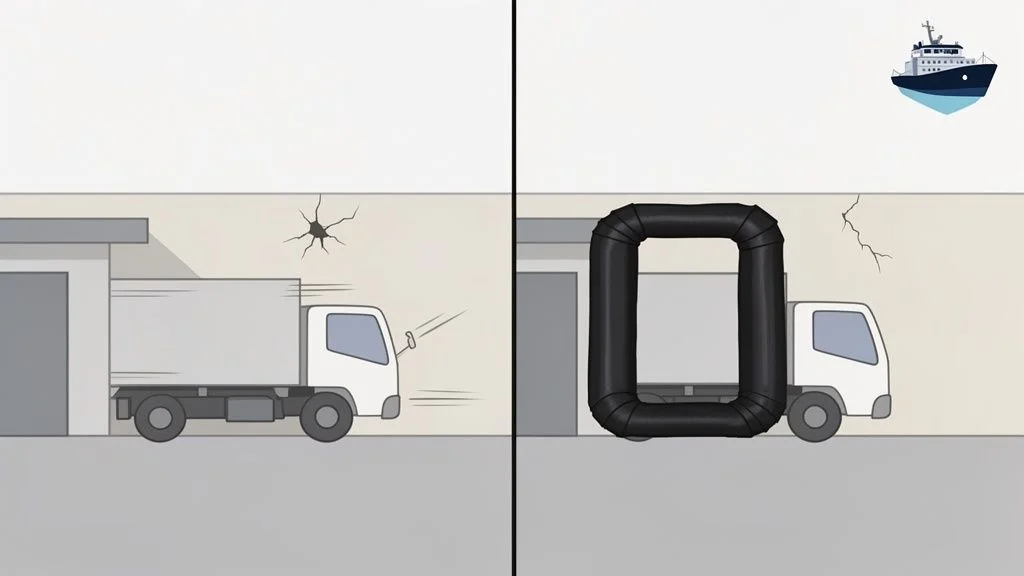
alt: A truck backing into an unprotected loading dock, causing damage, contrasted with a truck safely docking against a dock bumper.
The Role of Bumpers in Facility Protection
Think of a good dock bumper as an insurance policy you only have to pay for once. Its primary job is to absorb and dissipate the immense kinetic energy—the force of a moving object—of a reversing trailer, protecting four critical aspects of your operation:
- Structural Integrity: They take the hit, preventing direct impact on your building’s concrete walls and foundation, which are incredibly expensive and disruptive to repair.
- Asset Protection: Bumpers are the unsung heroes that safeguard your expensive equipment, like dock levelers, seals, and vehicle restraints, from being crushed or knocked out of alignment.
- Operational Uptime: By preventing damage before it happens, bumpers ensure your loading bays stay open and productive. This helps you avoid costly downtime that throws schedules and profitability into chaos.
- Employee Safety: A secure, stable docking environment is non-negotiable. Bumpers are a key part of this, preventing unexpected shifts or equipment failures caused by impact. A safer dock is an integrated system, and can include other measures like dock lip safety barriers for even more fall protection.
A Critical Component in Today’s Logistics Market
In Canada’s fast-paced logistics landscape, the need for robust dock bumpers has grown right alongside the nation’s industrial real estate boom—highlighted by the record-low warehouse availability rate of just 1.6% back in Q4 2022. As a company with over 100 years of coast-to-coast service, we’ve seen firsthand how upgrading to bumpers with superior shock absorption can slash repair costs by up to 30% in high-traffic docks. You can see more on these market trends in the full research on loading dock bumpers.
Investing in the right dock bumper isn’t an expense; it’s a strategic decision to protect your most valuable assets. It transforms a vulnerable point of contact into a fortified, reliable part of your facility.
Ultimately, these components are a small investment that delivers a massive return by preventing catastrophic failures. As your Respected Partners providing Reliable Service, we see them as the very foundation of a safe and efficient loading dock. Before you can choose the right bumper, understanding its protective role is the first step toward making a smart, long-term decision.
Choosing Your Bumper Material and Design
Picking the right bumper for your loading dock isn’t just about bolting a piece of rubber to the wall. It’s a critical decision that directly impacts your building’s structural integrity, your long-term maintenance budget, and the safety of your operations. The wrong choice can lead to cracked concrete, damaged trailers, and frequent, costly replacements.
Think of it like choosing tires. You wouldn’t put racing slicks on a dump truck and expect them to perform. The same logic applies here. The bumper that’s perfect for a low-traffic warehouse will be torn to shreds at a 24/7 distribution centre. It’s all about matching the equipment to the job.
Let’s break down the main options you’ll encounter so you can make an informed choice for your facility.
Laminated Rubber Bumpers: The Industry Standard
Walk past most loading docks in Canada, and you’ll see laminated rubber bumpers. There’s a good reason they are the industry workhorse. They are built by stacking pads of fabric-reinforced rubber—often from recycled truck tires—and compressing them under immense pressure between heavy-duty steel angles.
This layered design is brilliant at absorbing shock. When a trailer makes contact, each layer flexes and shifts, spreading out the impact force across the entire bumper instead of letting it concentrate on one weak point.
- Best For: The vast majority of loading docks with moderate to heavy traffic. They hit the sweet spot between durability, performance, and cost.
- Real-World Example: A regional grocery distribution hub handling 30-50 trucks a day is a perfect fit. Laminated bumpers easily withstand the daily, repeated impacts from standard trailers.
Molded Rubber Bumpers: The Light-Duty Solution
Molded rubber bumpers are just what they sound like: a single, solid piece of rubber cured into its final form. They are simpler in design and generally less expensive upfront than their laminated cousins.
While they offer basic protection, their one-piece construction means they don’t dissipate impact energy nearly as well. This makes them a good option only for environments where impacts are gentle and infrequent.
We often see facilities make the mistake of using molded bumpers in high-traffic areas to save on initial cost. This almost always backfires, leading to rapid wear, building damage, and more frequent replacements down the line.
A small manufacturing business that only gets one or two deliveries a week could use molded bumpers effectively. Here, they provide the necessary buffer against occasional bumps without the expense of a heavy-duty system. This is a perfect example of a situation where you might find our commercial door service useful as well.
Steel-Faced Bumpers: The Ultimate Protector
When your dock faces the toughest, most punishing conditions, you need the ultimate in protection: steel-faced bumpers. These start with a laminated rubber core for shock absorption and then add a heavy-duty, floating steel faceplate.
This design gives you the best of both worlds. The rubber soaks up the hit, while the steel plate takes on the grinding, up-and-down scraping from trailers—especially those with air-ride suspensions that adjust during loading. The trailer simply slides against the steel instead of tearing the rubber apart.
- Best For: High-volume 24/7 distribution hubs, cold storage facilities, and any dock where yard jockeys are constantly slamming trailers into place.
- Real-World Example: Imagine an international courier’s sorting centre. The constant, rapid-fire trailer swaps would shred standard bumpers. The steel face extends the bumper’s life dramatically, easily justifying the investment and cutting down on the service calls our loading dock repair teams have to make.
Dock Bumper Material Comparison
To help you visualize the differences, here’s a quick comparison of the three main material types. Use this table as a starting point to narrow down which option best aligns with your dock’s activity level and budget.
| Material Type | Best For | Durability/Lifespan | Impact Absorption | Relative Cost |
|---|---|---|---|---|
| Laminated Rubber | General purpose, moderate-to-heavy traffic warehouses | Good to Excellent | Excellent | $$ |
| Molded Rubber | Low-traffic, light-duty applications | Fair | Fair to Good | $ |
| Steel-Faced Rubber | High-volume, 24/7 distribution, air-ride trailers | Excellent+ | Excellent | $$$ |
Ultimately, the best material for you is the one that stands up to your specific operational demands without failing prematurely.
Beyond the material, you’ll also find specialized designs like extra-long bumpers for wide openings or vertical bumpers that offer protection for docks serving trucks of varying heights. Getting the right combination of material and design is the key to a safe, efficient, and cost-effective loading dock. As Respected Partners offering Reliable Service, we can help guide you to the perfect fit for your facility.
How to Select the Right Bumper Size and Projection
Choosing the right size for your dock bumpers for loading docks is about a lot more than just making a piece of rubber fit on the wall. It’s the critical difference between real protection and a false sense of security that can lead to thousands in building damage.
Get this part wrong, and even brand-new bumpers won’t stop a trailer from crunching into your wall. Let’s walk through how to select the right bumper projection to make sure every truck stops exactly where it should.
First, a quick definition. When we talk about projection, we’re simply talking about the bumper’s thickness—how far it sticks out from the dock wall. This single measurement is the most important factor in stopping a trailer in the sweet spot. Not too close, not too far.
Calculating the Correct Bumper Projection
Figuring out the right projection isn’t a guessing game. It’s a simple calculation based on the geometry of your loading dock approach. The main goal is to stop the top of the trailer from hitting the building wall above the dock, a surprisingly common and expensive problem.
The biggest factor here is the slope of your driveway. Is it perfectly level, or does it have an incline (uphill) or decline (downhill) grade?
- Incline Approach: If a truck has to drive up a slope to your dock, the top of the trailer naturally tilts away from the building. This usually means you can get by with less bumper projection.
- Decline Approach: This is the one to watch out for. When a truck drives down a slope, its top tilts forward, directly toward your building. This is a high-risk situation that calls for a thicker, higher-projection bumper to create the necessary clearance.
The most common mistake we see is underestimating the impact of a decline. A mere 2% grade can cause the top of a standard trailer to lean several inches forward, making a high-projection bumper an absolute necessity to prevent structural damage.
Before you finalize the size, you need to know what type of bumper you’re working with. The material itself is the foundation of the decision.
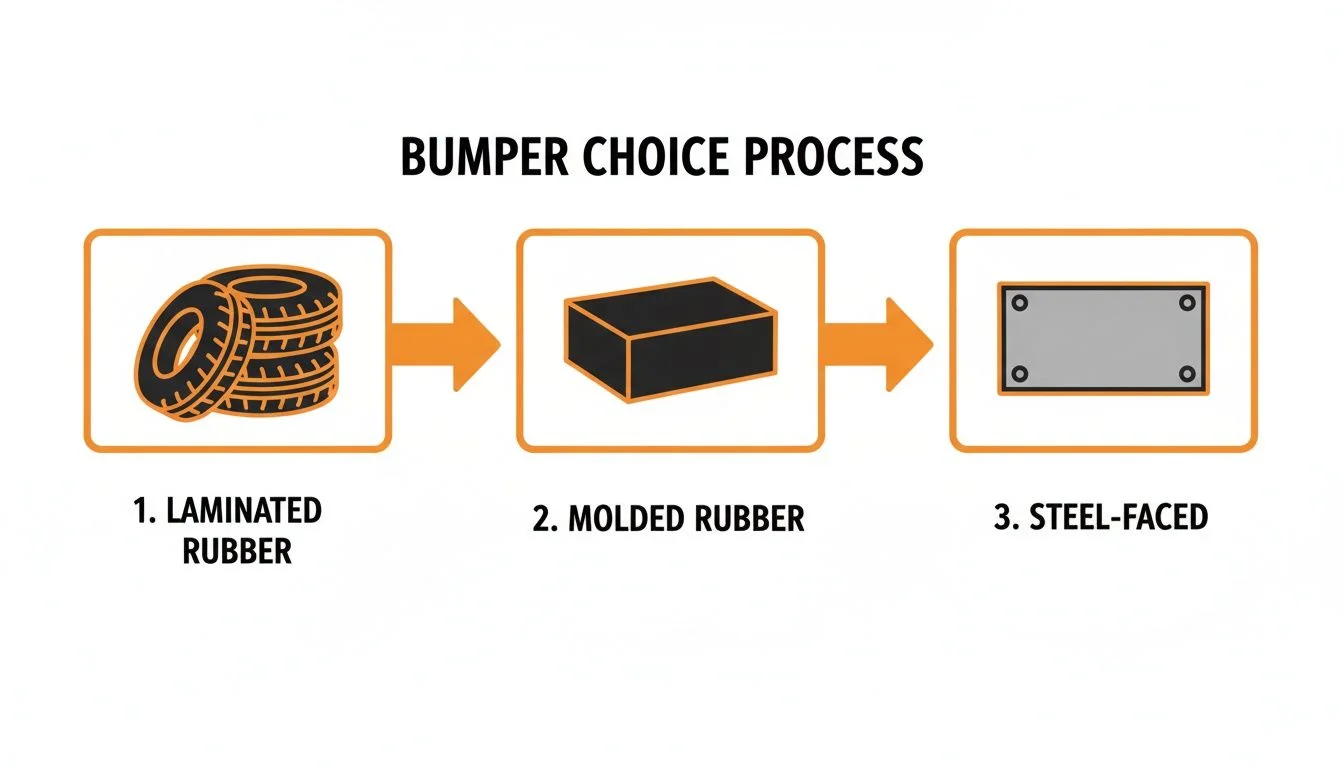
alt: A flowchart showing different types of dock bumpers for loading docks, including laminated, molded, and steel-faced options, to aid in selection.
This gives you a quick look at the main options, from versatile laminated rubber to heavy-duty steel-faced models, helping you match the right material to your facility’s needs.
Key Factors That Influence Bumper Size
Beyond the driveway slope, a few other things have to be considered to get the perfect fit. As a team that values providing Reliable Service, we always look at the full picture.
1. Dock Seal or Shelter Compression
If your dock has a seal or shelter for climate control, the bumper needs to let the trailer compress it just right. Too much projection and the trailer stops short, leaving gaps that leak energy. Too little, and the trailer can over-compress and crush your expensive seal.
2. Type of Trailers Serviced
Think about the trucks hitting your dock every day. Are they all standard dry vans? Or do you get refrigerated trailers (“reefers”) with cooling units that stick out? The bumper projection has to be thick enough to stop the truck before those units make contact with your building.
3. Dock Lip and Leveler Operation
Finally, the bumper must allow your dock leveler to work without interference. A bumper that’s too thick or poorly placed can block the leveler’s lip, preventing it from resting securely on the trailer bed. That creates a dangerous gap and a major inefficiency. By measuring these variables, you ensure your bumpers are an integrated part of your whole dock system, not just an afterthought.
Integrating Bumpers With Your Dock System
A high-quality bumper is only as good as its installation. The best dock bumpers for loading docks don’t work in isolation; they’re a critical piece of a bigger system that includes your dock leveler, vehicle restraint, and door seals. When these parts don’t work together seamlessly, your whole loading dock operation pays the price.
Think of it as a puzzle. Each piece—the bumper, the leveler, the seal—has a specific job. If one piece is just a little off, the entire picture is compromised. This is exactly why professional integration isn’t a luxury; it’s essential for safety, efficiency, and compliance.
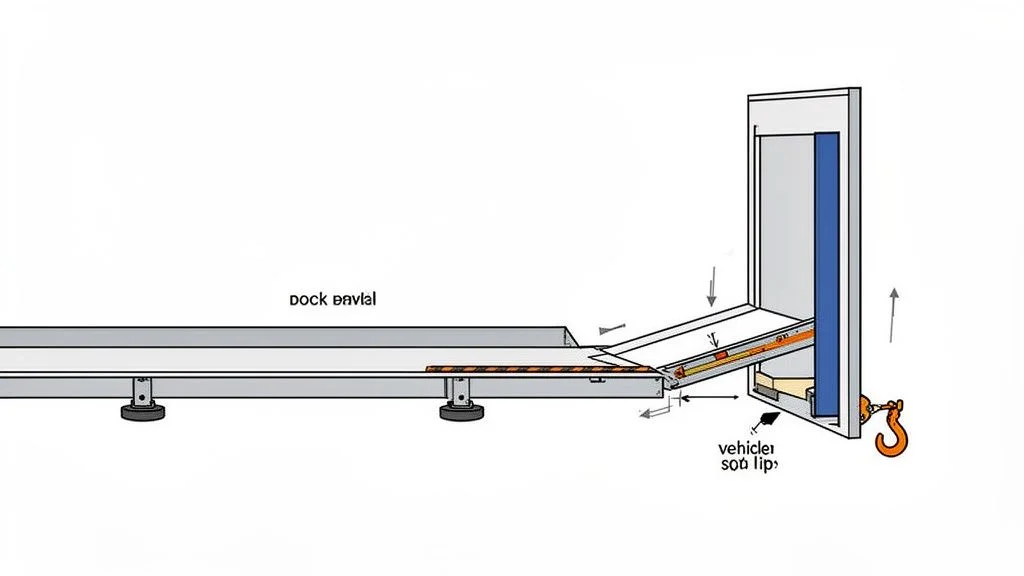
alt: A technical drawing showing how a dock bumper integrates with a dock leveler system, highlighting the importance of correct placement.
How Bumpers Interact With Other Dock Equipment
Choosing or placing the wrong bumper can set off a chain reaction of problems. A bumper with the wrong projection might not seem like a big deal, but it can have expensive consequences across your entire dock bay.
Here’s a real-world example we see all the time: a facility manager installs bumpers that are too thick for their dock. The trailer now stops several inches further from the wall than it should. This one mistake creates multiple points of failure.
- Dock Leveler Obstruction: The dock leveler’s lip may not be long enough to rest securely on the trailer bed. This creates a dangerous gap that’s a trip hazard and can wreck your forklift tires.
- Energy Loss: The dock seal can no longer create a tight connection with the trailer. Gaps form, letting your heated or cooled air pour out. This can cause energy bills to skyrocket, especially in food-grade or refrigerated facilities.
- Restraint Failure: Your vehicle restraint system might not be able to properly grab the trailer’s Rear Impact Guard (RIG). This compromises a critical safety feature designed to stop a trailer from accidentally pulling away from the dock.
A loading dock is a system of systems. Your bumper is the anchor point that dictates how everything else lines up. Get that bumper integration right, and the entire system works. Get it wrong, and you introduce inefficiency and risk into every single load.
Integration Checklist For New and Existing Docks
Whether you’re building a new facility or retrofitting an older one, thinking about these integration points upfront will save you from costly headaches later. Before you decide on a bumper, run through this simple checklist. When considering the integration of new or upgraded bumpers, you might explore professional services for dock systems to ensure a holistic approach.
Key Integration Points to Verify:
- Leveler Lip Engagement: Does the bumper projection allow your leveler lip to get at least four inches of purchase on the trailer bed? This is a non-negotiable safety standard.
- Dock Seal Compression: Will the bumper stop the trailer at the perfect spot for full seal compression, without crushing and damaging it?
- Vehicle Restraint Compatibility: Does the bumper’s placement let the vehicle restraint securely connect with the trailer’s RIG without any interference?
- Hardware & Anchoring: Is the bumper anchored directly into the building’s structural concrete? Mounting to brick or block is a recipe for failure under repeated impacts.
This holistic view is at the heart of our “Respected Partners, Reliable Service” philosophy. By making sure your dock bumpers are perfectly integrated, we help you build a safer, more efficient, and more profitable operation.
Maintaining Your Dock Bumpers for Long-Term Performance
Your investment in high-quality dock bumpers for loading docks is only as solid as the plan you have to take care of them. Just like any other piece of critical equipment in your facility, dock bumpers need regular attention to make sure they keep providing maximum protection and a long service life. A proactive maintenance strategy is the key to preventing expensive, unpleasant surprises.
Think of it this way: you wouldn’t drive a company vehicle for years without checking the tires for wear. Your dock bumpers endure far more punishment. A simple, consistent inspection routine can mean the difference between a small fix and a catastrophic failure that leads to building damage and operational downtime.
Your Bumper Inspection Checklist
Setting up a regular inspection schedule is the foundation of effective bumper maintenance. This doesn’t need to be complicated. By empowering your team to spot the early warning signs of trouble, you can catch issues long before they escalate.
During your inspections, keep an eye out for these simple visual cues:
- Significant Gouges or Missing Chunks: Minor scuffs and scrapes are perfectly normal. However, deep gouges or large missing pieces of rubber are a red flag that the bumper is breaking down and can no longer absorb impacts effectively.
- Bent or Detached Steel Facings: On steel-faced models, check that the front plate is still flat and securely attached. A bent plate can create a dangerous snag point, while a detached one leaves the rubber core completely exposed.
- Loose or Sheared Mounting Hardware: The bolts anchoring the bumper to the concrete wall are under immense and constant stress. Look for any signs of loosening, corrosion, or shearing—a bumper that isn’t securely fastened offers zero protection.
- Excessive Compression or “Pancaking”: Laminated bumpers are designed to be firm. If they look permanently squashed or flattened out, they’ve lost their shock-absorbing capacity and are due for replacement.
Knowing the difference between normal wear-and-tear and critical damage is crucial. Minor scuffs are just a sign the bumper is doing its job. A loose anchor bolt, on the other hand, points to a critical failure that needs your immediate attention.
Recommended Inspection Schedule
When it comes to inspections, consistency is far more important than intensity. A simple, repeatable schedule will give you the best results and help you stay ahead of potential failures.
Monthly Visual Checks (5-10 minutes per dock position)
- Perform a quick walk-by inspection of each dock position.
- Look for any obvious, glaring signs of damage, like large missing chunks of rubber or a bumper that is hanging off the wall.
- Make sure all bumpers are present and accounted for.
Quarterly In-Depth Inspections (20-30 minutes per dock position)
- Examine the mounting bolts up close for tightness and any signs of rust or shearing.
- Assess the condition of the rubber itself, looking for deep cracks, excessive wear, or hardening.
- For steel-faced bumpers, check the integrity of the welds and the condition of the faceplate.
- Document all your findings and schedule any necessary repairs or replacements.
By dedicating a small amount of time to planned maintenance, you shift from a reactive, costly repair cycle to a proactive, budget-friendly management strategy. This approach is fundamental to maximizing the lifespan of your loading dock assets.
Knowing When to Repair Versus Replace
A proactive maintenance program gives you the data you need to make smart financial decisions. Minor issues, like tightening a single loose bolt, can often be repaired quickly and by your own team. However, it’s vital to recognize when a bumper has simply reached the end of its functional life.
Trying to patch up a bumper that is structurally compromised is a dangerous and, in the long run, more expensive choice. If the rubber has lost its integrity or the steel frame is bent, replacement is the only safe option. Continuing to use a failed bumper puts your building, your equipment, and most importantly, your people at risk.
If you notice widespread or recurring issues across your dock positions, it might be time for a professional assessment. Our teams are trained to identify not just the damage but the root cause, helping you find a long-term solution. When issues do arise, knowing how to find qualified experts is crucial. If you’re looking for support, our guide on how to find loading dock repair companies can point you in the right direction. As your Respected Partners, we’re committed to providing Reliable Service that keeps your operations running smoothly.
Calculating the ROI of Quality Dock Bumpers
For any facility manager, an investment has to make sense on the balance sheet. While technical specs are important, the real case for high-quality dock bumpers for loading docks is all about the money you’ll save. The return on investment (ROI) here isn’t about making more money—it’s about preventing massive, unexpected costs.
You need to shift your thinking. A top-tier set of dock bumpers isn’t just another operational expense you try to shrink. It’s a vital capital investment that actively protects your building, prevents crippling downtime, and secures the financial health of your entire facility. When you see it that way, the ROI becomes crystal clear.
The Real-World Cost of Bumper Failure
Let’s walk through a scenario that’s all too common. One of your busiest loading bays has old, worn-out, or poorly sized bumpers. A truck driver, maybe in a hurry, reverses just a little too hard.
The failed bumper offers zero protection. The full force of that trailer slams right into your building’s foundation. Instantly, you’re looking at a cracked concrete wall, a dock leveler that’s been knocked out of alignment, and a damaged overhead door.
A single truck impact that damages your building’s foundation could easily result in a $15,000 structural repair bill. By contrast, a premium set of steel-faced bumpers for that same bay costs only a small fraction of that price.
And that’s just the start. That one incident kicks off a domino effect of financial hits that go well beyond the initial repair bill.
Calculating Your True ROI Through Cost Avoidance
To get the full financial picture, you have to add up all the potential expenses that a quality bumper helps you avoid. The numbers can be shocking.
Direct Cost Avoidance:
- Structural Building Repairs: This is the big one. Preventing damage to your concrete foundation and walls can save you tens of thousands of dollars with every single incident.
- Dock Equipment Replacement: Your expensive dock levelers, seals, and restraints are shielded from being crushed or jarred out of place, which significantly extends their working life.
Indirect Cost Avoidance:
- Operational Downtime: How much revenue do you lose for every hour a loading bay is out of service? For a busy distribution centre, that can easily be thousands of dollars.
- Labour Inefficiency: When a bay goes down, your team can’t work. They’re either standing around or forced into slower, less productive workarounds.
- Damaged Goods & Trailer Repairs: A severe impact can damage the products inside the trailer or the trailer itself, opening you up to claims and disputes with carriers.
- Increased Maintenance Calls: Good bumpers absorb the daily strain, reducing wear and tear on all the surrounding equipment. That means fewer emergency calls to your loading dock repair service.
When you factor in these avoided costs, the ROI on a premium bumper system isn’t just positive—it’s exponential. It becomes one of the smartest, highest-return investments you can make in your facility’s infrastructure. Choosing the right partner to ensure proper selection and installation is a critical part of realizing that return. As your Respected Partners providing Reliable Service, we help you protect your bottom line.
Frequently Asked Questions About Dock Bumpers
Here are some of the most common questions our team gets asked about dock bumpers. We’re sharing our answers to give you the practical insights you need as a facility manager.
How Do I Know When My Bumpers Need Replacing?
The most obvious signs are visual. Look for big chunks of missing rubber, steel facings that are badly bent or have peeled away from the rubber, or mounting bolts that have loosened or sheared off entirely.
A bumper that’s been crushed flat is no longer doing its job.
If a trailer can still hit the building wall or flatten your dock seal even with the bumper in place, it has completely failed. You need to replace it immediately to prevent expensive structural damage to your wall and to stop haemorrhaging energy.
Can I Install Dock Bumpers Myself?
While it might seem like a straightforward task, we always recommend professional installation. It’s about more than just bolting a piece of rubber to the wall. An expert ensures the bumper is anchored properly into structural concrete, giving it the strength to withstand repeated, heavy impacts.
Correct installation is also crucial for making sure the bumper works perfectly with your dock levelers and seals. A small mistake during a DIY install can void warranties, create serious safety hazards, and ultimately lead to much more expensive repairs down the line.
What Is the Most Durable Type of Bumper?
For most high-traffic, heavy-impact loading docks, steel-faced laminated rubber bumpers are the top performers. They offer the best of both worlds.
The steel faceplate takes the brutal friction and abrasion from trailers moving up and down, while the laminated rubber pads behind it are free to do their one job: absorb and dissipate the force of the impact. This combination delivers a long-lasting, highly protective solution that stands up to daily punishment.
Do I Need Different Bumpers for a Refrigerated Dock?
Yes, absolutely. Refrigerated and food-grade facilities have unique requirements that demand specific bumper solutions. The main challenge is maintaining a perfect thermal seal to prevent energy loss and keep your products safe.
Your bumpers must integrate seamlessly with specialized dock seals and shelters to create that tight envelope. It’s best to consult a professional to make sure your bumper choice supports your facility’s critical temperature control and sanitation standards.
At Wilcox Door Service, we believe reliable equipment is the foundation of a safe and productive operation. If you have more questions or need an expert eye on choosing, installing, or servicing your dock bumpers, our team is ready to help.
Contact us today to schedule an inspection and ensure your loading dock is operating as one cohesive, safe, and productive unit. Explore our comprehensive loading dock solutions.