


A side door garage opener usually becomes a priority when a facility starts feeling friction in daily operations. A secure pedestrian or service door gets left open for convenience. A loading area loses conditioned air. Staff waste time opening and closing a door manually, or the wrong operator keeps faulting in cold weather.
For Canadian facilities, the answer is rarely just “buy a motor and install it.” The right decision depends on door type, clearance, cycle demands, code compliance, and how the operator fits the rest of your building systems. That matters even more in warehouses, distribution centres, manufacturing plants, airports, and multi-site commercial portfolios where a small access point can create outsized safety and uptime issues.
This guide is written for facility managers who need practical answers, not residential-style pros and cons. It focuses on what works in commercial settings, what tends to fail, and how to choose a side door garage opener that supports safety, efficiency, and budget control.
Your Full Guide to Commercial Side Door Openers
A facility manager usually notices the problem before anyone else calls it one. A truck is waiting at a dock. A side access door is being used constantly. Heat or cooled air keeps escaping. Security gets looser because people prop open a door that should stay controlled.
That is where a side door garage opener earns its place. In commercial settings, this equipment automates a secondary door or smaller service opening so staff can move safely and efficiently without relying on manual operation or improvised workarounds.
In Canada, this equipment did not appear as a niche add-on. Its development tracked with industrial expansion after the war years. By 1974, over 50% of new Canadian commercial buildings incorporated two-bay garage configurations with side door access, up from 39% in 1971 according to this history of garage door opener development. That shift increased demand for automated operators tied to security and workflow.
Where the value shows up first
Most facilities feel the benefit in three places:
- Safer movement: Staff are not wrestling with a heavy service door during busy periods.
- Better control: Access points can stay closed, monitored, and integrated with site procedures.
- Lower operating drag: Doors open and close consistently instead of being left partially open or blocked.
Common commercial use cases
A side door garage opener often makes sense for:
- Warehouse service doors beside primary overhead openings
- Loading dock support openings used by carts or maintenance staff
- Secure parkade or fleet areas where controlled secondary entry matters
- Cold-storage support doors where air loss needs tight control
Practical takeaway: If a side opening affects traffic flow, security, or conditioned air, it should be treated as operational equipment, not just an accessory.
Understanding the Commercial Side Door Opener
A commercial side door garage opener is not the same thing as the main operator on your largest overhead vehicle door. In practice, it usually refers to an automated operator serving a smaller sectional, rolling steel, or service-access opening used by people, carts, or occasional vehicle traffic.
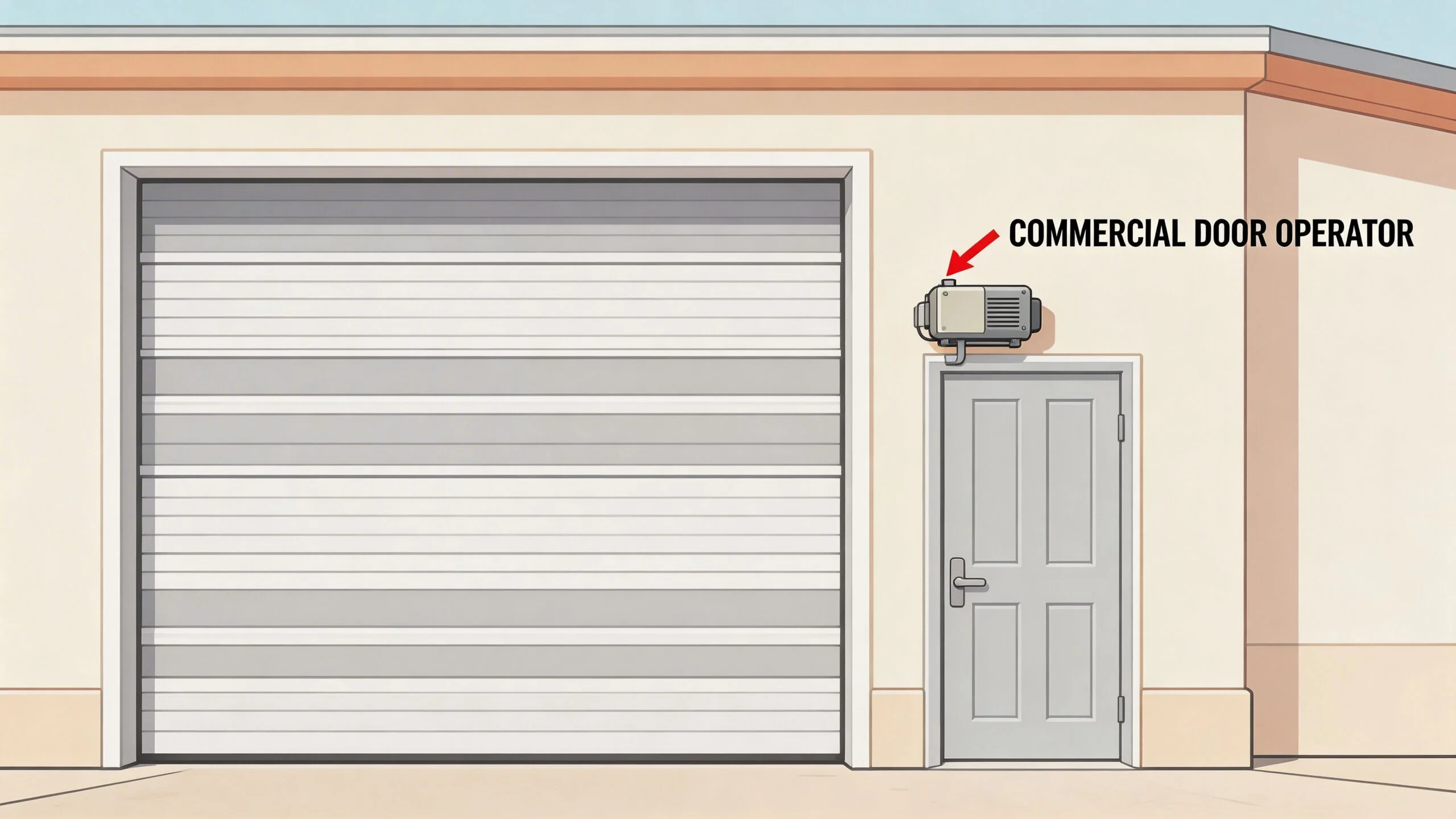
Think of it as a purpose-built operator for a door that works harder than it looks. These doors often sit beside loading bays, in maintenance corridors, or at service entries where frequent use, tighter security, and environmental control matter more than they do in a typical residential garage.
What makes it commercial
Commercial models are built for conditions that wear out light-duty equipment quickly.
- Higher cycle demands: A warehouse side door may open throughout the day, not just morning and evening.
- Heavier construction: Insulated sectional doors and rolling steel doors need the correct torque and control.
- More safety requirements: Entrapment protection, reversing systems, and proper site integration are expected.
- Tighter operational tolerances: Delays at a service opening can affect dock flow, sanitation, or internal traffic.
A residential opener in that environment is usually a short-term fix that creates a long-term problem. It may run for a while, but the wear pattern, safety expectations, and installation conditions are different enough that premature failure is common.
Why facility managers should care
Its primary purpose is not convenience. It is controlled movement.
If the right operator is in place, teams move through the opening without propping the door, forcing the mechanism, or bypassing safety devices. The door closes properly. Security improves. The building envelope performs better. Maintenance also becomes more predictable because the operator is matched to the application instead of being asked to do a job it was never designed for.
Comparing Operator Types and Technical Specifications
The wrong operator choice usually shows up in one of two ways. Either the door never performs smoothly from day one, or it works for a while and then starts eating parts, causing nuisance calls, and frustrating staff.
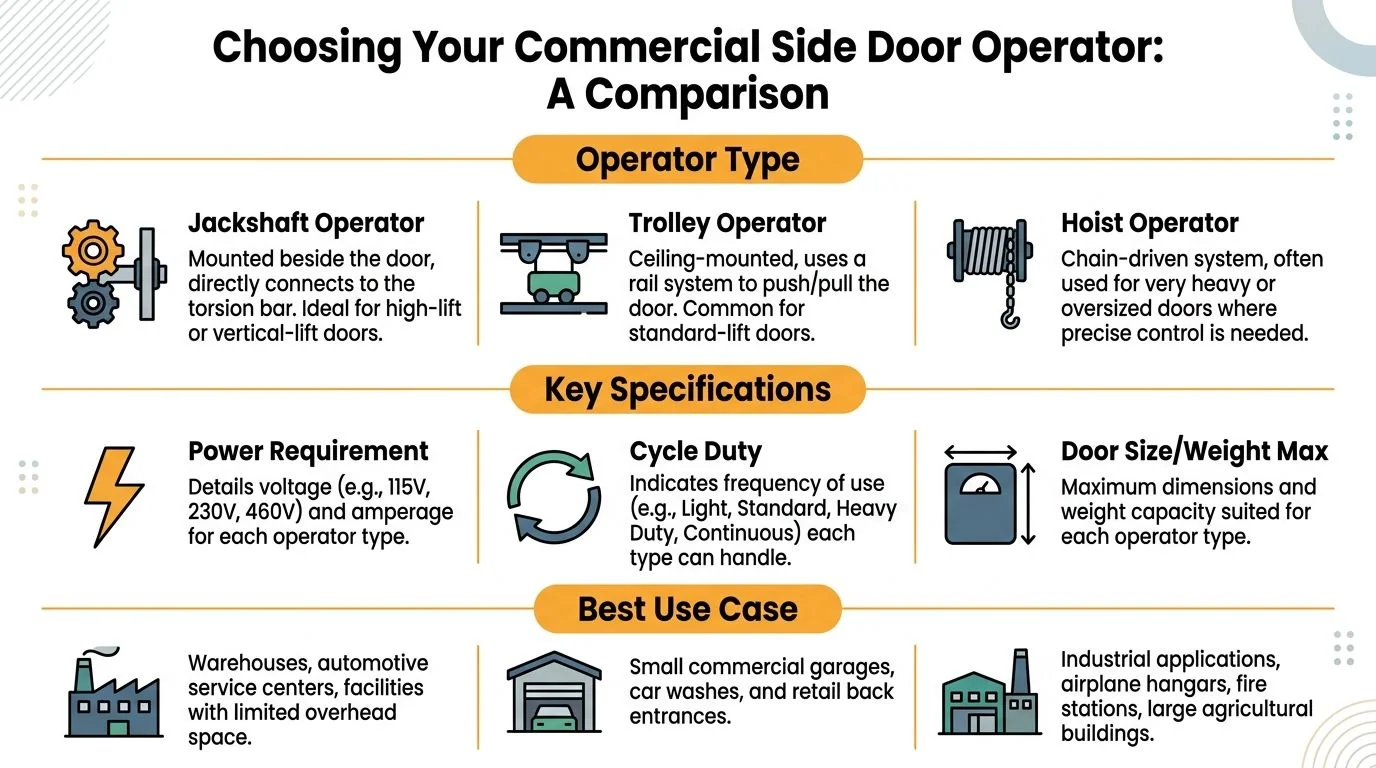
The three operator types facility managers most often compare are jackshaft, trolley, and hoist. Each works differently, and each has a place.
How each operator works
A jackshaft operator mounts beside the door and turns the torsion shaft directly. This is the common side-mount format. It is often the cleanest choice when ceiling space is tight or when the area above the opening is needed for lighting, piping, sprinkler lines, or storage.
A trolley operator mounts overhead and uses a rail to push or pull the door. It is familiar, straightforward, and often suitable for standard-lift doors where overhead space is available and traffic demands are moderate.
A hoist operator uses a chain-and-sprocket style arrangement and is built for heavier doors or more demanding industrial use. It is often selected when door size, weight, or duty cycle goes beyond what lighter configurations handle comfortably.
Commercial Side Door Operator Comparison
| Operator Type | Mounting Location | Ideal Use Case | Key Advantage |
|---|---|---|---|
| Jackshaft | Wall beside the door | Warehouses, service bays, retrofits with limited ceiling room | Frees overhead space and drives the torsion shaft directly |
| Trolley | Ceiling above the opening | Standard-lift commercial doors with clear overhead room | Familiar layout and straightforward operation |
| Hoist | Side-mounted with chain operation | Heavy industrial doors and oversized openings | Handles demanding door loads and tougher duty conditions |
Relevant Specs
For many side-mount applications, ¾ hp DC motors can operate doors up to 180 sq ft, and the soft start and stop of DC motors can reduce mechanical wear by 30% to 50% compared with AC motors according to these electrical specifications for garage door openers. That matters in high-cycle environments because smoother starts place less shock on springs, cables, and hardware.
A few practical checks matter more than brochure language:
- Door size and weight: Never choose by motor label alone.
- Available clearance: Side room and headroom often decide the operator style.
- Duty expectations: Busy service access needs a different operator than an infrequently used bay.
- Power supply: Verify what the site can support before specifying equipment.
If your team is also reviewing motor control strategy, this primer on variable frequency drive basics helps explain how controlled acceleration and deceleration affect equipment performance.
For a closer look at wall-mounted configurations, Wilcox has also published a practical guide on side-mounted garage door opener options.
Tip: If a salesperson leads with “quiet” or “space-saving” but cannot talk clearly about shaft condition, spring balance, and cycle demands, you are probably hearing a residential conversation in a commercial setting.
How to Select the Right Opener for Your Facility
Selection starts at the door, not the catalogue. Facility teams get better results when they assess the opening as part of the operation around it.
A side door by a loading dock behaves differently from one at a secure maintenance corridor. A cold-storage support door has different needs than a dry warehouse service entrance. The best operator fits the use pattern, not the one with the most features.
Start with the door and the opening
Check the basics first:
- Door construction: Sectional, rolling steel, insulated, fire-rated, or specialty
- Door size and weight: These govern operator suitability
- Track and spring setup: The operator has to match the actual mechanics
- Available space: Wall clearance, headroom, and nearby electrical service all matter
A side-mount unit can be a strong fit when the ceiling is crowded or when you want to preserve overhead space. It is not automatically the right fit if the shaft setup is poor, the side clearance is inadequate, or the door balance is already compromised.
Match the operator to the environment
Canadian conditions change the conversation quickly. In cold-storage and distribution settings, the operator has to work with the rest of the opening system, not against it. Natural Resources Canada’s 2026 data shows mismatched operators can lead to a 15% uptime loss in Alberta and Saskatchewan warehouses, while proper integration with air curtains and dock seals can cut related energy costs by up to 22% in this review of side garage door opener options and installation considerations.
That means selection is not just about opening and closing the door. It is about how the operator works with:
- Air curtains
- Dock seals or shelters
- Insulated door assemblies
- Cold-weather performance requirements
Consider the human side of operation
A good specification also reflects who uses the door.
A side opening used by maintenance staff on foot may need simple push-button access and reliable closing. A service opening tied to inventory movement may need faster response and tighter integration with access control. In food, pharma, or clean environments, easy cleaning and consistent closing behaviour often matter more than cosmetic features.
Field rule: If the door supports production, sanitation, shipping, or secure circulation, choose for repeatable performance first. Convenience features come second.
Navigating Installation Retrofits and Code Compliance
Installation quality decides whether a side door garage opener becomes a reliable asset or a recurring problem. In commercial work, the operator, door, structure, controls, and safety devices all have to function as one system.
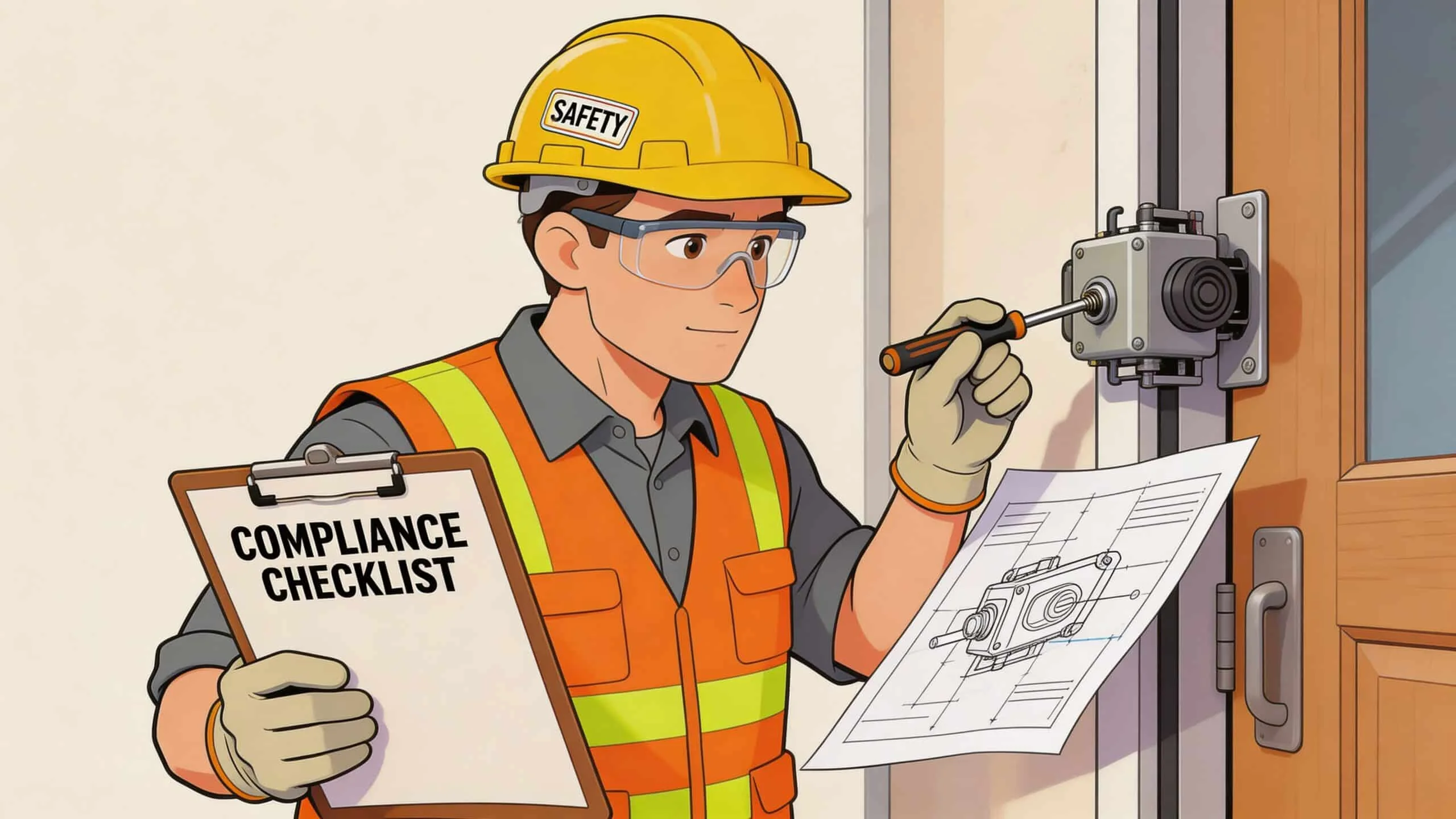
Retrofits are where issues often surface. A new build usually provides cleaner coordination for electrical, mounting points, and clearances. An existing facility may come with older wiring, limited side room, poor shaft condition, or legacy controls that do not line up with current safety expectations.
What compliance means in practice
Canadian compliance goes beyond plugging the unit in and setting limits. Depending on the opening, you may need to address the National Building Code of Canada, provincial requirements, electrical code rules, and fire door obligations.
For fire-rated applications, this often includes integration with alarm systems and formal drop testing. For pedestrian or service-access openings, it includes making sure entrapment protection and reversing functions are appropriate to the opening and the traffic pattern.
One overlooked issue is retrofit approval on industrial sites. A recent note on code gaps highlights that 28% of industrial door failures in Ontario and Quebec stem from non-compliant operators in a Public Services and Procurement Canada 2025 report discussed in this overview of side-mount opener compliance gaps. The practical lesson is simple. If the operator is not specified and installed properly, the failure is often procedural before it is mechanical.
Why modern safety features are not optional
The clearest historical lesson came in the 1970s. After obstruction-reversing sensors became mandatory under provincial codes, accident rates in industrial facilities fell by 62% between 1975 and 1985 according to historical safety data on garage door systems.
That is why experienced installers pay close attention to:
- Photo-eye placement: The sensors must see the opening clearly
- Reversing function: The door must respond properly to obstruction
- Entrapment protection: Especially important where pedestrians use the opening
- Operator mounting and alignment: A misaligned install creates force and wear issues fast
If you are planning a retrofit or replacement, this practical article on garage door opener installation is a useful starting point.
Advanced Integration with Access Control and Automation
A modern side door operator can do much more than open a door on command. In the right facility, it becomes part of the building’s control logic.
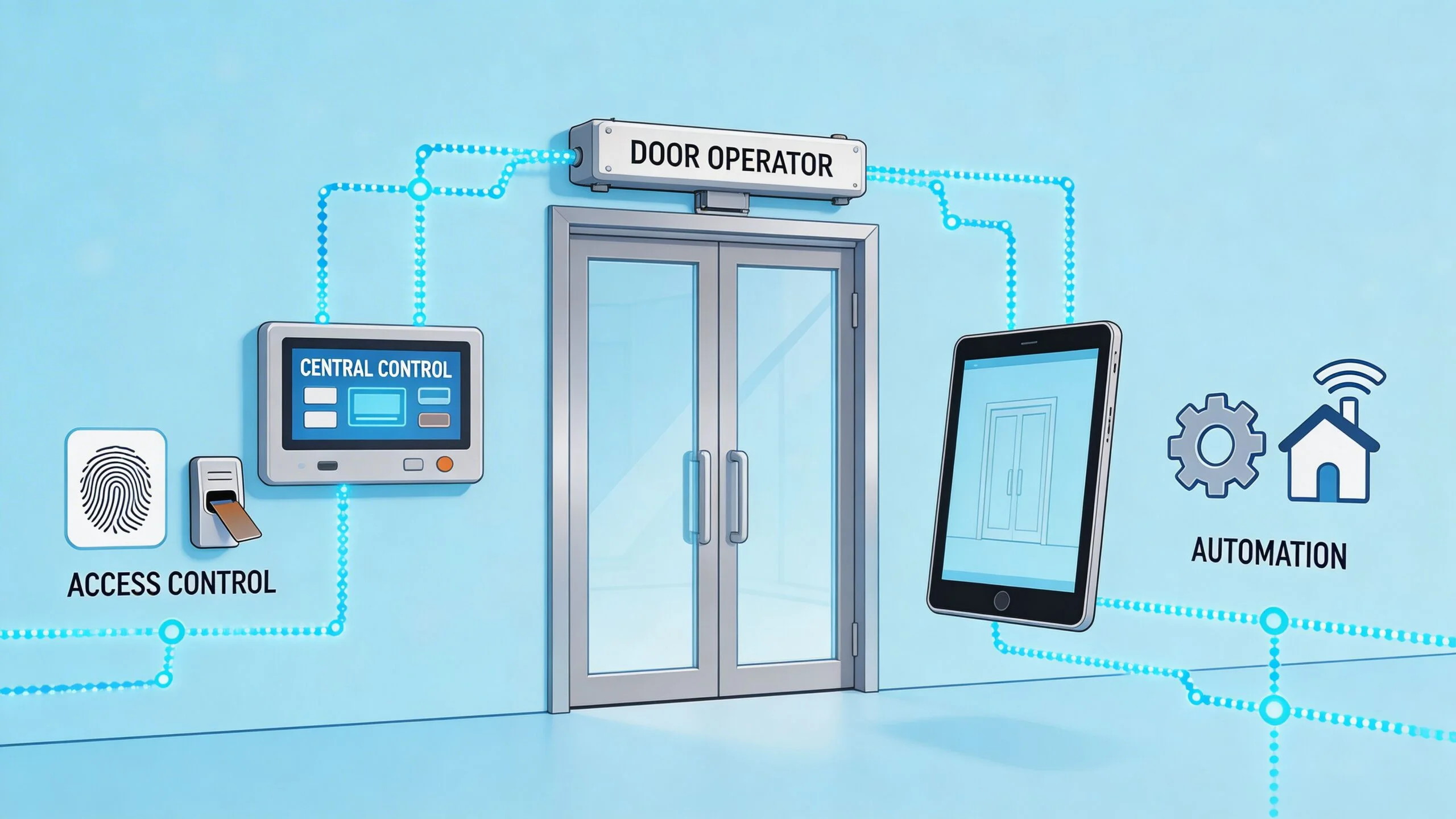
Consider a common warehouse scenario. A side service opening sits between a secured exterior lane and an internal pick area. You want approved staff to enter with credentials, you want the event logged, and you want supervisors alerted if the door stays open too long. That is not a motor problem. It is an integration problem.
Where integration helps most
The most useful integrations tend to be straightforward:
- Access control: Card, fob, keypad, or mobile credential permissions
- Security monitoring: Door position tied to alarms or camera events
- Building automation: Coordination with HVAC or zone controls
- Remote diagnostics: Status visibility without waiting for failure
A good side door garage opener should support that ecosystem cleanly. It should not force staff into local workarounds just to keep traffic moving.
Uptime features that matter
Battery backup and diagnostics are especially valuable on commercial sites. Systems such as the Genie Wall Mount can provide 20 to 50 cycles during a power outage, and Wi-Fi diagnostics can provide real-time health reports that support predictive maintenance, potentially extending asset life 2 to 3 times and reducing service calls by up to 40% by adjusting for issues such as thermal expansion, according to these jackshaft opener installation requirements and feature notes.
That matters on facilities where a short outage can leave a critical access point unavailable.
A useful way to think about it is this:
- Without diagnostics: Staff report the problem after operations are disrupted.
- With diagnostics: Maintenance can see abnormal force behaviour earlier and schedule corrective work before the opening fails in service.
For teams planning broader integration, Wilcox also provides practical guidance on access control system installation.
A short product walkthrough can also help teams visualise how automated control layers fit together:
Key takeaway: The most useful automation is not flashy. It reduces manual work, tightens accountability, and keeps the opening available when operations need it.
Proactive Maintenance and Emergency Repair Planning
A side door opener that supports daily traffic should never be treated as install-and-forget equipment. By the time a facility notices obvious failure, the cost is usually already higher than it needed to be.
The basic wear points are predictable. Springs lose balance. Cables fray. Photo-eyes get knocked out of alignment. Limits drift. Mounting hardware loosens. Operators start compensating for door problems they were never meant to overcome.
What maintenance should catch early
The warning signs are usually there before a shutdown:
- Unusual noise: Grinding, popping, rattling, or delayed starts
- Jerky travel: The operator is fighting balance or alignment issues
- Slow response: Motor strain, control issues, or environmental drag
- Intermittent reversals: Sensor, force-setting, or hardware problems
- Doors being propped open: Often a symptom of unreliable operation, not staff carelessness
A planned maintenance program gives the site a structured way to inspect, test, and correct those issues before they become service interruptions. It also helps maintenance leaders budget more predictably because work is scheduled instead of crisis-driven.
Why reactive service costs more
Reactive repair feels cheaper until operations get involved. A failed service opening can interrupt shipping, create a temporary security weakness, or force staff into unsafe manual operation.
For teams building internal procedures, a simple preventive maintenance checklist template can help standardise inspections and make sure recurring checks are not left to memory.
Facilities that want outside support often combine internal visual checks with specialist service for adjustments, testing, and repairs. One option in Canada is Wilcox Door Service Inc., which provides planned maintenance programs and emergency response for commercial door systems.
Maintenance rule: If an operator problem is causing staff workarounds, treat it as an urgent operational issue even if the door still opens.
Your Procurement Checklist and Next Steps
Before you approve a side door garage opener, make sure the opening has been reviewed as a system, not just as a product purchase.
Final checklist
- Confirm the door details: Size, weight, construction, and spring arrangement
- Review the opening conditions: Side clearance, headroom, power supply, and surrounding equipment
- Define actual usage: Pedestrian traffic, carts, security access, or occasional vehicle movement
- Check the environment: Cold-storage, washdown, dust, corrosion, or temperature swings
- Verify compliance needs: Fire rating, reversing devices, sensors, and site-specific code obligations
- Plan the integration: Access control, alarms, BAS, and remote monitoring if needed
- Set the maintenance approach: Internal checks, scheduled service, and emergency response expectations
A strong procurement decision usually comes from a site review, not a catalogue comparison. The right operator should suit your door, your facility conditions, and how your team uses the opening every day.
Respected Partners, Reliable Service means choosing equipment and support that protect uptime, safety, and long-term value.
If you need help assessing a side door garage opener for a warehouse, loading dock, parkade, or industrial retrofit, contact Wilcox Door Service Inc. to schedule a service inspection or discuss operator options for your facility.