


In this guide, you will learn the critical differences between residential and commercial barn style doors, how to select the right materials and hardware for performance, and what it takes to ensure a flawless installation that maximizes safety and efficiency. We will cover key compliance standards, total cost of ownership, and how to choose a reliable service partner for your facility.
Imagine trying to squeeze more usable space out of a busy warehouse or production floor. Traditional swing doors eat up valuable square footage, creating logistical headaches. Commercial barn style doors offer a simple, elegant solution by sliding horizontally along a track, completely eliminating the need for swing-out clearance.
This straightforward mechanism—what we call the door's operation—makes them a powerful upgrade for any facility looking to optimize its layout and streamline the movement of people and equipment.
Why Modern Barn Style Doors Are a Smart Facility Upgrade
What started as a practical design for agricultural buildings has become a high-performance solution for demanding commercial and industrial spaces. But it's crucial to understand the difference: while the residential barn doors you see in homes are all about aesthetics, their commercial counterparts are engineered from the ground up for durability, safety, and constant use.
The distinction isn't just a matter of size; it’s in every single component, from the heavy-duty track system right down to the core materials of the door panel itself.
For facility managers, the real advantages go far beyond simply saving space. These doors deliver tangible benefits that directly improve daily operations and can even impact your bottom line.
- Improved Spatial Efficiency: By sliding parallel to the wall, these doors free up critical floor space that would otherwise be lost to door swing. For example, a warehouse can place pallets or equipment right next to the opening, an impossibility with a swing door. This allows for tighter, more efficient layouts in warehouses, manufacturing plants, and loading docks.
- Enhanced Operational Flow: The sliding design creates a wide, unobstructed opening. This is perfect for facilitating the smooth movement of forklifts, pallet jacks, and personnel without a swinging door getting in the way.
- Increased Safety and Durability: Built with industrial-grade materials and robust hardware, commercial barn doors are designed to withstand the rigours of high-cycle environments—meaning they can open and close hundreds of times a day—and frequent impacts.
- Adaptability to Unique Spaces: They are an excellent fix for areas with low ceilings or overhead obstructions like pipes and conduits, where a traditional overhead door simply won’t fit.
Before we go further, it’s important to see just how different these two types of doors are. A residential door would fail almost immediately in a commercial setting.
Residential vs Commercial Barn Style Doors at a Glance
This table breaks down the fundamental differences between doors designed for homes and those engineered for the workplace. It highlights why a specialized commercial solution is not just recommended—it's essential for safety and reliability.
| Feature | Residential Barn Doors | Commercial Barn Style Doors |
|---|---|---|
| Primary Focus | Aesthetics and interior design | Durability, safety, and operational efficiency |
| Materials | Lightweight wood, MDF, or hollow-core panels | Heavy-gauge steel, insulated panels, solid-core wood, or high-strength fabric |
| Hardware & Track | Lighter-duty, decorative track and rollers | Heavy-duty, industrial-grade steel tracks and trolleys engineered for high-cycle use and heavy loads |
| Durability | Designed for low-frequency, gentle use | Built to withstand impacts, heavy usage (hundreds of cycles per day), and harsh industrial environments |
| Performance | Minimal focus on insulation or security | Can be specified with high R-value insulation, perimeter seals for climate control, and robust locking mechanisms |
| Code Compliance | Generally not subject to strict building codes | Must meet specific building, fire, and safety codes (e.g., ADA, NFPA) depending on the application |
| Typical Application | Interior closets, pantries, and room dividers in homes. | Warehouses, manufacturing facilities, cold storage, loading docks, large equipment bays, and institutional buildings. |
As you can see, choosing the right door type is critical. They are two entirely different products built for vastly different purposes.
From Farm to Factory Floor
The journey of the barn style door from rural Canada to modern industrial facilities is a testament to its brilliant, practical design. On farms across the country, these doors have been a common-sense solution since the late 19th century because they were simple, reliable, and didn't get blocked by snow.
Today, we're adapting that proven concept for modern, high-performance applications. For instance, in a recent project, we helped a food distribution client in a frigid climate retrofit their old loading dock doors with modern, high-speed fabric versions of these sliding doors. The result? They cut energy losses by nearly 25% during the winter months. You can discover more about this evolution from historic barns to modern solutions.
This is why settling for anything less than a true commercial-grade door is a mistake. It’s the difference between a reliable asset and a recurring maintenance headache. As your Respected Partner providing Reliable Service, Wilcox Door Service delivers dependable commercial door installations that are built to last and boost your facility’s performance.
Selecting the Right Materials and Hardware
Think of your commercial barn door like a work truck. The real performance isn't just about the size or colour—it's in the engine, the frame, and the suspension. The same is true for your doors. The materials and hardware you choose are the engine that dictates how well they’ll perform and, more importantly, how long they'll last.
Getting this wrong isn't a minor inconvenience. A system that’s not matched to its job will wear out fast, leading to frustrating downtime, expensive repairs, and even serious safety hazards. We're going to walk through the critical components, from the door panels to the motors, so you can specify a system that’s truly built for the demands of your facility. A food processing plant and a high-traffic warehouse have completely different needs, and their door specs should reflect that.
This decision guide gives a quick overview of how the process starts.
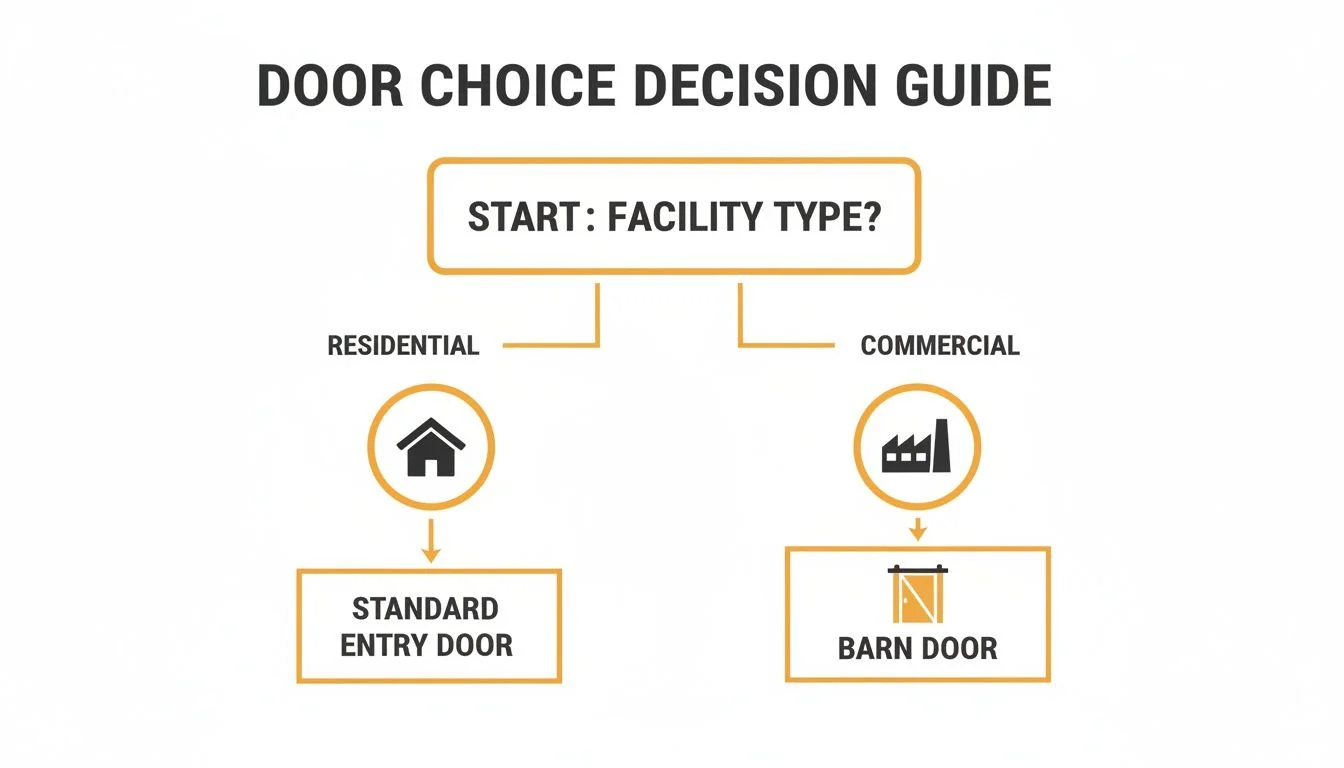
Alt text: Decision guide for door choice, starting with facility type. Residential leads to standard entry door, commercial to barn style doors.
As you can see, the first fork in the road is always the application. Once you confirm it’s a commercial environment, every choice in materials and hardware flows from there.
Choosing Your Door Panel Material
The door panel itself is the most visible part of the system, but it’s also your main barrier against everything from forklift impacts to weather. The material you pick defines the door's core characteristics—its durability, weight, and how it holds up in your specific environment.
- Heavy-Gauge Steel: This is the undisputed workhorse for most industrial jobs. It’s tough, resistant to impacts, and can be insulated for excellent thermal control. You’ll find it in warehouses, manufacturing plants, and loading docks where durability is the top priority.
- Aluminum: Lighter than steel and naturally rust-resistant, aluminum is a smart choice for wash-down areas, humid environments, or exterior doors exposed to a lot of moisture. It's not quite as tough as steel against impacts, but it offers a fantastic low-maintenance, long-lasting solution.
- Solid-Core Wood: When appearances matter but you still need strength, solid-core wood provides a classic, robust option. It’s a common sight in institutional buildings or commercial spaces aiming for a more polished look without giving up on performance. For a deeper dive into wood door construction, check out our guide on stile and rail doors.
- Specialized Surfaces: Some environments have non-negotiable requirements.
- Stainless Steel: This is the industry standard for food processing, pharmaceutical facilities, and clean rooms. It’s non-porous, corrosion-proof, and easy to keep sanitized.
- High-Speed Fabric: Found in high-traffic openings, these tough, lightweight fabric doors are built for one thing: speed. They cycle in seconds, helping to maintain climate control and keep productivity high.
Demystifying Track and Roller Systems
The track and roller assembly is the backbone of the entire door system. It has the tough job of carrying the full weight of the door panel—often hundreds or even thousands of pounds—and guiding it smoothly, cycle after cycle.
Key Insight: One of the most common mistakes we see is underspecified hardware. A track rated for a 200 kg door will fail—and fail quickly—if you hang a 450 kg insulated steel panel on it. Always make sure the hardware's weight capacity is well above the actual door weight to handle the stress of daily operation.
The track is the heavy-duty rail mounted above the opening, and the rollers (or trolleys) are attached to the door to glide inside it. For any commercial job, these have to be industrial-grade steel components engineered for a high number of cycles. And don't forget the small stuff; the quality of the fasteners and fittings that anchor the track to the wall is just as critical to the system's longevity.
Selecting the Right Operator and Controls
What a door is made of is only half the story; how it opens is the other. The operator, or motor, is what automates the system and makes it a functional part of your workflow.
- Manual Operation: This is really only practical for doors that are used infrequently, such as for seasonal access to a storage area. It's simple and inexpensive, but completely impractical for any busy opening.
- Automated Operators: For most commercial settings, an electric motor is a must. These can be activated by anything from a simple push-button or pull-cord to a remote control.
- High-Speed Operators: Paired with fabric doors, these powerful motors are designed for rapid-fire opening and closing. They are essential for minimizing air transfer between climate zones and keeping forklift traffic moving without delay.
Of course, these operators need to connect to your access controls. This might be as basic as a wall-mounted button for staff or as advanced as motion sensors for hands-free forklift traffic. In more secure areas, it could be a card reader or keypad. Getting this integration right doesn't just add convenience—it boosts your facility's security and overall efficiency.
The right combination of materials, hardware, and operators ensures your barn style doors become a reliable asset, not a constant maintenance headache.
Meeting Performance and Compliance Standards
In any commercial facility, a door is never just a door. It's a critical part of your building’s operational strategy, responsible for everything from energy efficiency to the safety of your people. When you’re specifying commercial barn style doors, understanding key performance metrics and compliance standards isn’t just about ticking boxes—it's about protecting your assets, your team, and your bottom line.
Let's demystify the technical ratings and codes that matter most. You’ll learn how to interpret thermal performance, fire ratings, and wind load capabilities so you can make an informed decision that guarantees both safety and long-term value.
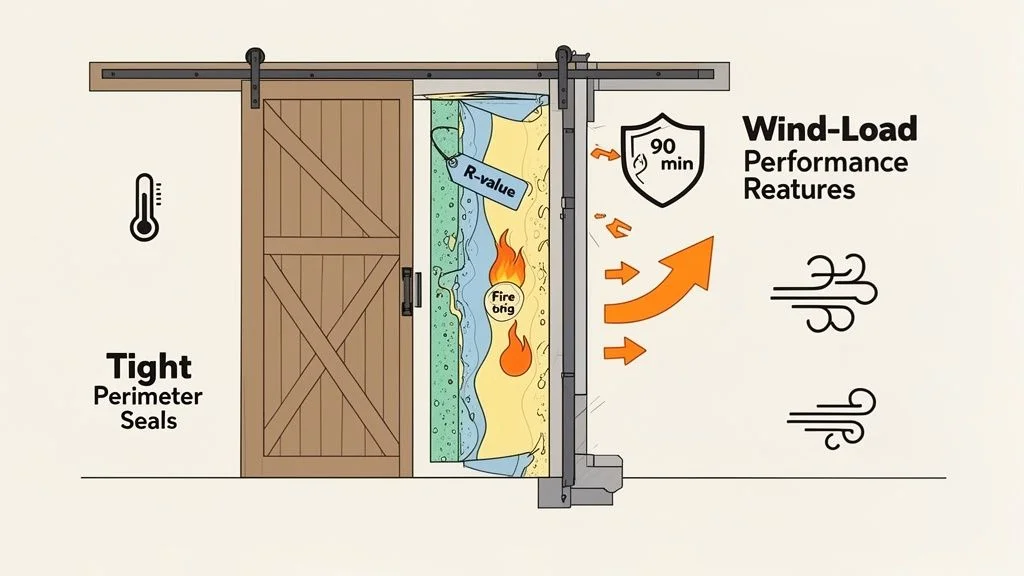
Alt text: Illustration detailing a barn style door system’s insulation (R-value), fire rating (in hours), and wind-load performance features.
Thermal Performance and Energy Savings
For any facility manager in Canada, managing utility costs is a constant battle. An uninsulated or poorly sealed door is like leaving a window wide open, letting your heated or cooled air escape and driving up energy bills. This is where thermal performance ratings become absolutely essential.
The most important metric to look for is the R-value. In simple terms, R-value measures a material's ability to resist heat flow.
A higher R-value means better insulation. A door with an R-value of 16 will do a much better job of preventing heat transfer than one with an R-value of 4.
For facilities like cold storage warehouses or food processing plants, maintaining strict temperature zones is non-negotiable. An insulated barn style door with a high R-value, paired with a robust sealing system, is critical for climate control. Modern sealing systems include:
- Perimeter weather seals: These flexible gaskets run along the top and sides of the door, creating a tight barrier against the wall when closed.
- Bottom seals: A heavy-duty rubber or brush seal along the bottom edge prevents drafts and stops pests, dust, and debris from getting in.
- Overlapping designs for bi-parting doors: When two doors meet in the middle, they are often designed to overlap with a seal in between, completely eliminating the central gap.
By specifying a door system with a high R-value and comprehensive seals, you can slash energy loss, leading to lower utility bills and a much more stable indoor environment.
Fire Safety and Code Compliance
In certain applications, a door’s most important job is to act as a fire barrier. Fire-rated barn style doors are engineered to contain fire and smoke, effectively compartmentalizing a building to slow a blaze and give people precious time to evacuate safely.
These doors are tested and assigned a fire-resistance rating, measured in minutes or hours (e.g., 20-minute, 60-minute, 90-minute). This rating tells you how long the door can withstand a fire while maintaining its structural integrity. For instance, a 90-minute fire-rated door is crucial for separating a high-risk area, like a storage room for flammable materials, from main operational zones or escape routes. If you'd like more details, you can learn more about fire door ratings and what they mean for your facility.
Beyond the rating, compliance is everything. These doors must be installed and maintained according to strict codes, like those from the National Fire Protection Association (NFPA). This includes regular inspections and fire door drop testing—a mandatory procedure to ensure the door closes and latches properly when triggered by a fire alarm.
The importance of professional service is clear. In our experience, facilities that partner with us for fire door maintenance see significantly higher pass rates during mandatory inspections. For example, our clients in Ontario's government sector consistently achieve a 98% pass rate on fire door drop tests, far surpassing the industry average of 75%. This reliability reduces the risk of hefty compliance fines and ensures a safer environment.
Structural Integrity and Wind Load
For exterior doors, especially in large formats, structural integrity is paramount. These doors have to withstand serious environmental forces, with wind being the most significant. Wind load is the amount of force that wind exerts on a surface. A door that isn't rated for the wind loads in your specific region can buckle, deform, or even fail completely during a severe storm.
Canadian building codes, including standards from the CSA Group, specify the wind load requirements for different geographical areas. A certified provider will ensure your exterior barn style doors are engineered to meet or exceed these local codes. This gives you peace of mind that your building envelope is secure, no matter what the weather throws at it. This is especially important for large openings at airports, distribution centres, and coastal facilities.
Choosing a door that meets these performance and compliance standards is a smart investment. It ensures your facility is safe, energy-efficient, and protected from costly fines and operational disruptions.
Ensuring a Flawless Installation Process
You can have the best door system in the world, but it’s only as good as its installation. Even the most durable commercial barn style doors, built with top-tier materials and hardware, will fail to perform if the installation is sloppy. A professional, precise installation isn’t just the final step—it’s the one that guarantees your door will operate safely, efficiently, and reliably for years to come.
This section gets into the brass tacks of installation for both new construction and retrofits. For contractors, we’ll outline the structural requirements that are absolutely non-negotiable. For facility managers, we’ve put together a practical checklist to help you assess an existing opening and head off costly surprises. A flawless installation is the bedrock of long-term performance.
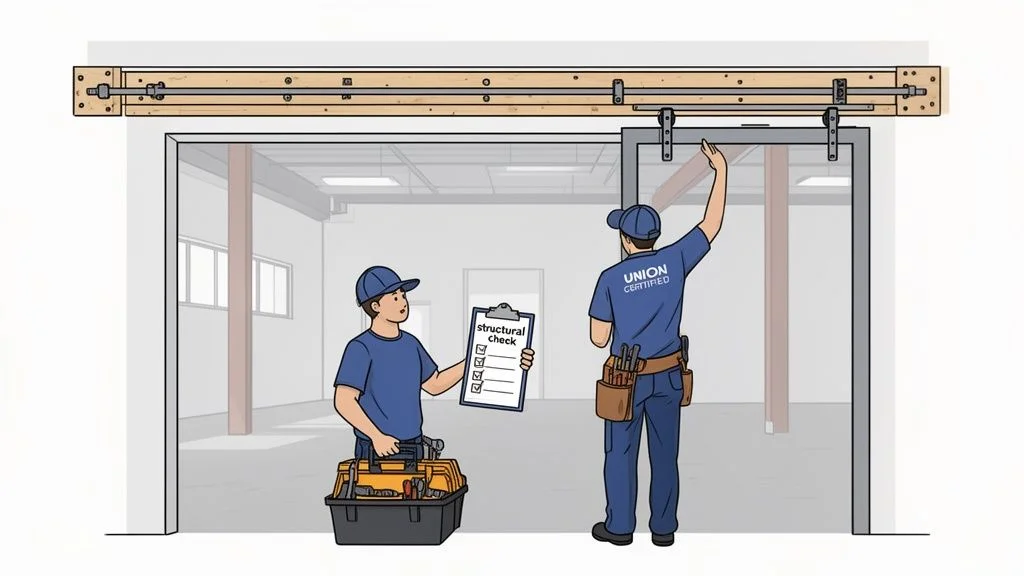
Alt text: Two construction workers performing a structural check on a newly installed commercial barn style door.
New Construction Best Practices
Integrating barn style doors into a new build is the ideal scenario. Why? Because planning is everything. You have the perfect opportunity to design the surrounding structure to support the door system perfectly from day one, avoiding the common headaches that can pop up in a retrofit.
Key Insight: Think of it this way: a sliding door system transfers its entire weight—plus the forces of movement—downward and sideways into the header and wall. If that structure isn't built to handle the load, you’re setting yourself up for sagging tracks, wall damage, and eventual door failure.
For contractors and project managers on the ground, here are the critical structural points to get right:
- Header and Wall Reinforcement: The header, which is the beam running across the top of the opening, must be strong enough to carry the full static weight of the door without any deflection. In simple terms, it can't bend at all. The wall where the track is mounted needs solid blocking inside to give the mounting brackets a rock-solid anchor point.
- Clearance and Wall Space: This one sounds simple, but it’s often overlooked. You need to ensure there is enough unobstructed wall space for the door to slide open completely. If you have a 3-metre wide door, you need 3 metres of clear, empty wall right next to it.
- Floor Levelness: A perfectly level floor is absolutely crucial. It ensures the door travels smoothly and creates a proper seal at the bottom. Any noticeable slope can cause the door to drift open or closed on its own, or create frustrating gaps.
Retrofitting an Existing Opening
Putting a modern barn style door into an existing facility can be a game-changer for workflow. We’ve seen busy warehouses reclaim huge amounts of valuable floor space just by swapping out old, cumbersome swinging doors for a sliding system. This simple change allows for tighter pallet staging and smoother traffic flow.
However, retrofits demand a thorough site assessment. You have to know what you’re getting into before you start drilling holes.
Here’s a straightforward checklist for facility managers to use when sizing up an opening for a potential retrofit:
- Assess Wall Structure: What’s the wall made of? Concrete block, steel studs, or wood frame? A professional installer needs to confirm it can take the weight or figure out what kind of additional reinforcement is required.
- Check for Obstructions: Take a good, long look at the wall where the track will go. Are there electrical conduits, plumbing pipes, fire alarm pull stations, or HVAC vents in the way? These will likely need to be relocated.
- Measure and Confirm Clearances: Get the tape measure out and double-check everything. You need that lateral wall space for the door to open, and while sliding doors have minimal headroom needs compared to overhead doors, you still need to confirm there's enough.
- Evaluate the Floor Condition: Walk the path of the door. Are there major cracks, slopes, or high spots in the concrete slab? Anything that could interfere with the door’s travel or the bottom seal needs to be noted.
Working with union-certified technicians, like the team here at Wilcox, ensures that both new installations and complex retrofits are handled correctly from the start. Our crews have the expertise to manage a professional door installation that minimizes your downtime and gets your facility’s workflow moving better than ever.
Ready to ensure your next door project is a success? Contact our experts to schedule a site assessment and professional installation quote.
Understanding Total Cost of Ownership
When you're specifying a new commercial barn door, it’s easy to focus on the upfront purchase price. But the real cost of a door isn't on the initial quote—it's in the hidden expenses that pile up over its lifetime. That’s what we call the Total Cost of Ownership (TCO).
A smart manager knows to look past the sticker price. TCO accounts for everything: the energy it uses, the maintenance it needs, the repairs it demands, and how soon you'll have to replace it. Thinking in terms of TCO is what separates a savvy investment from a purchase that will drain your budget for years to come.
Beyond the Initial Investment
A cheaper door might feel like a good deal today, but it often becomes a financial headache tomorrow. In a tough industrial environment with high-cycle demands, those less expensive components simply can't hold up. The result? More breakdowns, more repair bills, and costly interruptions to your workflow.
Think about the long-term expenses that really define a door’s value:
- Energy Efficiency: A well-insulated door with a solid R-value and tight perimeter seals is your first line of defence against high heating and cooling bills. That initial premium for better insulation is often paid back quickly through month-over-month energy savings.
- Maintenance and Repair Costs: Doors built with heavy-duty, commercial-grade hardware and durable materials just don't break down as often. That translates directly to fewer service calls and, more importantly, less disruption to your operation.
- Lifespan: A door that's properly engineered for your specific application is going to last longer. Period. Investing in quality from the start pushes the major expense of a full replacement further down the road.
The High Cost of Unplanned Downtime
What’s the real cost when a critical doorway suddenly fails? The emergency repair bill is just the beginning. For a busy warehouse or a production line that can’t stop, a non-operational door means lost productivity, backed-up shipments, and a ripple effect of financial losses.
A planned maintenance program is your best defence against expensive, unexpected downtime and emergency repairs. Proactive care costs a fraction of reactive fixes.
This is where a reliable service partner becomes a true asset. In fact, we find that for many manufacturing maintenance teams, upgrading to high-quality barn style doors can cut down repair calls by as much as 30%. It’s a number backed by our own 24/7 emergency response, which resolves 85% of issues within just four hours, getting you back online with minimal disruption. The industrial application of these doors has come a long way, and you can explore more insights from door industry experts to see how designs have evolved.
Proactive Maintenance: A Sound Strategy
A Planned Maintenance Program (PMP) is the single most effective way to protect your investment and control your Total Cost of Ownership. Regular, scheduled inspections by certified technicians catch the small problems—a worn roller, a loose bolt, a frayed seal—before they turn into catastrophic failures that shut you down.
Below is a table that clearly shows the financial difference between proactive care and waiting for a breakdown.
Planned Maintenance vs Emergency Repair Cost Comparison
This table illustrates the long-term financial benefits of a proactive maintenance strategy compared to reacting to unexpected failures, highlighting savings in downtime, repair costs, and asset life.
| Expense Category | Planned Maintenance Program | Reactive Emergency Repairs |
|---|---|---|
| Labour Costs | Scheduled, standard rates | Emergency call-out premiums, overtime pay |
| Repair Parts | Bulk pricing, standard stock | Sourcing premium for urgent parts, expedited shipping |
| Operational Downtime | Minimal, scheduled during off-hours | Unplanned, often at peak times, significant revenue loss |
| Asset Lifespan | Extended through preventative care | Shortened due to excessive wear and stress |
| Energy Costs | Optimized with regular seal/insulation checks | Increased due to failing seals and gaps |
| Overall TCO | Lower | Significantly Higher |
As you can see, the choice is clear. Investing a small amount in a PMP consistently saves you from the much larger, unpredictable costs associated with emergency repairs and operational chaos.
You can even empower your own team to perform quick visual checks between professional service visits. A simple checklist keeps everyone aware of the door's condition.
Sample In-House Maintenance Checklist:
- Track Inspection: Walk the track line. Look for dents, bends, or any debris that could stop a roller. Make sure all mounting bolts are tight.
- Roller and Hardware Check: Watch and listen as the door operates. Do you see any worn-out rollers? Hear any grinding or scraping?
- Operator and Safety Sensor Test: Run the door through a full cycle. Test the photo eyes and reversing edge to ensure all safety systems are working correctly.
- Seal and Panel Inspection: Check the seals around the door's perimeter for any cracks or gaps. Give the door panels a once-over for any impact damage that could weaken the structure or its insulation.
By making proactive maintenance a priority and working with a trusted service provider, you ensure your critical access points stay secure, operational, and cost-effective for their entire lifecycle.
Ready to lower your facility's total cost of ownership? Contact Wilcox Door Service to discuss a Planned Maintenance Program tailored for your needs.
Finding the Right Installation and Service Partner
Picking out the perfect barn style doors is really only half the battle. The partner you choose to install and service those doors is just as critical for the long-term health of your facility. A top-notch installation is your guarantee of safety and peak performance from day one, while dependable service is what protects that investment from the headaches of costly downtime.
Your facility’s access points are far too important to trust to just anyone. A truly great partner does more than just hang a door; they offer a complete support system that starts with smart advice during the planning phase and extends all the way to 24/7 emergency service. The goal isn't just to hire a vendor—it's to find a team that functions as an extension of your own, dedicated to keeping your operations flowing.
What to Look for in a Service Provider
Not all door companies are built the same. When your uptime and your team's safety are on the line, you absolutely need a partner with a proven track record. Taking the time to properly vet potential providers is the single best thing you can do to prevent future problems and ensure you get the performance you paid for.
Here are the key things to look for when you're evaluating your options:
- Deep Industry Experience: Find a company that has spent decades working in demanding commercial and industrial settings. A partner with a long history—like Wilcox, with over a century in the business—has seen and solved just about every challenge you can imagine.
- Certified and Trained Technicians: Your doors should only be touched by professionals. Ask if their technicians are union-certified, factory-trained, and current on the latest product tech and safety standards.
- A Strong Safety Record: Safety is completely non-negotiable. Any reputable provider will have a formal safety program, carry full insurance, and maintain a low incident rate. This protects your facility, your people, and your liability.
- Comprehensive Service Capabilities: Can they do it all? The best partner offers a full suite of services, from tricky installations and retrofits to planned maintenance programs and, most importantly, urgent repairs when things go wrong.
Essential Questions to Ask Potential Vendors
Once you’ve got a shortlist, it’s time to start asking the tough questions. This is where you separate the real experts from the rest. How they answer will tell you everything you need to know about their processes and their commitment to being a reliable partner.
A Key Takeaway: A vendor’s response to these questions speaks volumes. Vague answers suggest a lack of process, whereas specific, confident responses indicate a well-organized and dependable operation.
Before you even think about signing a contract, make sure to ask:
- How do you manage projects to minimize our operational downtime? A professional team will have a clear strategy for scheduling work around your peak hours to keep your business moving without interruption.
- What is your emergency response time and availability? Critical failures don't stick to a 9-to-5 schedule. You need to confirm they offer genuine 24/7 emergency service and get clear commitments on their response times.
- Can you provide documentation of your safety certifications and compliance knowledge? They should be able to immediately show you proof of their safety record and demonstrate a solid understanding of local and national building codes.
The right partner gets it. Their job isn't just about doors—it's about making sure your facility runs like a well-oiled machine. And if you're thinking about the bigger picture of facility security, our guide on planning an access control system installation is a great next step.
Your facility deserves a partner committed to excellence, from the initial handshake to the final turn of the wrench.
Frequently Asked Questions
When it comes to specifying, using, and maintaining industrial-grade barn style doors, facility managers and contractors have a lot of practical questions. We've gathered some of the most common ones here to give you the clear, straightforward answers you need to make the right decisions for your building.
How Much Wall Space Do I Need For Installation?
This is one of the first things people ask, and for good reason. For a single sliding door, you need a clear, unobstructed patch of wall that’s at least as wide as the door panel itself. Think of it this way: a 3-metre wide door needs 3 metres of open wall space right next to it so it can slide completely out of the way.
If you’re looking at bi-parting doors—where two panels meet in the middle—you'll need that space split between both sides of the opening. Each side will need to accommodate roughly half the total width of the door system.
The real game-changer with barn style doors is how little headroom they demand. Unlike overhead doors, which require a ton of vertical space for tracks and coiling systems, sliding doors are a perfect fit for areas with low ceilings or obstructions like pipes and HVAC ducting. Still, the best way to be certain is to have a professional out for a site assessment to confirm the exact spatial needs.
Can These Doors Be Automated And Integrated?
Absolutely. Modern commercial barn style doors are built from the ground up for automation and integration into a facility’s workflow. They can be fitted with heavy-duty electric operators specifically engineered for the high-cycle demands of an industrial environment.
These systems are designed to connect with a whole range of access controls, including:
- Keypads and card readers for secure, controlled entry.
- Motion sensors and in-ground loops for seamless, hands-free operation.
- Simple push-button stations or remote controls for manual activation.
Tying these systems together allows for incredibly efficient and secure traffic flow, which boosts both productivity and safety in your busiest zones. A qualified provider can put together a complete, customized system that fits your facility’s unique operational rhythm.
Are They Suitable For Exterior Use In Cold Climates?
Yes, they are—but only if you specify them correctly for the climate. For an exterior door to stand up to a Canadian winter, it absolutely must have a high R-value for top-notch insulation, robust weather seals around the entire perimeter to kill drafts, and a durable, weather-resistant finish.
The track and hardware are just as important. They must be rated for outdoor use to stop corrosion from snow, ice, and salt. For regions with severe weather, you’ll also need wind-load certified doors to ensure structural integrity and meet local building codes.
Working with an experienced local provider is key to making sure your door is built to handle the elements. Choosing the right installation team is just as vital. Knowing the 8 crucial questions to ask general contractors is an indispensable step to confidently select a team that will deliver the quality you expect.
At Wilcox Door Service, we are your Respected Partners, providing Reliable Service. Our experts are here to help you specify the perfect door system for your facility’s needs and ensure it operates safely and efficiently for years to come.
Explore our commercial door solutions or contact us today to schedule a professional consultation.