Meta description: Commercial garage opener guide for facility managers. Learn how to choose for uptime, safety, integration, and long-term lifecycle cost.
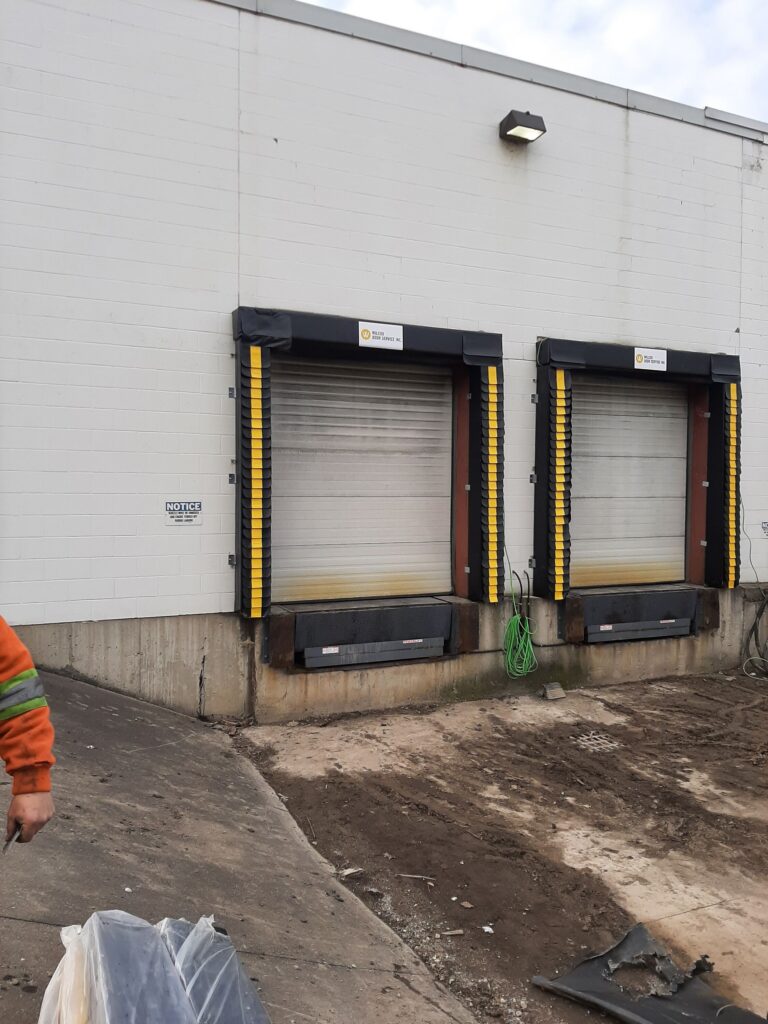
A failed door operator rarely fails at a convenient time. It fails at shift change, during a delivery window, or on the coldest morning of the month when traffic is already backed up at the dock.
That is why choosing a commercial garage opener is not a simple hardware decision. For facility managers, it is an uptime decision, a safety decision, and often a budgeting decision that has to stand up to scrutiny long after the installation crew leaves. The right unit fits the door, the power available, the traffic pattern, the safety requirements, and the way the rest of the building operates. The wrong one may still open the door for a while, but it will show its limits under load, in winter, or during the busiest part of the day.
This guide focuses on what matters in the field. Not just opener types, but the trade-offs that affect lifecycle cost, integration, compliance, and serviceability.
The Hidden Engine of Your Facility
At many sites, the overhead door gets attention only when it stops moving. By then, the opener has already become the bottleneck.
A loading bay door that hesitates, reverses unexpectedly, or stalls halfway open can disrupt truck flow, expose inventory to weather, create a security gap, and force staff into manual workarounds. In a busy warehouse or plant, that single point of failure affects much more than one opening.
The market direction reflects that reality. The global commercial garage door openers market is projected to reach USD 3.5 billion by 2033, expanding at a CAGR of 5.8%, driven by growing adoption of automated and integrated solutions for efficiency and security, according to Strategic Revenue Insights on the commercial garage door openers market.
Why the opener matters more than many budgets assume
The door panel gets most of the visual attention. The opener does the hard work. It controls lift force, start and stop behaviour, safety inputs, access commands, and often the logic that ties the door into the rest of the facility.
A properly selected commercial garage opener helps you control:
- Uptime: The unit must match real traffic, not a rough estimate.
- Safety: Sensors, entrapment protection, and fail-safe operation have to work every cycle.
- Energy performance: Door speed and control logic affect how long openings stay exposed.
- Security: Openers increasingly sit inside access control and lockdown workflows.
- Maintenance planning: A serviceable operator reduces surprises and supports predictable budgeting.
Where facilities usually go wrong
The most common mistake is buying on upfront price alone. The second is sizing from the door opening dimensions without considering cycle volume, lift type, available power, or integration requirements.
Practical takeaway: Treat the opener like a critical piece of operating equipment, not an accessory. If the door supports shipping, receiving, security, or environmental separation, the operator belongs in the same conversation as dock equipment and access control.
A modern commercial garage opener needs to fit your building as it runs. That means matching the mechanism to the door, then matching the specification to the workload.
Choosing Your Powertrain An Overview of Operator Types
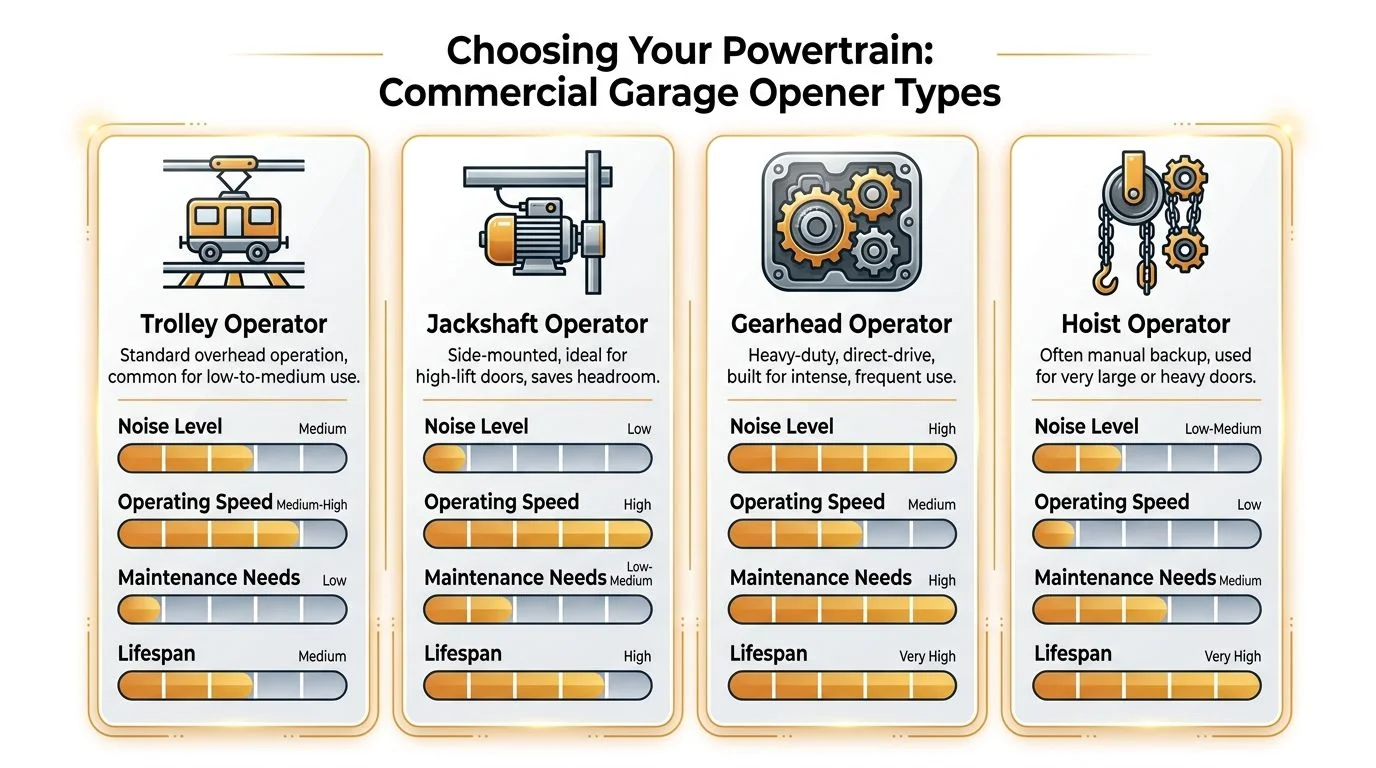
The opener mechanism determines how force reaches the door. That choice affects noise, clearance, maintenance access, and how well the unit handles repeated use.
Chain drive and trolley operators
A trolley operator pulls the door along a rail. In many facilities, that motion is driven by a chain system. Think of it as the familiar overhead arrangement adapted for commercial duty.
These units work well on standard sectional doors where ceiling space is available and the traffic level is light to moderate. They are common in service bays, smaller commercial buildings, and openings that do not run continuously through the day.
What works well
- Straightforward layout: Most maintenance teams can understand the configuration quickly.
- Proven design: Chain-driven systems remain popular because they are rugged and well suited to practical industrial use.
- Accessible parts: Service and adjustment are direct.
What does not
- More noise: Metal-on-metal operation is rarely the best choice near offices or occupied interior spaces.
- Ceiling conflict: Tracks, sprinklers, lighting, or other overhead services can make this layout awkward.
- Less ideal for unusual lift setups: High-lift and vertical-lift doors often need a different approach.
Belt drive operators
A belt drive uses a reinforced belt instead of a chain to move the trolley. The basic operating idea is similar, but the feel is different.
Belt drives make sense in places where noise matters, such as mixed-use buildings, retail back-of-house areas, institutional settings, or commercial spaces with occupied rooms nearby. They trade some rugged simplicity for quieter motion.
Best fit
- Buildings where a loud start-stop cycle will be noticed
- Doors with moderate daily use
- Sites where smoother motion matters more than raw industrial toughness
Primary consideration
- Belt systems are not usually the first recommendation for the harshest, dirtiest, highest-cycle industrial environments.
Jackshaft operators
A jackshaft operator mounts beside the door and turns the torsion shaft directly. Instead of pulling the door along a rail, it applies rotational force at the shaft.
That makes it one of the most useful commercial configurations. You preserve overhead space, simplify the ceiling area, and gain a practical option for high-lift or space-constrained openings. If your building has blocked ceiling space or you want cleaner headroom above the opening, this style deserves a close look. Wilcox has a helpful overview of jackshaft garage door opener applications.
Field note: Jackshafts often solve two problems at once. They free overhead space and reduce the amount of suspended hardware that can drift out of alignment over time.
Gearhead and hoist operators
A gearhead operator is built for heavier work. It uses a reduction system to deliver controlled torque to demanding doors and higher cycle environments.
A hoist operator is often specified for large rolling steel or industrial doors and commonly includes a hand chain for manual operation during power loss or service conditions. These are practical choices where door mass, wind load, or operating frequency exceed what a lighter unit should handle.
Use them when
- The door is large, heavy, or non-standard
- The opening serves shipping, production, or secured perimeter functions
- You need a stronger drive train and manual fallback
High-speed and specialty operators
Some facilities need more than a conventional open-close cycle. High-speed industrial systems are used where traffic flow, environmental separation, or contamination control matters. Think cold storage, clean operations, or forklift-intensive routes.
The opener here is part of a broader door system, not just a motor. Control logic, safety devices, and opening speed all matter as much as the drive mechanism itself.
Commercial garage opener type comparison
| Operator Type | Ideal Environment | Key Advantage | Primary Consideration |
|---|---|---|---|
| Trolley | Standard sectional doors in light-to-medium commercial use | Familiar layout and straightforward service | Needs overhead room |
| Chain drive | Industrial settings where ruggedness matters | Durable mechanical operation | Higher noise |
| Belt drive | Noise-sensitive commercial buildings | Quieter operation | Less suited to harsh heavy-duty use |
| Jackshaft | High-lift doors or obstructed ceilings | Saves headroom and mounts beside the opening | Requires correct shaft and door setup |
| Gearhead | Heavy, frequent-use industrial doors | Strong torque delivery | More involved specification |
| Hoist | Large rolling steel or specialty doors | Good for heavy-duty use and manual fallback | Must be matched carefully to door type |
| High-speed system | Traffic-intensive or climate-controlled spaces | Faster cycle performance and tighter control | Usually part of a broader integrated system |
Decoding Power Torque and Duty Cycle Specs
Spec sheets lose a lot of buyers because they look more complicated than they are. The important point is simple. The numbers tell you whether the opener is properly matched to the door and to the workload.
Horsepower is only part of the story
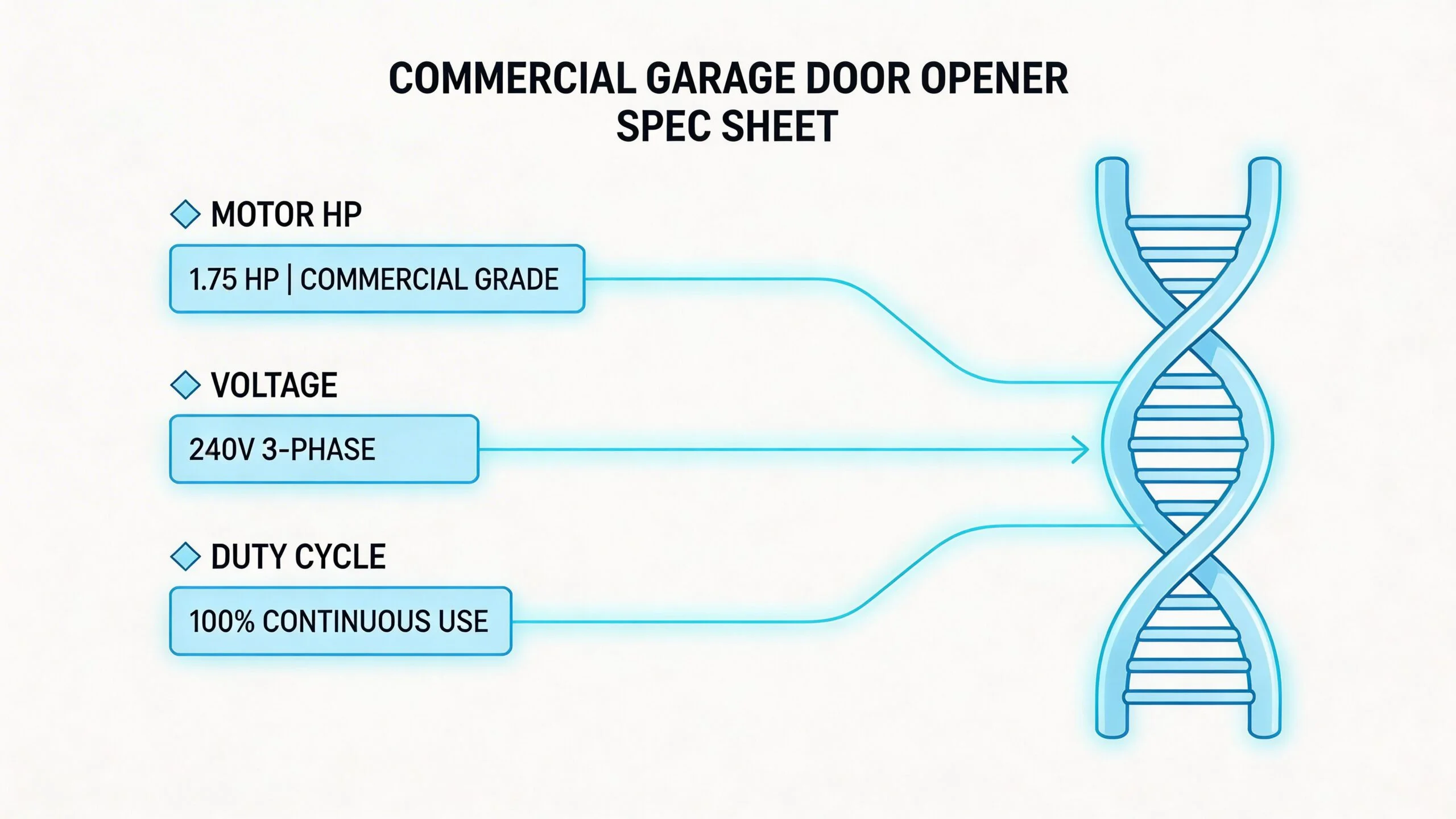
Horsepower tells you motor capacity, but it does not replace proper sizing. A bigger motor does not fix a poor match between the operator, the door balance, and the lift requirement.
In practice, the opener has to provide enough torque, which is the turning force required to move the actual door smoothly. A well-balanced sectional door may not need an oversized operator. A poorly balanced or heavy industrial door can overstress even a decent motor if the rest of the system is wrong.
Look at the whole assembly:
- Door size and construction
- Spring condition and balance
- Lift type
- Shaft setup
- Frequency of operation
Voltage and phase matter in real-world uptime
For high-traffic doors, the power supply choice is not a minor electrical detail. It directly affects heat, stress, and motor life.
For frequent-use doors in high-traffic environments, 220V or 575V three-phase power is recommended over 115V single-phase. Higher voltage reduces current draw, minimizes motor heat buildup, and can extend motor life by 2 to 3 times compared to undersized 115V setups in high-cycle applications, based on heavy-duty commercial garage opener guidance from All Security Equipment.
That matters in large facilities where doors cycle constantly and electrical runs are not short or simple. When a light-duty single-phase unit is pushed into industrial service, you often see the same pattern. Slow starts, excess heat, nuisance faults, and early failure.
Key point: If the door runs often, size the powertrain for the workload you have, not the service you happen to have nearby.
Duty cycle is the number many buyers miss
Duty cycle is the rating that tells you how often the opener can run within a given period without overheating or wearing out prematurely.
The same source notes that heavy-duty operators are rated for 90 to 300+ cycles per day, and mismatching that rating to real traffic can lead to premature failures that cost over $5,000 per incident in repairs.
That is the spec most closely tied to uptime.
A few practical examples:
- A rear service door used periodically may not need an industrial-duty operator.
- A shipping door serving constant forklift and trailer movement usually does.
- A door with short, intense peaks at shift start may need heavier duty even if the daily total seems moderate.
What to verify before approval
Ask your supplier or technician to confirm these items in writing:
- Actual cycle demand: Daily use and peak-hour use are both relevant.
- Available electrical service: Single-phase and three-phase are not interchangeable assumptions.
- Door balance and condition: A strong opener should not be used to compensate for a poorly tuned door.
- Operator class: Medium-duty and heavy-duty units are built for different realities.
If a quote focuses on motor size but says little about power supply or duty cycle, it is incomplete.
Navigating Safety Standards and Code Compliance
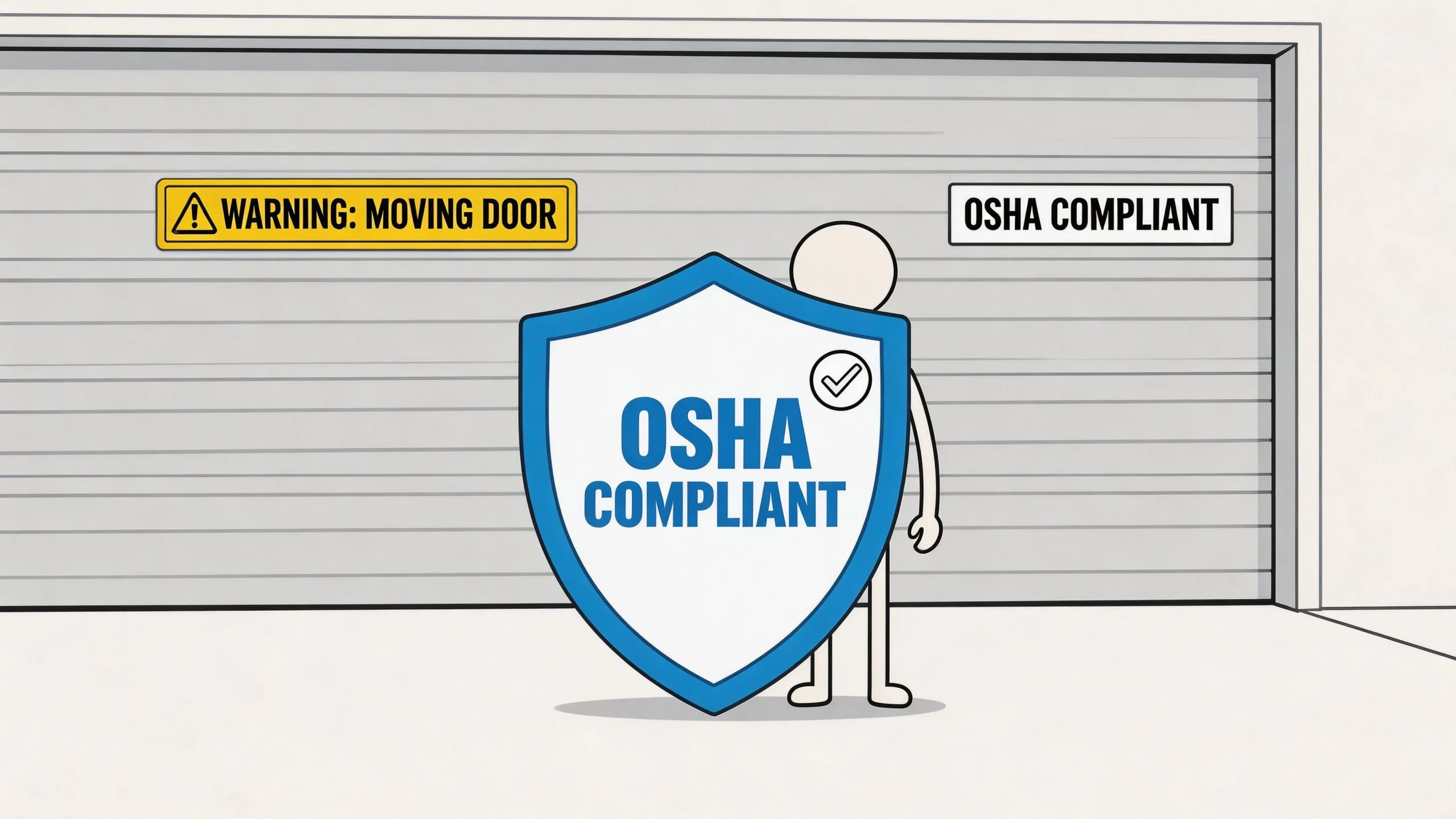
A commercial door operator controls a large moving assembly. Safety devices are not optional add-ons. They are part of the operating system.
Safety inputs must work as a system
In commercial settings, the opener has to respond correctly to monitored sensors, reversing devices, and control inputs. That includes photo-eyes, sensing edges where required, and logic that stops or reverses the door if an obstruction is detected.
If you are reviewing an existing opening, look closely at sensor condition, mounting position, wiring integrity, and whether the operator logic still matches the installed safety devices. A door can appear functional while still being out of compliance or unsafe.
For a closer look at how detection devices affect performance at the opening, Wilcox has a practical article on sensors for garage doors.
Fire doors and emergency operation need special attention
Fire-rated openings are a different category of risk. The operator has to support the door’s emergency function, not interfere with it.
That usually means reviewing:
- Drop-test requirements: The assembly must close as intended during a fire event.
- Release logic: Automatic closure functions must remain reliable.
- Manual override: Staff need a clear emergency procedure.
- Interlocks: Connected systems cannot defeat life-safety behaviour.
A rolling fire door is not the place for improvised fixes or deferred testing.
The short video below is a useful visual refresher on safe commercial door operation and site awareness.
Electrical compliance is part of operator safety
The opener may be mechanical equipment, but many failures start with poor electrical practice. Correct disconnects, wiring methods, grounding, and protection devices all affect reliability and safe service access.
Facility teams reviewing upgrades may also benefit from this explanation of the importance of AFCI and GFCI in electrical systems. It is residential in tone, but it helps clarify why fault protection matters whenever electrical equipment is installed in environments where people, moisture, and metal structures are close together.
Compliance habit that saves trouble: Ask for commissioning records, sensor testing results, and any required fire-door documentation before sign-off. If the paperwork is vague, the installation probably is too.
Integrating Openers with Your Facility Systems
At 6:45 a.m., the first truck is at the dock, the restraint is waiting for a signal, and the door will not cycle because the opener was bought as a standalone unit while the rest of the bay was specified separately. That kind of mismatch costs more than a delayed opening. It creates workarounds, service calls, and avoidable risk.
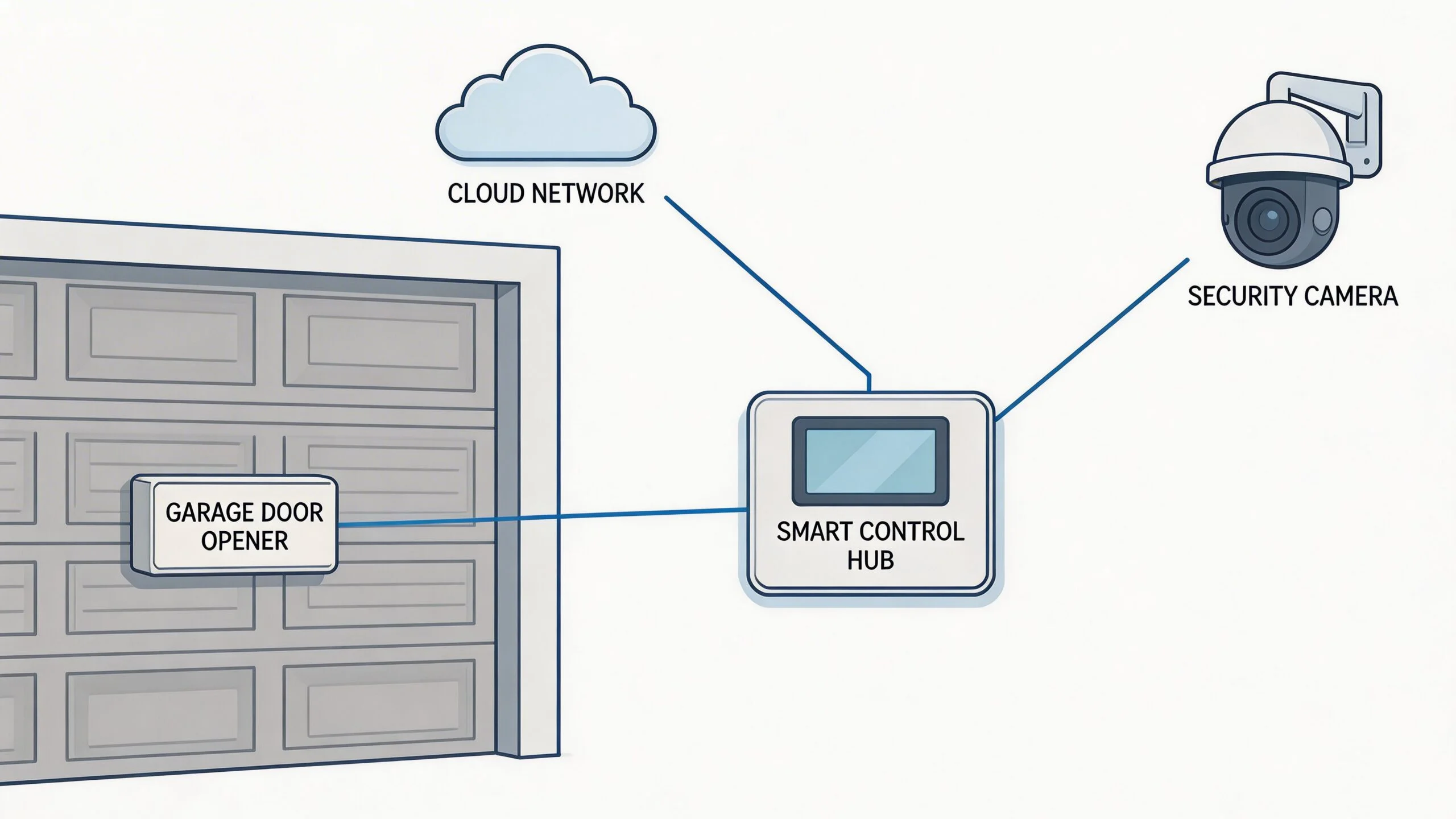
Access control is the first integration layer
For many facilities, the opener should tie into the same credential system used on pedestrian doors, gates, or restricted areas. Cards, fobs, keypads, and vehicle credentials give you tighter control than shared remotes or basic wall stations.
That changes day-to-day management in practical ways:
- Access can follow shifts, departments, or tenant permissions
- Security staff can remove credentials without collecting remotes
- Audit trails are easier to review after an incident
- Staff have fewer reasons to bypass the intended entry process
Compatibility matters here. Some operators support broader control schemes and monitored inputs better than others. The HCTDCUL, for example, is approved under UL 325 for both gate and commercial door applications, as noted by Action Industries. That kind of flexibility can reduce integration friction in sites with layered security requirements, but only if the access vendor, electrician, and door contractor agree on the control sequence early.
Dock sequencing is where integration often pays back fastest
At a loading dock, the opener is one part of a process. If it cycles independently from the restraint, leveler, traffic lights, and bay controls, the building depends on people to catch sequencing mistakes.
A better setup links those devices so the bay follows a defined order of operation. The trailer is secured first. The door opens under the right conditions. The leveler runs only when the bay is ready. That reduces nuisance faults, cuts unsafe manual overrides, and lowers the odds of damage that starts as a controls issue and ends as a downtime problem.
Building systems and security workflows
Integrated operators also fit into broader facility systems when the opening affects shipping, security, sanitation, or controlled circulation.
Useful functions often include:
- Central status visibility: Teams can confirm open, closed, or fault conditions without sending someone across the building
- Event-based response: Doors can follow approved lockdown or after-hours rules
- Alarm coordination: Forced entry, held-open conditions, or unusual activity can trigger review
- Service diagnostics: Fault history and control behavior help technicians arrive with the right parts and a shorter troubleshooting path
Not every opening needs that level of connection. A low-use service door and a high-cycle shipping door should not be specified the same way. The more expensive mistake is usually under-integrating a door that affects throughput or compliance, then paying for repeat callouts and lost time later.
What usually goes wrong in integration projects
The common failure point is scope. The opener gets selected after access control, dock equipment, and electrical design are already set, so the operator has to adapt to decisions made without the door system in mind.
The result is predictable:
- Control voltages do not align
- Input and output logic gets patched in the field
- Fire, security, and operating sequences conflict
- Responsibility for the final sequence is unclear
Better process: Write the sequence of operation before ordering hardware. Define who can open the door, what conditions must be met, which devices confirm a safe state, and how the system behaves during alarm, power loss, and manual operation.
Integration adds coordination up front. In most facilities, that extra planning lowers lifecycle cost because the door works with the building instead of fighting it.
A Selection Checklist for Facility Managers
Most buying problems start with an incomplete scope. If the request is “replace opener at door three,” you will probably get a generic answer.
A better specification starts with the opening, then works outward into operations, power, safety, and integration.
Start with the door itself
Before discussing opener brands or controls, confirm the mechanical facts.
- Door type: Sectional, rolling steel, high-lift, vertical-lift, or specialty door
- Door size and weight: The operator must match the actual load
- Current condition: Springs, tracks, shaft, and balance affect operator performance
- Mounting constraints: Ceiling congestion may rule out some operator styles
A jackshaft that fits the building well can be a poor choice if the shaft setup is wrong. A trolley may be mechanically fine but impossible once headroom and services are considered.
Match the operator to traffic, not assumptions
Traffic is often described too loosely. “Busy” is not a useful specification.
Look for patterns:
- Is the door used steadily all day or in intense bursts?
- Do forklifts queue at certain hours?
- Does the opening support shipping, staff vehicles, or security patrols?
- What happens operationally if the door is down?
A low-frequency opening can tolerate a simpler unit. A door that affects dispatch, refrigerated product flow, or secure access needs a tougher specification and a clearer service plan.
Factor in the environment
The same commercial garage opener will behave differently in a clean warehouse, a corrosive plant, and a mixed-use property.
Review the setting:
- Temperature: Cold changes lubrication behaviour and stresses weaker systems
- Moisture or washdown: Protection of controls and electrical components matters
- Dust or airborne debris: It affects wear and sensor reliability
- Noise sensitivity: Offices, retail, and institutional spaces often require quieter operation
Confirm power and controls early
This step prevents a lot of redesign.
Check:
- Available voltage and phase at the opening
- Disconnect location
- Control station needs
- Remote or supervised control requirements
- Any existing access control or BMS interface expectations
If the electrical service does not support the proper operator class, solve that before procurement, not after the unit arrives.
Put compliance on the checklist, not at the end
Do not leave safety review to commissioning day.
Include:
- Required sensors and monitored entrapment devices
- Fire-door requirements where applicable
- Manual operation needs during outage conditions
- Documentation and testing expectations
- Responsibility for sequence-of-operation approval
Procurement tip: Ask every bidder to state what assumptions they made about cycles, power, door condition, and integration. Quotes become much easier to compare when the assumptions are visible.
A complete checklist gives you a specification that supports uptime instead of just replacing a motor.
Installation and Planned Maintenance Best Practices
A commercial opener usually earns its reputation in the first few weeks after startup. If the operator is mounted on weak steel, the door is out of balance, or the limits are rushed, you do not just get nuisance issues. You get premature wear, repeat service calls, and avoidable downtime that keeps showing up on the maintenance budget.
Good installation work starts with the opening as a system, not the motor by itself. The technician needs to verify door balance, track condition, spring performance, control response, safety-device function, and full-travel behavior under load. On integrated sites, commissioning also has to confirm that the opener responds properly to access control, fire interface, or supervised controls before the opening is handed over.
Installation details that affect lifecycle cost
The expensive mistakes are often quiet at first.
- Weak mounting support: Vibration loosens hardware, affects alignment, and shortens operator life
- Poor limit setup: Aggressive stops and overtravel put extra strain on the door and drive components
- Bypassed safety circuits: Temporary troubleshooting shortcuts create compliance and liability problems later
- Exposed or poorly routed wiring: Vibration, forklifts, and washdown conditions damage controls faster than expected
- Unbalanced door conditions: The operator ends up doing the spring system's job on every cycle
For replacement projects, this guide to commercial garage door opener installation steps is a useful reference, especially for teams comparing a like-for-like swap against a full opening correction. In practice, the cheaper scope often costs more if the old door problems are left in place and transferred to the new operator.
Planned maintenance protects uptime and inspection readiness
Facility managers usually feel the cost of an opener failure in labor disruption long before they see the repair invoice. Shipping routes change. Staff start using alternate doors. Security workarounds appear. If the opening serves a critical area, one failure can create a chain of small operational losses that easily outweigh the price of a scheduled service visit.
A planned maintenance routine should cover:
- Lubrication: Use the right product at the correct wear points, based on the environment and manufacturer guidance
- Mechanical inspection: Review chains, belts, couplings, bearings, sprockets, hinges, rollers, and mounting hardware
- Safety-device testing: Test photo-eyes, monitored edges, reversal logic, and related controls during service, not only after a complaint
- Adjustment: Recheck limits, tension, alignment, and door balance as conditions drift over time
- Electrical review: Inspect terminations, enclosures, disconnects, and control stations for heat, moisture, corrosion, or impact damage
- Documentation: Record findings, corrections, and failed components so repeat issues can be tracked across sites
Service intervals should match actual use and conditions. A low-cycle opening in a clean facility does not need the same schedule as a dock door that sees constant traffic, dust, and abuse from lift equipment. That is where maintenance planning affects ROI. You spend less by inspecting the doors that fail expensively before they fail expensively.
Wilcox Door Service Inc. offers planned maintenance programs for commercial door systems and 24/7 emergency repair support. For multi-site operators, the value is not just faster response. It is standardized inspection records, more predictable service scheduling, and fewer surprise failures during operating hours.
Maintenance rule: If a door is expensive to have down for one hour, it belongs on a scheduled inspection plan.
Calculating the True ROI of Your Operator
The invoice price is the visible cost. The harder question is what the opener will cost your facility over its full service life.
That is where Total Cost of Ownership, or TCO, becomes useful. As noted by All Security Equipment on industrial garage door opener lifecycle evaluation, many buying guides skip the need for 5 to 10 year cost comparisons that include energy use, maintenance frequency, and downtime risk.
What belongs in the calculation
A realistic ROI review should include more than equipment and installation.
Consider:
- Downtime exposure: What happens operationally when the opening is unavailable
- Service frequency: How often the chosen unit is likely to need adjustment or repair
- Labour impact: Internal time spent on workarounds, escorting access, or manual operation
- Energy effect: Door speed, control behaviour, and opening duration influence building performance
- Compliance risk: Failed inspections or missing documentation cost time and money
- Replacement timing: A cheap unit that ages out early is rarely cheap
Why low price often loses over time
The lowest quote can still become the highest-cost option if the opener is under-specified, poorly integrated, or difficult to maintain. In commercial settings, failure costs spread well beyond the parts invoice.
A stronger ROI usually comes from a package that does four things well:
- Fits the actual traffic pattern
- Uses power correctly for the workload
- Integrates cleanly with the facility
- Has a maintenance path your team can sustain
That is the practical business case. A commercial garage opener is more than a motor purchase. It is a control point for access, safety, dock flow, and daily productivity.
If you need help scoping a commercial garage opener around lifecycle cost, compliance, and uptime, contact Wilcox Door Service Inc. for a site review and quote. Respected Partners, Reliable Service.