


A facility manager finds sliding door problems during routine work, not during a major security event. It might be a scuffed bottom track at a staff entrance, a loose keeper on a glazed side door near a loading area, or a pry mark that someone nearly missed during a morning walk-through.
That’s why security bars for sliding doors deserve more attention in commercial and industrial settings than they get. Sliding doors often look solid because the glass is large and the frame feels substantial. In practice, many fail at the same weak points. The latch isn’t built to resist force, the panel can rack under pressure, and the door can sometimes be lifted out if no anti-lift hardware is present.
Most online advice treats this like a home improvement problem. It isn’t. In a warehouse, plant, distribution centre, or multi-tenant commercial building, a sliding door security upgrade affects burglary resistance, emergency egress, maintenance workload, and accessibility at the same time. A bar that improves one of those areas but harms the others is not a good solution.
The right approach is straightforward. Choose hardware built for repeated use, install it correctly, pair it with anti-lift protection, and make sure the assembly still supports safe exit and barrier-free access where required. That’s the standard a new facility manager should work from.
Your Facility's Hidden Vulnerability
The problem often shows up in an ordinary moment. A supervisor opens a side entrance before shift change and notices a small bend in the screen channel, a faint scrape near the jamb, or a mark across the top rail. Nothing is broken. No alarm went off. But someone tested the opening.
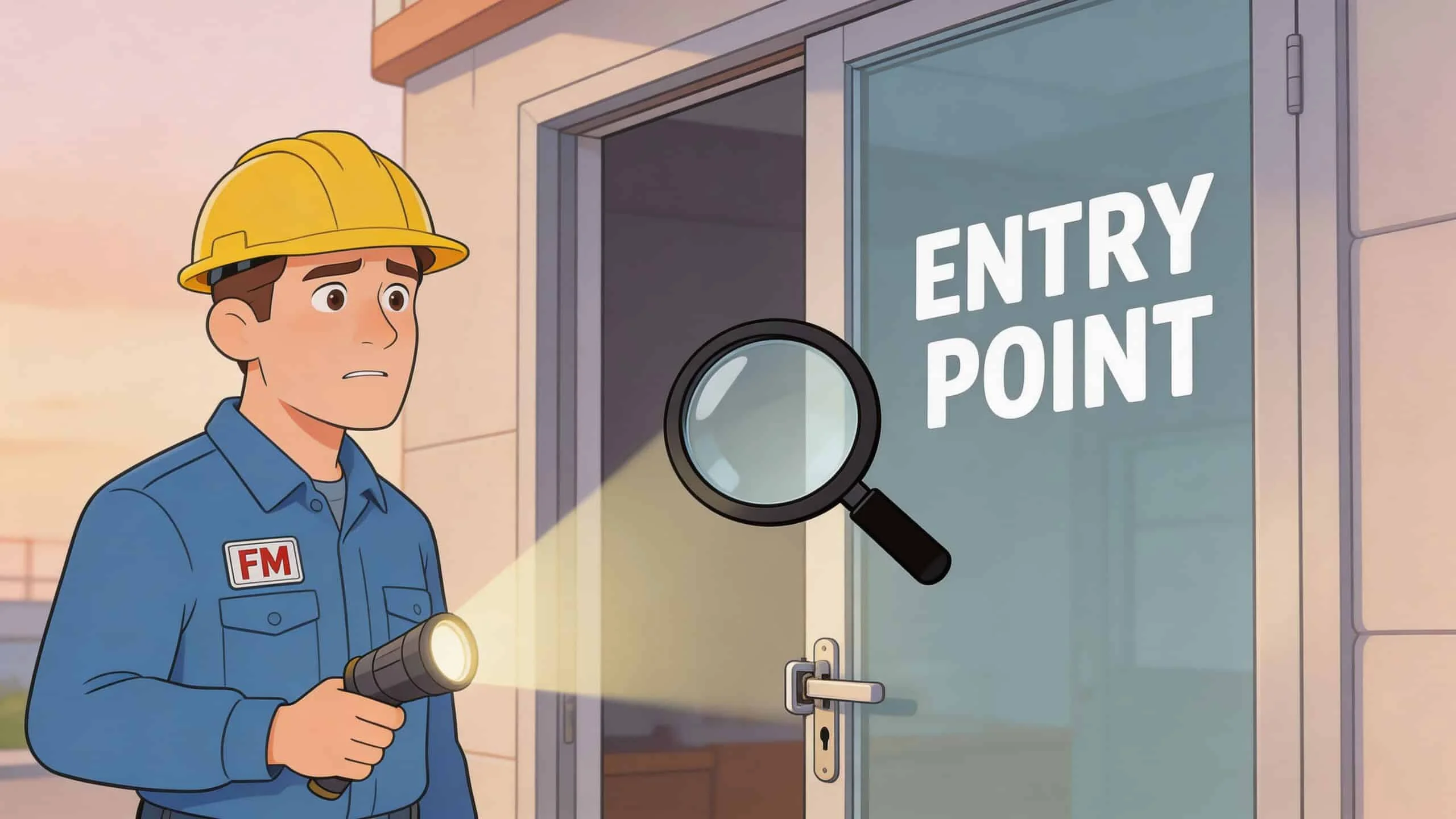
That’s what makes sliding assemblies risky. They don’t always fail dramatically. They often give an intruder a low-visibility target on the edge of the building, especially near fenced yards, smoking areas, lunchrooms, or office additions attached to industrial space.
Why sliding doors get targeted
In Toronto, approximately 6,000 break-and-enter incidents were reported in 2025, and sliding patio doors were consistently identified as one of the top two residential entry points. The same source notes that most break-ins exploit the lift-and-remove method, and that visible deterrents like security bars reduce break-in chances by over 60% (installixwnd.ca on sliding glass door security bars).
Commercial buildings aren’t identical to houses, but the mechanical weakness is similar. A standard latch mainly keeps the panel closed during normal use. It doesn’t reliably stop prying, racking, or lifting.
Practical rule: If a sliding door can be forced open by prying or lifted within its track tolerance, the latch alone isn’t security hardware.
What a near-miss usually means
When maintenance teams find pry marks, the question isn’t whether the latch held that day. The question is what happens on the next attempt, when the intruder has more time, a better tool, or a less visible moment.
A few common examples show up repeatedly in facilities:
- Staff patio-style exit at an office annex: The lock engages, but the panel has enough play to shift under pressure.
- Glazed lunchroom door facing a yard: The hardware looks intact, yet the top clearance allows lift.
- Sliding entrance near a loading dock office: Forklift vibration and repeated use loosen fasteners over time.
A security bar changes that equation because it gives the door a second line of resistance that’s visible from outside and mechanically separate from the factory latch. For most sites, that’s the starting point, not the finish line.
Understanding Security Bar Fundamentals
A security bar for a sliding door works like a deadbolt for a moving panel. Instead of relying on a small latch inside the lockset, the bar creates a physical stop that prevents the active panel from travelling far enough to open.
That sounds simple because it is. Its value comes from where the force goes. A good bar transfers force into the frame or mounting hardware instead of letting the lock take the full load.
Two jobs every bar should do
Every bar does two things when it’s properly chosen.
- Block horizontal movement: The door can’t slide past the bar, so a pry attempt has to defeat the bar assembly rather than just the latch.
- Signal resistance before contact: Intruders often look for fast entry points. A visible bar tells them this opening will take more effort and more time.
That second point matters more than many people think. A visible security measure changes behaviour before anyone touches the glass.
Good perimeter security doesn’t rely on one hidden feature. It layers visible deterrence with mechanical resistance.
The main types you’ll see
Most facility managers run into three broad categories when reviewing security bars for sliding doors.
Hinged Charlie bars
These are mounted to the frame and swing into place across the inside path of the moving panel. Many people know them as Charlie bars.
They’re common because they’re easy to understand, quick to deploy, and hard to ignore during an inspection. In low-to-moderate traffic locations, they’re often the most sensible baseline option.
Telescoping bars
These adjust in length and fit the door opening more flexibly. Some versions are designed to rest or lock between contact points, while others use more fixed mounting hardware.
They’re useful when openings vary across a property portfolio, or when the door width makes a fixed-length bar impractical. In commercial settings, the better versions matter. Light-duty residential products rarely hold up well in high-cycle use.
Floor-mounted bolts and blocking devices
These secure the panel by anchoring movement closer to the floor. On paper, they can provide strong resistance. In practice, they create more concerns in occupied commercial buildings.
The issue isn’t only security. It’s housekeeping, trip risk, wheelchair clearance, and emergency release. That’s why these devices need much more scrutiny in facilities than they get in residential buying guides.
What bars don’t do on their own
A bar stops sliding movement. It doesn’t automatically stop lifting. That distinction is where many retrofits go wrong.
If your team works on perimeter hardening more broadly, it helps to think of bars the same way you’d think about locking cables. Both are simple physical restraints, but each works only when matched to the specific attack method. A cable won’t solve every theft problem, and a bar won’t solve a lift-out vulnerability by itself.
A simple way to evaluate one
Before approving any product, ask three plain questions:
- What force is this bar resisting?
- Where does that force transfer when someone pushes or pries the panel?
- Can staff release it quickly and safely when they need to exit?
If a vendor can’t answer those clearly, keep looking.
Types and Specifications for Commercial Environments
A sliding door at a distribution office, parts counter, or staff entrance fails in different ways than a patio door at home. The opening sees more cycles, more abuse, and more pressure to stay usable during deliveries, shift changes, and emergency egress. That changes what a security bar has to do.
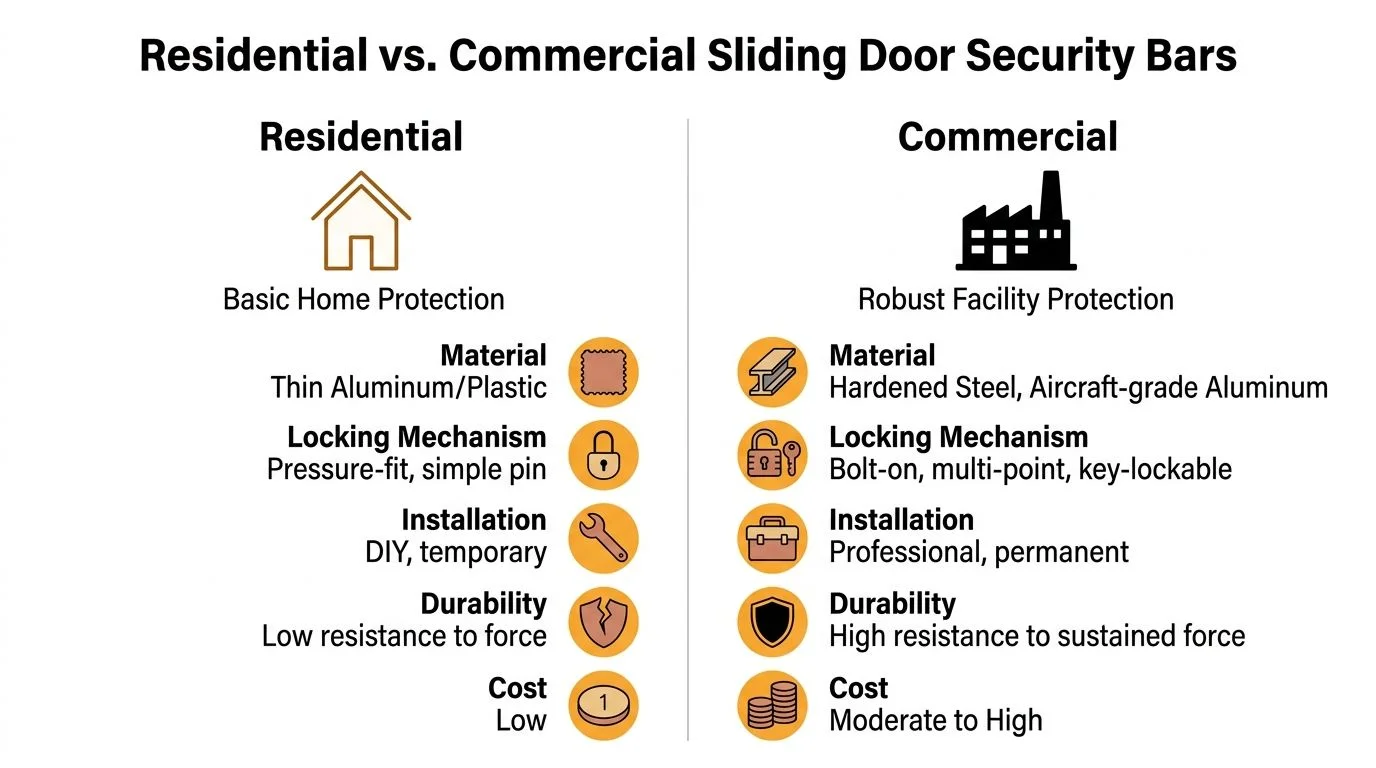
In commercial and industrial facilities, the right specification is not just about resisting force. It also has to fit the opening, hold alignment over time, and avoid creating problems with egress, cleaning, or accessible use. Residential buying advice usually stops at “will it block the panel.” Facility managers need a stricter screen.
What commercial-grade construction looks like
Commercial-grade bars commonly use 5/8-inch square extruded aluminum tubing with plated steel hinge brackets and plastic saddles. FHC USA’s S4013 product details show that kind of assembly clearly. The material mix makes sense for facilities. Aluminum keeps weight down and resists corrosion. Steel brackets handle repeated loading at the mounting point. The saddle helps keep the bar seated instead of letting the end shift out under pressure.
That balance matters in the field. A light residential bar may be easy to swing in and out of place, but it can loosen or deform after repeated use. A heavy all-steel bar can add strength, yet it may also become awkward for staff using the door several times a shift, especially in colder spaces where gloves are common.
The parts that usually decide performance
The visible bar gets the attention. The supporting components decide whether it will still work after a year of use.
- Extruded aluminum bar body: It has to stay straight when the active panel is pushed or pried.
- Plated steel hinge or support bracket: Load concentrates at this point, so weak fasteners or thin bracket stock usually fail first.
- Plastic saddle or receiver: It keeps the free end located and spreads contact pressure across the frame surface.
- Positive retention detail: On better models, the bar does not merely rest in place. It is retained so vibration, misuse, or a partial lift does not dislodge it.
I tell facility teams to inspect the receiver as closely as the bar itself. A cracked saddle, elongated screw hole, or receiver mounted slightly out of line can turn a decent product into a weak one.
Anti-lift capability matters more in facilities
Commercial openings often have more frame wear and more head movement than residential sliders. That makes lift resistance a bigger issue, not a minor feature.
Some mounted bars include a keyed or mechanically retained anti-lift feature that keeps the bar assembly from being raised out of engagement. The principle is simple. If the hardware can be lifted clear, the sliding restraint is no longer doing its job. The exact mechanism varies by manufacturer, but the specification should state how the bar remains engaged during attempted lifting, vibration, or misuse.
This is also where commercial decision-making should widen beyond security alone. If the opening is part of a required exit route, any keyed or retained feature has to be reviewed against fire code and life safety requirements. A product that improves after-hours security can still be the wrong choice if it slows occupant release or conflicts with the building’s egress strategy.
A commercial sliding door bar has to resist horizontal force, stay engaged under vertical movement, and release in a way staff can use correctly under stress.
Matching bar type to the opening
Different openings call for different hardware. Traffic level, occupancy type, staffing pattern, and code constraints all change the answer.
| Bar Type | Security Level | Installation | Best Use Case |
|---|---|---|---|
| Hinged Charlie bar | Strong for routine perimeter control when paired with lift restraint | Frame-mounted, straightforward | Staff-only openings with predictable use and trained occupants |
| Telescoping mounted bar | Strong if the locking points and receiver are well made | More fitting adjustment required | Multi-site portfolios where opening widths vary and standardization matters |
| Key-retained or anti-lift bar | Better resistance where lift-out is a known attack path | Needs careful hardware selection and policy review | After-hours openings in low-occupancy areas, subject to egress review |
| Floor-mounted blocking device | Can resist force, but often creates operational and compliance problems | Invasive retrofit work | Restricted non-public locations only, after review for trip risk, clearance, and release requirements |
Use patterns matter as much as hardware strength. A low-traffic exterior opening at a service corridor can often accept a mounted bar if the release method is simple and staff training is controlled. A public-facing sliding entrance, healthcare setting, school, or barrier-free route usually needs a different solution.
For high-visibility deterrence or wider compartment control, some facilities compare bars with other physical security options such as folding security gates. That comparison is worth making when the goal is to secure an area without adding confusion at the sliding panel itself.
Specifications worth checking before approval
Vendor sheets vary, so I focus on a short list of details that affect service life and compliance review:
- Material and finish: Aluminum, plated steel, stainless components, and corrosion resistance suitable for the environment.
- Mounting method: Surface mount, jamb mount, and fastener type matched to aluminum, hollow metal, or reinforced framing.
- Retention method: Whether the bar is only seated, mechanically captured, or protected against lift-out.
- Operating force and reach: Staff must be able to release and re-secure it without awkward bending or excessive force.
- Projection into the path of travel: A bar that sits proud of the frame can create clearance issues, especially near accessible routes.
- Labeling and procedure fit: Hardware should support clear lockup procedures, not rely on memory or improvised workarounds.
Those last points get missed often. In Canada, a device can be physically strong and still be a poor facility choice if it interferes with barrier-free travel, conflicts with CSA and AODA expectations for operability, or complicates fire-safe exit use.
What usually works, and what usually creates trouble
The better performers in commercial settings share a few traits. They mount permanently, use durable corrosion-resistant components, and give maintenance staff a clear way to inspect wear before failure shows up during an incident.
The problem products are predictable too.
- Pressure-fit bars borrowed from residential use
- Cut wood or loose pipe used as an improvised blocker
- Bars with weak receivers or undersized brackets
- Devices that require special knowledge to release
- Hardware that intrudes into an accessible route or creates a trip point near the threshold
A security bar should be treated as part of the opening system, not a cheap add-on. In a commercial building, the right specification is the one that holds up under daily use and still respects egress, fire safety, and accessibility obligations.
Installation and Retrofit Considerations
A sliding door can look serviceable at a glance and still be a weak point in the building. I see that often in older commercial spaces, especially where the opening has been adjusted, patched, or repurposed over the years. The bar gets blamed later, but the underlying problem started with the condition of the door, frame, and track.
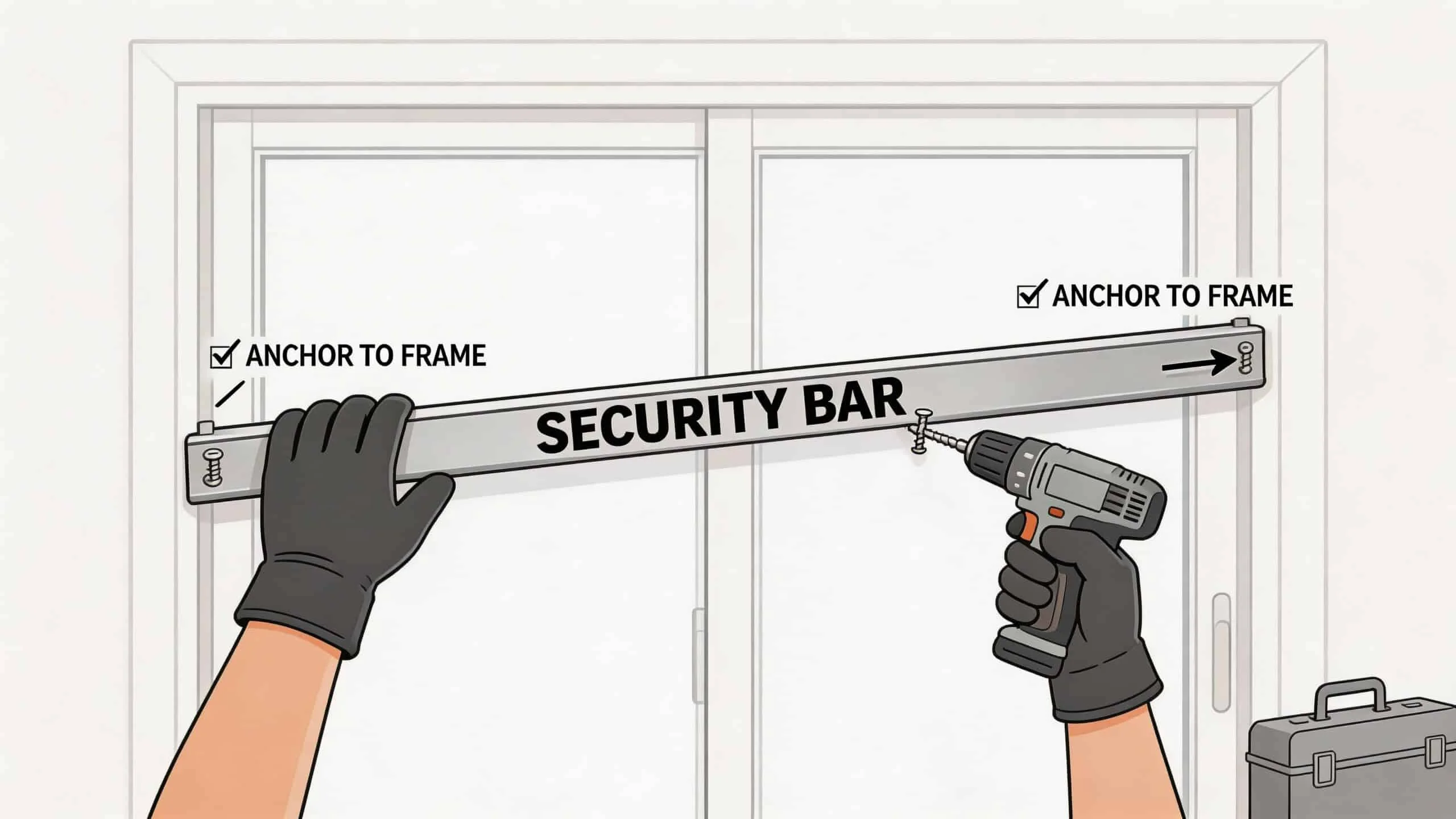
Retrofit work is where good products fail. New construction gives the project team a chance to coordinate substrate blocking, frame alignment, and hardware placement before occupancy. In an existing facility, the installer usually inherits worn rollers, uneven jambs, questionable fasteners, and limited shutdown windows.
Start with the opening, not the bar
Inspect the whole assembly before drilling anything.
Check track wear, roller condition, frame movement, glazing stop damage, reveal consistency, and how the active panel sits when fully closed. If the door racks during normal use or has too much vertical play, the bar will only mask the problem for a while.
On a staff entrance, lunchroom patio door, or shipping office slider, maintenance should confirm a few basics first:
- Track condition: Dirt, corrosion, and wear change panel alignment and can make a properly sized bar feel loose one day and over-tight the next.
- Frame material and substrate: Aluminum storefront framing, hollow metal, and mixed retrofits all hold fasteners differently.
- Top clearance: Excess lift at the head leaves room for the panel to be manipulated upward.
- Actual traffic pattern: A door used during shift changes needs a release method staff can operate consistently without delay or confusion.
Mounting geometry decides whether the hardware lasts
Receiver brackets and pivot points need full contact with the mounting surface. If the jamb is bowed, shimmed poorly, or out of square, tightening the screws can twist the bracket and preload the hardware from day one.
That kind of installation may feel solid at handover. It rarely stays that way. Repeated use works the fasteners loose, the bar stops lining up cleanly, and staff start forcing it into place.
Correct the substrate first. Then mount the hardware.
That advice matters even more on older commercial openings that have seen multiple repairs. A security bar is a load-bearing part of the opening once installed. Treating it like a light accessory is how retrofit jobs come back as service calls.
A bar does not solve lift risk by itself
Facilities often install a bar and assume the opening is secure. Sliding travel is only one part of the problem.
If the panel can still be lifted enough to reduce engagement at the track, the opening remains vulnerable. That is why retrofit planning should include the top rail condition, anti-lift features already present, and whether previous repairs changed the panel height or roller setting. As noted earlier, anti-lift performance depends on proper fit and alignment, not just the bar itself.
Installation has to fit building operations
Occupied buildings add another layer of decision-making. Noise, dust, temporary access restrictions, and staff workarounds all affect whether the upgrade succeeds in practice.
A side office entry is usually straightforward. A sliding door beside production, a vestibule tied to after-hours access, or an opening into a controlled environment needs tighter planning. If the door is already part of a larger security project, coordinate the retrofit with access control system installation planning so release procedures, credential rules, and staff instructions line up with the physical hardware.
In Canadian facilities, that coordination also helps avoid a common mistake. Security teams focus on forced-entry resistance, while operations teams focus on convenience. The result can be hardware that is strong on paper but awkward in daily use, which leads to propping, bypassing, or informal shortcuts.
Common retrofit pitfalls
The recurring failures are predictable:
- Uneven mounting surfaces: The bracket twists as fasteners are tightened, which changes the load path and shortens hardware life.
- Wrong fastener selection: Light-duty screws can feel acceptable at first, then loosen under vibration and repeated cycling.
- Poor release planning: Staff leave the bar disengaged because operating it during normal traffic is slow or awkward.
- No full-function test after installation: The bar engages, but nobody verifies panel lift, rack, clearance, and repeatable release under real use conditions.
- No allowance for cleaning and seasonal movement: Tracks collect debris, frames shift slightly, and marginal installations start binding.
A good retrofit is uneventful after commissioning. The bar engages smoothly, releases the same way every time, and stays aligned without constant adjustment. That is the standard to aim for in a commercial building.
Navigating Compliance Safety and Accessibility in Canada
A sliding door can be the weak point in your perimeter and part of your exit strategy at the same time. In commercial and industrial buildings, that combination is where poor hardware choices create true exposure.
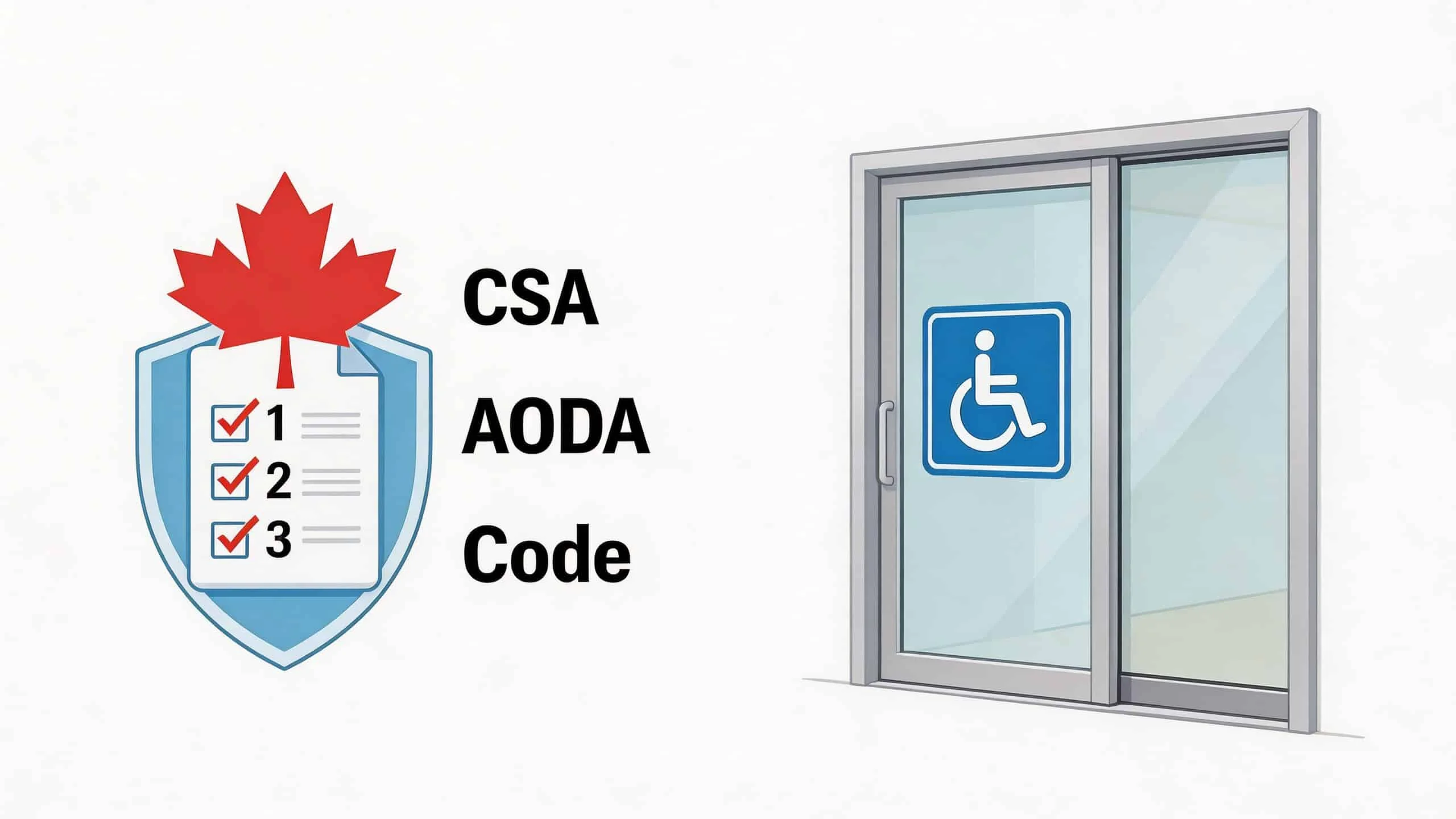
Residential advice usually stops at intrusion resistance. A facility manager has a wider job. The opening may serve staff, visitors, cleaners, delivery teams, and emergency responders. It may also sit on an accessible path of travel or near an area with higher occupant loads. That changes the selection criteria immediately.
Egress requirements set the baseline
If a sliding door is part of an exit route, security hardware cannot interfere with prompt release. That is the first screening question, not the last one.
In practice, the problem is often less dramatic than a locked door and more common. The bar is mounted too low, the release point is awkward, the hardware needs two hands, or staff need informal training to explain how it works. Any of those conditions can slow evacuation and create a compliance issue during an inspection or after an incident.
For Canadian facilities, review the opening against the applicable building and fire code requirements for egress, plus the site’s actual occupancy and use. Warehouses, mixed-use commercial units, schools, and multi-tenant buildings all create different risk profiles. The right question is simple. Can an occupant release this opening quickly, predictably, and without special knowledge?
Accessibility has to be checked at the same time
Barrier-free access is where many sliding door bar retrofits go off track. A floor-mounted bar or receiver may look minor on a drawing, but at the opening it can interfere with wheelchairs, carts, walkers, cleaning equipment, and pallet traffic. It can also introduce a trip point at the threshold.
That matters under accessibility expectations such as AODA in Ontario and CSA B651 guidance for accessible design. In facilities work, I see this missed most often when the security decision is made in isolation. The hardware may resist forced entry well, yet still create an obstacle that should never have been introduced on an accessible route.
Good practice is to assess the full user path, not only the door leaf. Check reach range, clear width, floor projection, operating force, visibility of the release point, and whether a person with limited dexterity can use it reliably.
Common compliance failures with sliding door bars
The pattern is usually predictable:
- A security bar is added to a door that serves a required exit path
- The release method is not obvious to new staff or contractors
- Floor hardware intrudes into a barrier-free route
- Night security procedures conflict with daytime occupancy needs
- No one documents who is allowed to engage the bar and when
- The facility treats the opening as a security item instead of a life-safety item
Those problems are avoidable if security, operations, and health and safety review the same opening together.
Choose hardware that matches the opening's role
Some sliding doors are suitable for a manual security bar. Some are not. If the opening has frequent traffic, accessibility sensitivity, or egress complexity, a different hardware approach may be the better fit.
That is one reason teams sometimes compare manual bars to controlled locking methods that tie into access control and fire alarm release. In those cases, it helps to understand how a door magnetic lock system works in commercial openings before committing to a purely mechanical retrofit.
The point is not to specify electrified hardware by default. It is to choose a setup that matches the occupancy, the code obligations, and the way the door is used every day.
A practical review standard for facility managers
Before approving a sliding door bar, ask five direct questions:
- Is this opening part of an expected or required means of egress?
- Can all expected users operate the release without coaching or unusual force?
- Does any component project into the accessible route or threshold area?
- Will after-hours security procedures stay consistent with fire safety requirements?
- Has this opening been added to the site's inspection process and commercial building maintenance checklist?
That last point matters more than many teams expect. Compliance problems often appear months after installation, once traffic patterns change, floor conditions shift, or staff start bypassing hardware that is technically installed correctly but impractical in daily use.
A sliding door bar should improve security without creating a fire, access, or liability problem. In Canadian commercial settings, that is the standard.
Effective Maintenance and Lifecycle Management
Security hardware fails before it fails visibly. That’s why bars on sliding doors belong in the maintenance routine, not only in the security file.
A good inspection process doesn’t have to be complicated. It needs to be consistent and tied to the actual conditions of the opening.
A practical inspection routine
Add sliding door bars to the same cadence you use for other perimeter checks. If your team already works from a broader commercial building maintenance checklist, fold these items into that process so the hardware gets reviewed as part of normal building care.
Check these points during routine rounds:
- Bracket stability: Put a hand on the mounting point and test for movement, looseness, or pull-out.
- Bar alignment: Close and engage the bar. It should seat cleanly without forcing.
- Receiver condition: Look for cracked saddles, worn contact areas, or distortion.
- Corrosion and contamination: Moisture, cleaners, dust, and debris all shorten service life.
- Release function: Staff should be able to disengage the hardware smoothly every time.
Signs the bar is nearing replacement
Most bars don’t need replacement because they look old. They need replacement because they stop behaving predictably.
Watch for these warning signs:
- The bar no longer sits square in the receiver
- Fasteners repeatedly loosen after re-tightening
- Plastic components show cracking or deformation
- The assembly binds because the frame or bracket has shifted
- Staff avoid using it because operation feels awkward
If people stop using a security device because it’s annoying, the device has already lost part of its value.
Treat it like an asset, not an accessory
That mindset changes decisions. When teams treat a bar as a disposable add-on, inspections get skipped and replacements get delayed. When they treat it as a working security asset, they budget for periodic review, hardware renewal, and adjustments after door service.
That approach also extends the life of the opening itself. Misaligned bars often signal broader door problems that deserve attention before they become a larger repair.
Calculating ROI and When to Call a Professional
A facility manager usually sees the true cost of a weak sliding door after an incident. A rear patio entrance at a staff area gets forced overnight. Shipping is delayed the next morning. The temporary repair blocks normal access. Then someone asks whether the added security hardware now interferes with egress or wheelchair clearance. That is how a low-cost hardware decision turns into a security, operations, and compliance problem at the same time.
Return on investment is broader than the purchase price of the bar. In commercial and industrial settings, the payback often comes from avoided break-ins, fewer service calls, less damage to the opening, and fewer corrective retrofits after a code or accessibility review. In Canada, those downstream costs matter because a security device that conflicts with exit requirements or barrier-free use can trigger another round of labour, hardware, and documentation.
The best value usually comes from getting four things right at the start: the threat level, the door type, the occupancy risk, and the code context for that opening.
Where the value comes from
A properly specified bar protects the opening and reduces secondary costs that facility teams often miss during purchasing.
It can lower:
- Unplanned downtime when a vulnerable side or rear entrance is put out of service
- Repeat maintenance labour caused by loose brackets, poor fastener selection, or improvised field fixes
- Retrofit expense when a device has to be removed because it affects egress, clearance, or accessible operation
- Loss exposure at low-visibility openings such as shipping offices, enclosed patios, amenity spaces, and after-hours staff entries
For multi-site operators, standardisation has its own return. One approved hardware approach, installed with the same review process across locations, is easier to inspect, train on, and budget for than a patchwork of site-level fixes.
DIY has a narrow place
An in-house team can handle some installs. I would limit that to low-risk openings that are not on an exit route, not used by the public, and not part of an accessibility path. The frame also needs to be in good condition, with a clear mounting surface and no unresolved alignment problems.
Commercial applications get more complicated fast. Frequent traffic, mixed users, aluminum storefront framing, hollow metal adaptations, and sliding systems with limited mounting depth all change what will work safely. Add AODA expectations, CSA accessibility considerations, and local fire code obligations, and the job stops being a simple hardware swap.
Floor-mounted and low-profile devices deserve extra scrutiny in public-facing spaces. Even when they improve forced-entry resistance, they can create clearance issues, trip concerns, cleaning problems, or wheelchair interference if the opening was not reviewed properly beforehand. Residential buying guides often miss that point because they are written for homes, not for facilities with staff circulation, visitors, inspectors, and formal life-safety obligations.
When professional help is the right call
Bring in a qualified commercial door and hardware specialist when any of these conditions apply:
- The sliding door is on or near an exit path
- The opening serves the public, tenants, or mobility device users
- The frame is out of square, deteriorated, or made of mixed materials
- You need anti-lift, glazing protection, or lock reinforcement in addition to a bar
- The site is subject to formal accessibility review or insurer requirements
- You are creating a standard for several facilities, not solving one isolated opening
At that point, the decision affects security performance, fire safety, accessibility, and long-term maintenance. A good installer does more than fasten hardware to a frame. They check whether the product suits the door, whether the mounting will hold under load, whether staff can release it quickly, and whether the finished opening still works as required by the building's use.
If you need help evaluating security bars for sliding doors in a warehouse, plant, commercial property, or multi-site portfolio, contact Wilcox Door Service Inc.. Their team can assess the opening, identify code and accessibility concerns, and recommend a compliant solution that supports the brand promise of Respected Partners, Reliable Service.