


When securing your facility, your first line of defense isn't at the building's entrance—it's at the edge of your property. This guide will teach you how to choose, install, and maintain the right security barrier gate to control vehicle access and protect your assets. We'll demystify the different types, from simple boom arms to high-security bollards, and show you how to integrate them into a smart, reliable security plan for your commercial or industrial site.
A security barrier gate is more than just a physical arm across a roadway; it's the gatekeeper of your property, controlling traffic flow and deciding who gets in. It acts as the physical enforcement for your site's security rules.
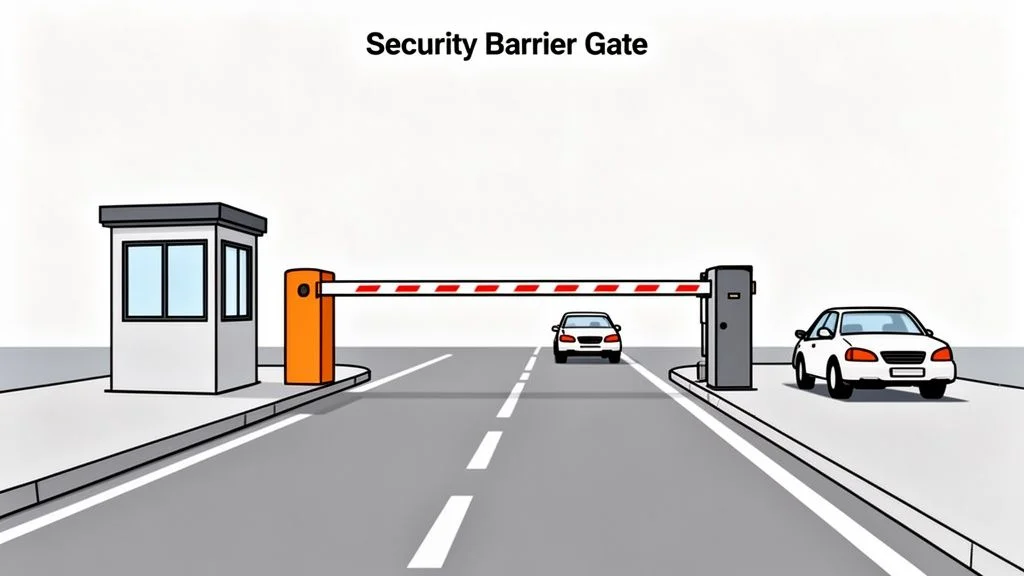
alt="Illustration of a security barrier gate system with a guard booth and two cars controlling traffic flow on a road leading to a facility. Wilcox Door Service provides expert installation."
What Is a Barrier Gate’s Real Job?
At its core, a security barrier gate is the physical muscle behind your site's security rules. It’s a crucial part of a complete access control system, which acts as the 'brain' making the decisions. The gate is what actually enforces them.
These systems are absolutely vital in Canada's commercial and industrial sectors. Think about a busy distribution centre or a manufacturing plant—uninterrupted vehicle flow is directly tied to uptime and profitability. It's no surprise that North America, with Canada as a major player, accounted for over 35% of the global market share in 2023 for an industry valued at USD 1.3 billion. For facility managers, the right gate can slash unauthorized entries by up to 70%.
Why Your Facility Needs a Clear Access Strategy
Putting a solid barrier gate strategy in place does more than just stop the wrong vehicles. It delivers tangible benefits across your entire operation.
A well-planned system helps you:
- Tame Traffic: You can direct vehicles smoothly through entry and exit points, which is crucial for preventing bottlenecks at your loading docks or in your parking areas. A real-world example is a logistics facility where timed entries for trucks prevent congestion on public roads and keep the supply chain moving.
- Fortify Your Perimeter: It creates a clear, controlled boundary. This alone can deter opportunistic threats and provides a strong first layer of defence.
- Boost Operational Uptime: By automating entry for approved trucks and staff, you cut down on manual checks, reduce waiting times, and keep your operations moving.
Whether you're planning a new build or looking to upgrade your current site, the first step is understanding the different types of commercial gates available. Here at Wilcox Door Service, we know a thoughtfully chosen system is more than just a piece of hardware—it's a powerful asset. It protects your property, streamlines your operations, and reinforces your commitment to safety.
Breaking Down the Different Types of Security Barrier Gates
Choosing the right security barrier gate starts with knowing what you’re trying to achieve. Not every gate is built for the same job; some are designed to simply manage traffic, while others are engineered to stop a high-speed vehicle cold.
It’s a bit like choosing a lock. You wouldn't use a simple privacy lock on your main entrance; you’d want a heavy-duty deadbolt. In the same way, the gate you need depends entirely on the level of security and traffic flow your site demands. Let's look at the workhorses of access control, from the familiar boom arm to fortress-like high-security barriers.
Boom or Rising-Arm Barriers
The most common gate you'll see is the boom barrier, often called a rising-arm gate. Think of it as a traffic controller for a commercial property. Its main job isn’t to be an unbreakable wall, but to create an orderly, one-at-a-time flow of vehicles.
These gates are all about speed and high volume. With quick opening and closing cycles, they are perfect for places with heavy vehicle traffic where the main goal is management, not stopping a determined intruder.
- Real-World Example: At a busy distribution centre, boom barriers at employee entrances allow for fast entry and exit during shift changes. This prevents long queues from spilling onto public roads and keeps loading dock operations moving—a critical factor for efficiency. You’ll also find them managing access in paid parking lots and at the entrances to large corporate campuses.
Heavy-Duty Sliding Gates
When you need to secure your entire perimeter, a heavy-duty sliding gate acts like a movable section of your fence. Unlike a boom arm that just blocks a single lane, a sliding gate seals the entire roadway opening, often spanning 12 metres or more.
These gates are built for raw strength and deterrence. They move horizontally on a track, creating a formidable physical barrier. While they operate slower than a boom arm, their strength makes them the standard for securing industrial yards, manufacturing plants, and any site where stopping unauthorized vehicles is a top priority. A properly specified sliding gate operator is vital for ensuring they perform reliably day in and day out.
A sliding gate sends a clear, unmistakable message: this perimeter is secure. It's the difference between suggesting a vehicle stop and commanding it to stop.
High-Security Barriers: Wedge and Bollard Systems
When security is absolute and stopping a vehicle attack is the primary goal, you need a barrier engineered for pure, brute-force impact. This is where high-security solutions like wedge barriers and bollards come into play.
Think of these systems as the immovable objects of the security world. They are crash-rated, meaning they have been physically tested and certified to stop a specific vehicle weight travelling at a specific speed.
- Wedge Barriers: These are heavy-duty steel plates that rise up from the roadway, creating a powerful, angled ramp. They are designed to absorb and redirect the kinetic energy of an impacting vehicle, stopping it dead in its tracks. You'll see them guarding government facilities, data centres, and airports.
- Security Bollards: These robust vertical posts can be fixed in place, removable, or fully retractable. When retractable, they rise from the ground to block access and disappear completely when a vehicle is cleared. They deliver an incredibly high level of security while maintaining a more open, aesthetic look when lowered, making them a popular choice for public-facing buildings.
To help you visualize these options, here’s a quick comparison of the most common gate types and where they fit best.
Security Barrier Gate Types at a Glance
| Gate Type | Primary Use Case | Security Level | Ideal Environment |
|---|---|---|---|
| Boom/Rising-Arm Barrier | Traffic management, access control | Low | High-traffic areas like parking lots, corporate campuses, and employee entrances. |
| Heavy-Duty Sliding Gate | Perimeter security, access denial | Medium to High | Industrial yards, manufacturing plants, and facilities with valuable assets. |
| Wedge Barrier | Anti-ram protection, high security | Very High (Crash-Rated) | Government buildings, critical infrastructure, data centres, and embassies. |
| Retractable Bollards | High security with aesthetic flexibility | Very High (Crash-Rated) | Public-facing high-security sites, government buildings, and pedestrian-heavy areas. |
| Tire Killers/Spike Strips | One-way traffic enforcement | Deterrent | Exit-only lanes, rental car facilities, and border crossings. |
Each of these gate types serves a distinct purpose, from guiding traffic to providing certified anti-ram protection.
Specialized Gates: Tire Killers
Sometimes, the mission isn’t just to block access but to enforce one-way traffic with serious consequences for anyone who breaks the rules. Tire killers (also known as spike strips) do exactly that.
Their saw-toothed spikes lie flat for approved traffic but are designed to shred the tires of any vehicle trying to enter or exit from the wrong direction.
They are an aggressive deterrent, almost exclusively used for enforcing traffic direction at high-security exit lanes, car rental returns, and border crossings. Because of their destructive nature, they must be used with very clear signage as part of a comprehensive security strategy. To see how these specialized gates fit into a broader plan, explore Wilcox’s full range of commercial doors and gate systems.
How to Choose the Right Security Gate
Choosing the right security barrier gate is a critical investment in your facility's safety and efficiency. To get it right, you have to look past the gate itself and really dig into your site's specific operational needs. It's a lot like putting together a puzzle—every piece has to fit perfectly for the final picture to make sense.
Think of it as a practical checklist. By walking through each key decision point, you can ensure the system you end up with performs exactly how you need it to, without any costly surprises down the road. Let's break down the factors you need to consider.
Analyze Your Throughput and Vehicle Types
First up, throughput. In simple terms, this is the number of vehicles that need to get through your gate during a specific period, like your morning rush hour. A slow gate at a high-traffic distribution centre is a recipe for disaster. It can create a frustrating and expensive bottleneck, just like a single slow cashier at a packed supermarket. Your gate’s opening and closing speed has to match the pace of your business.
Next, think about the vehicle types that come and go. A gate system designed for a staff parking lot full of cars has totally different demands than one at a loading dock that sees large transport trucks all day. The width, height, and even weight of these vehicles directly influence the gate's design, from the opening width to its overall physical strength.
A gate that’s too narrow for your biggest delivery truck is basically useless. At the same time, a light-duty arm just won't hold up in a tough industrial environment. Matching the gate to the vehicle is a fundamental first step.
This decision tree infographic shows how facility type influences the choice between a boom arm for low traffic and a more robust solution for high-security needs.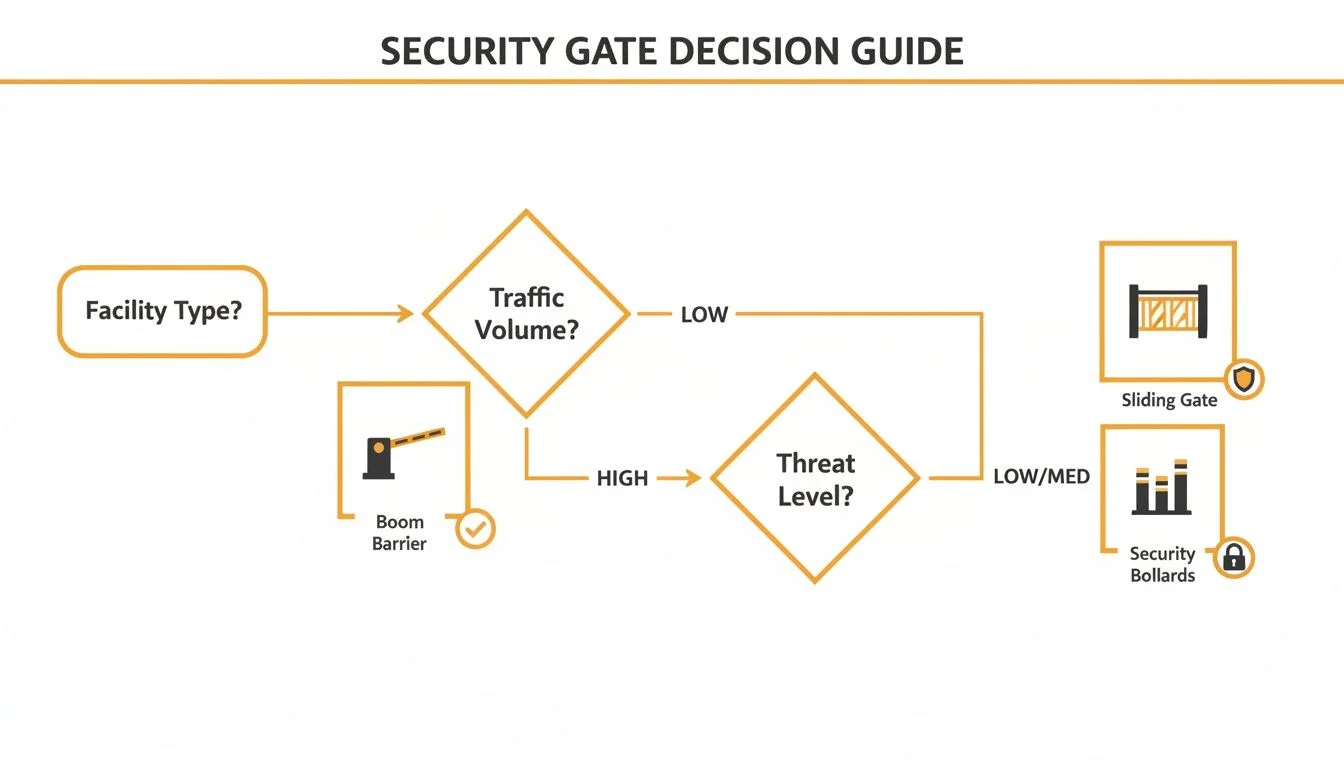
alt="A decision-guide flowchart for selecting a security barrier gate based on facility needs, from low-security boom barriers to high-security bollards, emphasizing the importance of site assessment."
As you can see, your first move—assessing your site’s security level and traffic volume—is the most critical factor in narrowing down the best options for your property.
Decode Crash Ratings and System Integration
For facilities that need a higher level of protection, you can't ignore crash ratings. These ratings, like the common "K-ratings," aren't just technical jargon. Think of them as an insurance policy against a vehicle ramming your gate. They certify that a gate can physically stop a vehicle of a specific weight moving at a specific speed.
Do you need a gate that just directs traffic, or one that can physically stop a hostile vehicle? Answering this question honestly is crucial for protecting your people and assets.
The role of security gates in Canada has evolved, especially in property management where they contribute to compliance and cost savings. With the North American market set for an 8.5% CAGR and Canada seeing a 28% increase in barrier installations between 2021 and 2024, the demand for truly robust solutions is undeniable.
Facilities retrofitting their sites to align with the 2020 National Building Code's anti-ram requirements have seen 15% lower insurance premiums, averaging CAD 200,000 in annual savings for large properties. For example, hydraulic wedge gates with a K12 rating can stop a 15,000 kg vehicle travelling at 80 km/h, which shows you the serious stopping power we're talking about.
Beyond the gate itself, you need to plan for its integration with your existing security infrastructure. Your security gate shouldn't operate on an island. For it to be truly effective, it has to communicate seamlessly with your other security tools.
This includes:
- Access Control: Connecting to card readers, RFID tags, or keypads to automate entry for authorized personnel.
- Video Surveillance: Triggering cameras to record activity whenever a gate is used.
- Intercom Systems: Allowing communication between drivers and your security staff.
Beyond these basics, understanding how gates tie into sophisticated commercial access control systems is the key to unlocking advanced protection. You can learn more about how all these elements work together in our guide on top commercial security gate solutions.
Evaluate Site and Environmental Constraints
Finally, don't overlook the physical realities of your location. A gate that works flawlessly in a dry, temperate climate could easily fail during a harsh Canadian winter if it isn't properly weatherproofed.
Here are the key site constraints to evaluate:
- Weather: Will the gate need to operate reliably through heavy snow, ice, and extreme cold? This will affect your choice of motor and whether you need built-in heaters.
- Power Availability: Is there a reliable power source nearby? If not, you'll need to factor in the cost of running new electrical lines.
- Physical Space: Is there enough room for a sliding gate to retract fully or for a swing gate to open without hitting anything?
- Ground Conditions: The soil and subsurface have to be suitable for the concrete footings needed to properly support the gate and its operator.
Taking the time to plan for these site-specific details will ensure your chosen gate is not only secure but also practical for years of reliable service.
Installation and Integration Best Practices
You can invest in the most advanced security barrier gate on the market, but its reliability comes down to one thing: the quality of its installation. A proper setup isn't just about bolting the equipment to the ground. It’s about creating a solid foundation that guarantees long-term performance, safety, and function. Getting this stage right is the single most important factor in seeing a real return on your investment.
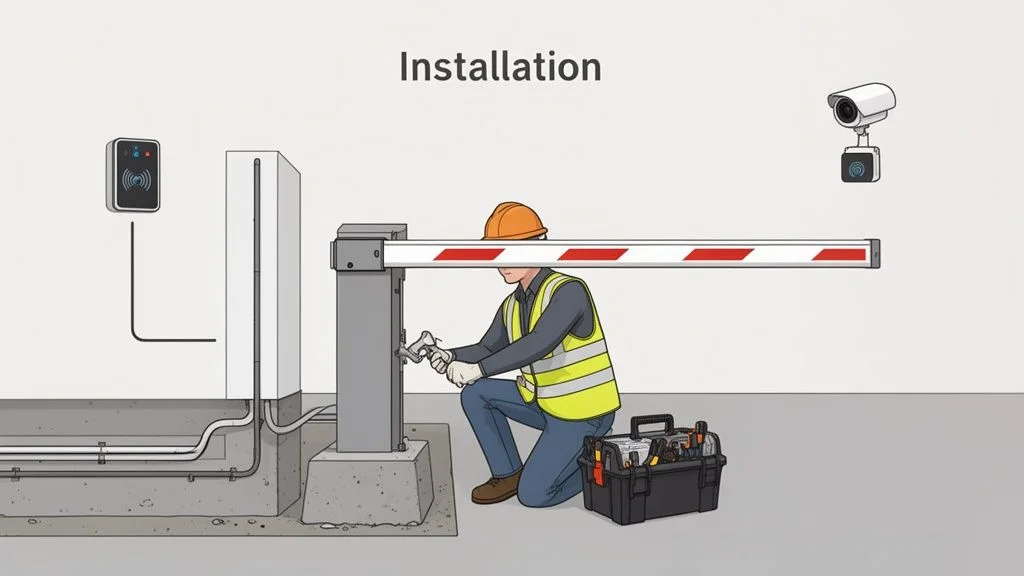
alt="Professional technician installing a security barrier gate, integrating a card reader and CCTV camera. Wilcox Door Service ensures proper installation for maximum reliability."
The work starts long before the gate even arrives on your property. Proper site preparation is a non-negotiable first step, involving detailed groundwork that creates a stable and safe environment for the system to operate in, no matter the weather or how heavily it's used.
Preparing the Ground for Success
A successful installation comes down to three core site preparation tasks. If you rush or cut corners on any of these, you're setting yourself up for premature failure, expensive repairs, and serious safety hazards down the road.
Pouring Correct Concrete Footings: The footing is the anchor for your entire system. It must be engineered to support the gate's weight and operator, while also handling the dynamic forces of constant movement. Here in Canada, that means digging below the frost line to prevent heaving that can knock the whole system out of alignment.
Running Electrical Conduits: All power and communication wiring needs to be run through buried conduits. This is crucial for protecting sensitive electrical components from moisture, accidental damage during landscaping or snow removal, and general wear and tear.
Ensuring Proper Drainage: Water is the enemy of any electromechanical system. The installation area must be graded so that water flows away from the operator and electrical housings. Poor drainage can lead to short circuits, corrosion, and total system failure, especially during spring thaws or heavy rains.
The Importance of Professional Installation
While the DIY route might look like a way to save a few dollars, installing a commercial security barrier gate is a complex job that demands professional expertise. Using union-certified technicians isn't just a best practice—it's essential for safety, compliance, and protecting your investment.
Professional installation is your assurance that every component, from the mechanical arms to the safety sensors, is installed to meet stringent safety codes and manufacturer specifications. This is crucial for preserving your warranty and limiting liability.
A professional team understands the nuances of integrating a gate operator correctly, ensuring it communicates perfectly with its safety devices and access controls. This is where Wilcox’s commitment to “Respected Partners, Reliable Service” truly shines, as our technicians ensure your system is dependable from the moment it's switched on.
Integrating Your Gate into a Security Ecosystem
A standalone barrier is just a physical object. A fully integrated barrier, on the other hand, becomes an intelligent part of your security infrastructure. Integration is how we connect your gate to a wider network of security tools, creating a unified system that improves control and gives you valuable data.
Think about how this works in the real world:
Warehouse Logistics: An RFID reader automatically identifies an incoming delivery truck, opens the gate, and simultaneously logs the arrival time in your system—all without the driver ever needing to stop. This makes loading dock operations smoother and more efficient.
Pharmaceutical Plant: A vehicle attempting a forced entry at a high-security gate triggers an instant alert at your central security station. At the same time, nearby cameras are automatically activated to record the event, providing critical information for a rapid response.
This level of integration transforms your security barrier gate from a simple checkpoint into a proactive part of your facility’s security strategy. To explore how these systems can be tailored for your site, our team can help you design a complete access control solution.
Essential Maintenance for Maximum Uptime
Your security barrier gate is a machine in constant motion. Just like any commercial vehicle in your fleet, it needs regular attention to perform reliably, day in and day out. Neglecting it is just asking for unexpected downtime, expensive emergency repair calls, and serious safety risks that could affect your team and your property.
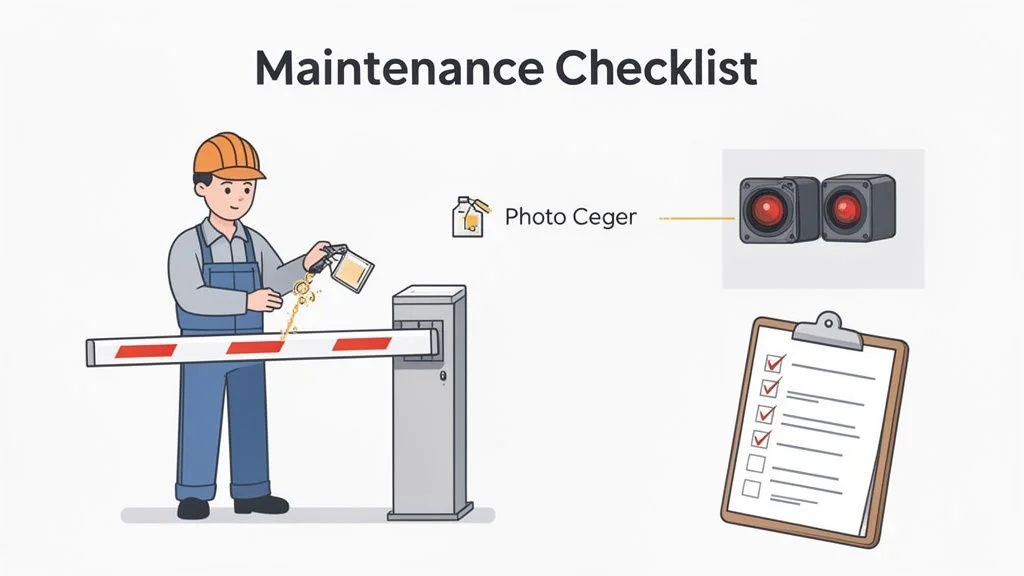
alt="A technician performs planned maintenance on a security barrier gate, checking components to ensure maximum uptime and reliability. This is a core service from Wilcox Door Service."
Think of it this way: a proactive maintenance plan keeps your gate system running smoothly, preventing failures and maximizing the return on your investment by extending the equipment's life.
Creating a Proactive Maintenance Plan
A preventive maintenance program is the best strategy for ensuring your security barrier gate delivers consistent service. Instead of reacting to breakdowns, you're catching small issues before they can escalate into major problems that shut down your access points. It’s like a routine check-up for your most critical equipment.
This kind of proactive care is a game-changer for operations leaders tracking asset lifecycle. For instance, well-maintained gates can last 20-25 years, while unmaintained ones might only give you 10-15 years. When the Canadian Manufacturers & Exporters association estimates an average facility outage costs around CAD 50,000 per day, the value of uptime becomes crystal clear.
At Wilcox, our union-certified technicians make sure these systems can stand up to harsh Canadian winters, following CSA standards that have helped cut vehicle ramming incidents by up to 65% in some provinces. It’s all about reliability and safety.
A solid maintenance plan should always include these key tasks:
- Lubrication of Moving Parts: All hinges, bearings, and chains need regular lubrication to cut down on friction and prevent premature wear and tear.
- Hydraulic System Checks: For hydraulic gates, technicians should inspect fluid levels and look for any leaks that could cause a loss of pressure and power.
- Electrical Component Inspection: This means checking wiring for fraying or corrosion, making sure connections are tight, and confirming control boards are free of moisture and debris.
- Safety Feature Testing: This is arguably the most critical step. It involves functionally testing all safety devices to ensure they are working exactly as designed.
Regular testing isn’t just a best practice; it's essential for compliance and liability protection. Verifying that photo-eyes, reversing sensors, and vehicle loop detectors are working correctly is the only way to prevent accidents and ensure the safety of people and property.
Troubleshooting Common Issues
Even with diligent maintenance, issues can sometimes pop up. Knowing how to spot simple problems can save you an unnecessary service call, while also helping you know when it’s time to bring in the professionals.
Simple Troubleshooting Checklist:
- Check for Obstructions: Is there anything physically blocking the gate's path? Look for debris, snow, or ice that could be jamming the mechanism.
- Verify Power: Has a circuit breaker tripped? Double-check that the gate operator is actually receiving power.
- Inspect Safety Sensors: Are the photo-eye lenses clean and properly aligned? Sometimes, a simple wipe-down is all it takes to get things working again.
- Test Access Controls: Try a different access method. If a keycard isn't working, for example, try the keypad or intercom to see if the issue is with the credential itself, not the gate.
If you run through this list and the gate still isn’t cooperating, it’s time to call for professional help. Trying to fix complex electrical or mechanical systems without proper training can be dangerous and might cause even more damage.
A trusted partner like Wilcox provides the emergency repair services needed to get your facility secure and operational again, quickly and safely. To make sure your security barrier gate remains a reliable asset, a planned maintenance program is key.
Partnering with Wilcox for Reliable Security
Choosing the right security barrier gate isn't just about picking a piece of equipment; it's a major decision that impacts your facility's safety, traffic flow, and overall security posture. This kind of project calls for a partner with real-world expertise and a solid reputation for quality. At Wilcox Door Service, our promise of “Respected Partners, Reliable Service” isn’t just a slogan—it’s how we approach every single job, supporting you at every stage.
Our work starts long before a single tool comes out. We begin by helping you navigate the options to find the perfect system for your site, whether you're managing a high-traffic distribution centre or locking down a high-security manufacturing plant. Our team walks you through the details of throughput needs, crash ratings, and integration to make sure the final choice fits your goals and your budget.
From Expert Installation to Lifetime Support
Once we’ve landed on the right system, our union-certified technicians take the lead. They handle the installation with a focus on safety, compliance, and long-term performance. We manage every detail, from pouring the correct concrete footings to seamlessly connecting the gate with your existing access control systems. This professional approach ensures your gate works perfectly from day one, preserves your warranty, and limits your liability.
But our partnership doesn't stop once the gate is running. A security barrier is a dynamic piece of machinery that needs ongoing care to deliver the uptime and service life you expect.
By choosing Wilcox, you aren’t just buying a product; you’re gaining a dedicated partner in reliable service, committed to keeping your facility secure and operational for years to come.
This commitment to long-term support is where our value really becomes clear. As our work with major partners has shown, consistent and professional service is the key to success. You can see these principles in action by exploring our Unilever project profile.
Ensuring Uptime with Maintenance and Emergency Service
To head off unexpected failures and avoid costly downtime, we offer comprehensive planned maintenance programs. These proactive service plans are designed to spot small issues before they snowball into major problems, keeping your gate in top condition and significantly extending its lifespan. Think of it as the best way to protect your investment.
Of course, even with the best care, problems can sometimes pop up. That’s why we offer 24/7 emergency services across Canada. When a gate goes down, our responsive team is ready to get your site secured and running again with minimal delay, delivering the reliable service you need when it matters most.
Ready to take the next step toward securing your perimeter with a partner you can trust? Contact Wilcox Door Service today to schedule a site assessment and discover how we can reinforce your facility’s security and efficiency.
Frequently Asked Questions About Security Gates
When you're responsible for securing a facility, you've got a lot on your plate. Investing in a security barrier gate is a major decision, and it’s only natural to have questions. We get it. Over the years, we've heard just about every question there is, so we've put together some straight-shooting answers to the most common ones we hear from facility managers.
How Much Does a Security Barrier Gate Cost?
This is usually the first thing people ask, and the honest answer is: it depends entirely on what you need it to do. The price can swing wildly.
A simple boom arm meant to manage employee parking lot traffic might only run a few thousand dollars. On the other hand, a tested, crash-rated wedge barrier designed to stop a hostile vehicle at a high-security site can easily climb into the tens of thousands.
A few key things drive the price:
- The motor type (hydraulic systems are powerful but pricier than electromechanical ones).
- The length and material of the barrier itself.
- How fast it needs to open and how many times a day it will cycle.
- The complexity of tying it into your existing security and access control systems.
It's crucial to think beyond the sticker price and consider the Total Cost of Ownership (TCO). This isn't just about buying the gate; it's about the professional installation, a solid maintenance plan, and long-term reliability. To get a real number, nothing beats a professional site assessment.
What Maintenance Do Barrier Gates Need?
Think of your security gate like any other critical piece of machinery: it needs regular check-ups to stay reliable and safe. A preventive maintenance plan from a certified technician is the best way to catch small problems before they turn into major downtime.
A typical maintenance visit usually covers:
- Lubricating all moving parts like bearings and chains to cut down on wear and tear.
- Checking fluid levels and inspecting for leaks in hydraulic systems.
- Testing all safety devices—like photo-eyes and vehicle loop detectors—to make sure they’re working perfectly.
- Inspecting electrical connections for any signs of corrosion or damage.
How often should this happen? It depends on usage and the environment. A high-traffic gate battling through a harsh Canadian winter might need service every quarter. A gate with lighter use in a more sheltered spot might only need a visit twice a year. Proactive maintenance is always cheaper than an emergency repair.
Can a Barrier Gate Integrate with My Security System?
Yes, absolutely. This is where a modern barrier gate really shines. They are designed to talk to other systems, transforming a simple physical barrier into an intelligent part of your entire security strategy.
The gate can be connected to your access control solutions, allowing it to work seamlessly with:
- Keycard readers and employee badges
- Long-range RFID tags for fleet vehicles
- Keypads and intercom systems for visitor management
- Your central security software, which can log every entry and exit and flag alerts
This kind of integration gives you incredible control, creates a detailed audit trail of all vehicle movements, and makes access smooth and efficient for authorized people.
Should I Choose a Boom Gate or a Crash-Rated Barrier?
This is a great question, and it all boils down to one thing: what is your primary goal? Are you trying to manage traffic flow, or are you trying to stop a physical attack?
A boom gate is for traffic control. Its job is to manage the flow of vehicles, deter casual or mistaken entry, and keep things orderly. It's the perfect tool for staff parking lots, commercial properties, and industrial sites where the main threat is unauthorized presence, not a deliberate breach.
A crash-rated barrier (like a wedge, bollard, or tire killer) is for asset protection. It has been engineered, built, and physically tested to stop a vehicle dead in its tracks. These are non-negotiable for critical infrastructure, data centres, government buildings, and any site with a high-risk profile where a vehicle could be used as a weapon.
A proper risk assessment is the best way to determine which level of protection your facility truly needs.
At Wilcox Door Service Inc., we believe in being respected partners who provide reliable service. We’re here to help you navigate every step, from selection to long-term maintenance.
Contact us to schedule a site assessment and explore your options.