


A lot of garage sizing mistakes start the same way. A project team picks a footprint that looks reasonable on paper, the door opening gets value-engineered, and the first real truck or service van shows everyone what was missed.
That mistake gets expensive fast. Tight bays lead to scrapes at the frame, awkward approach angles, poor seal contact, and operators working harder than they should. In a warehouse or multi-site commercial property, that doesn’t just create inconvenience. It creates downtime, repair calls, safety exposure, and wasted heat.
This guide covers standard garage sizes in Canada from the practical side. It starts with common residential benchmarks, then moves into the dimensions relevant for commercial and industrial use, including bay width, depth, door size, clearances, and the National Building Code of Canada.
Why Standard Garage Sizes Are Critical for Success
When a facility manager asks what the “standard” size should be, the right answer is usually, “Standard for which vehicle, which door system, and which operation?”
A garage or bay isn’t just a box that has to fit a vehicle. It has to support safe entry, comfortable exit, maintenance access, proper door travel, and room for the operator to do its job without strain. In commercial settings, it also has to work with dock equipment, seals, shelters, floor traffic, and winter conditions.
What goes wrong when the bay is too small
Undersized spaces create problems in layers:
- Vehicle damage: Mirrors, bumpers, and roof equipment end up closer to tracks, jambs, and framing than they should be.
- Door damage: Repeated contact at the opening can twist frames, affect alignment, and shorten operator life.
- Traffic delays: Drivers take longer to line up, especially when they’re backing in or working around pedestrians and pallet movement.
- Energy loss: Poor fit around the opening often means poorer sealing, more air infiltration, and harder-working HVAC.
Practical rule: If drivers need multiple corrections every time they enter a bay, the opening or approach is already telling you the design is too tight.
Residential rules don’t translate cleanly to industrial use
A residential garage can get by with dimensions built around passenger vehicles. A warehouse bay can’t. The moment you introduce fleet vans, service bodies, dock traffic, lift equipment, or insulated industrial doors, the sizing standard shifts.
That’s why generic online guides often create trouble for Canadian facilities. They tell you what’s common. They don’t tell you what works under code, in winter, and under daily cycle counts.
Common Residential Garage Size Benchmarks
A facility manager usually sees the residential baseline when a mixed-use property adds a service bay, replaces an overhead door on a condo parkade entry, or inherits an older building that was designed around passenger vehicles. That baseline matters, but only as a point of comparison. In Canadian housing, a one-car garage is commonly about 12×20 feet and a two-car garage about 20×20 feet, based on Angi’s garage size overview.
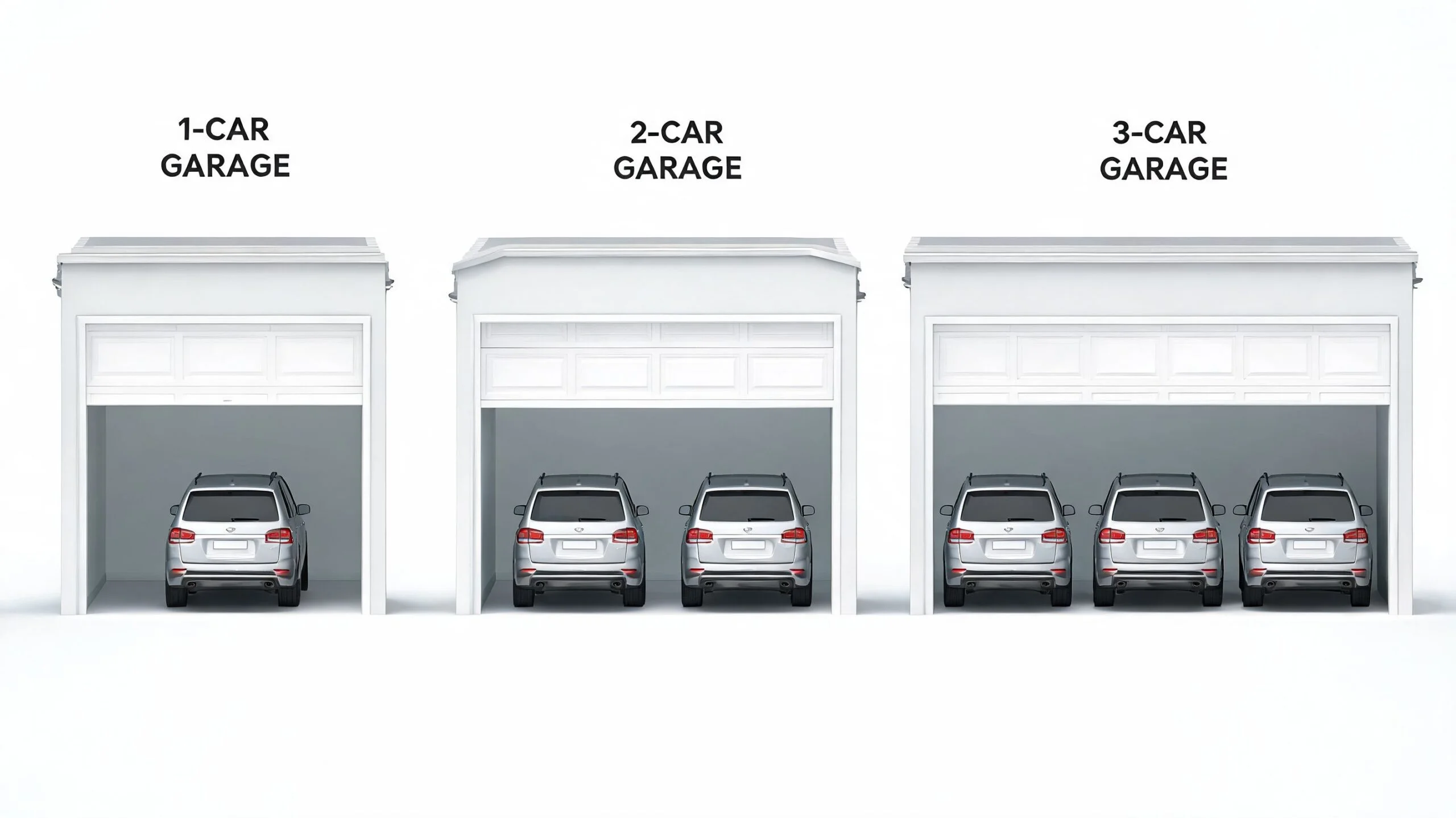
The residential baseline
For quick reference, these are the footprints facility teams will see most often in houses, small detached buildings, and light mixed-use properties:
| Garage type | Common footprint | Typical use |
|---|---|---|
| One-car | 12×20 ft | One passenger vehicle |
| Two-car | 20×20 ft | Two smaller passenger vehicles, or a tighter fit for larger pickups and SUVs |
Those sizes work in residential use because traffic is slower, cycle counts are low, and users accept tighter side clearance than any commercial bay should. They also leave very little room for carts, waste bins, snow buildup, wall-mounted equipment, or staff movement around the vehicle. In Canada, that becomes more obvious in winter, when tracked-in snow and ice reduce usable floor area and make approach lines less forgiving.
Door sizes that usually pair with residential layouts
For residential openings, common garage door widths generally fall into these ranges, as outlined by The Spruce’s garage door size guide:
- Single-bay doors: 8 to 10 ft wide
- Double-bay doors: 16 ft wide
That sounds straightforward, but the opening is only part of the decision. Older Canadian buildings often have tighter framing, lower headroom, or slab changes at the threshold. Under the National Building Code of Canada, a compliant project still has to account for structure, egress, fire separation, and the way the door system operates inside the available space. A nominal door size that fits the rough opening on paper can still create field problems if tracks, operators, or weather seals are forced into a cramped layout.
For facilities that also manage site circulation outside the opening, parking lot design standards affect how easily drivers line up before they ever reach the door.
A residential opening can be standard and still perform poorly if the approach is tight, the headroom is limited, or the door leaves no margin for winter sealing.
Where residential standards stop helping
A 20×20 layout may be acceptable for home parking. It does not leave much tolerance for technicians opening side doors, handling materials, or keeping pedestrian paths clear.
That is the practical limit of residential benchmarks. They describe what fits a passenger vehicle. They do not describe what supports repeatable commercial operation, safe circulation, lower air leakage, or longer door and operator life.
Commercial and Industrial Garage Bay Dimensions
A bay that looks generous on a floor plan can still fail in operation. I see that most often in Canadian service shops and warehouse annexes where the vehicle clears the opening, but mirrors clip jamb guards, roof racks force slower entry, and winter air pours in every cycle because the door was sized for storage, not traffic.
For many commercial facilities, a practical starting point is the full bay, not just the door. Conestoga Buildings’ garage sizing guide lists 24×32 feet (768 sq ft) as a common two-vehicle commercial layout, with larger configurations reaching 30×40 feet (1,200 sq ft). Those dimensions make more sense for light industrial use because they leave room for the vehicle, staff movement, shelving, hose reels, and the door hardware package that often gets ignored during early planning.
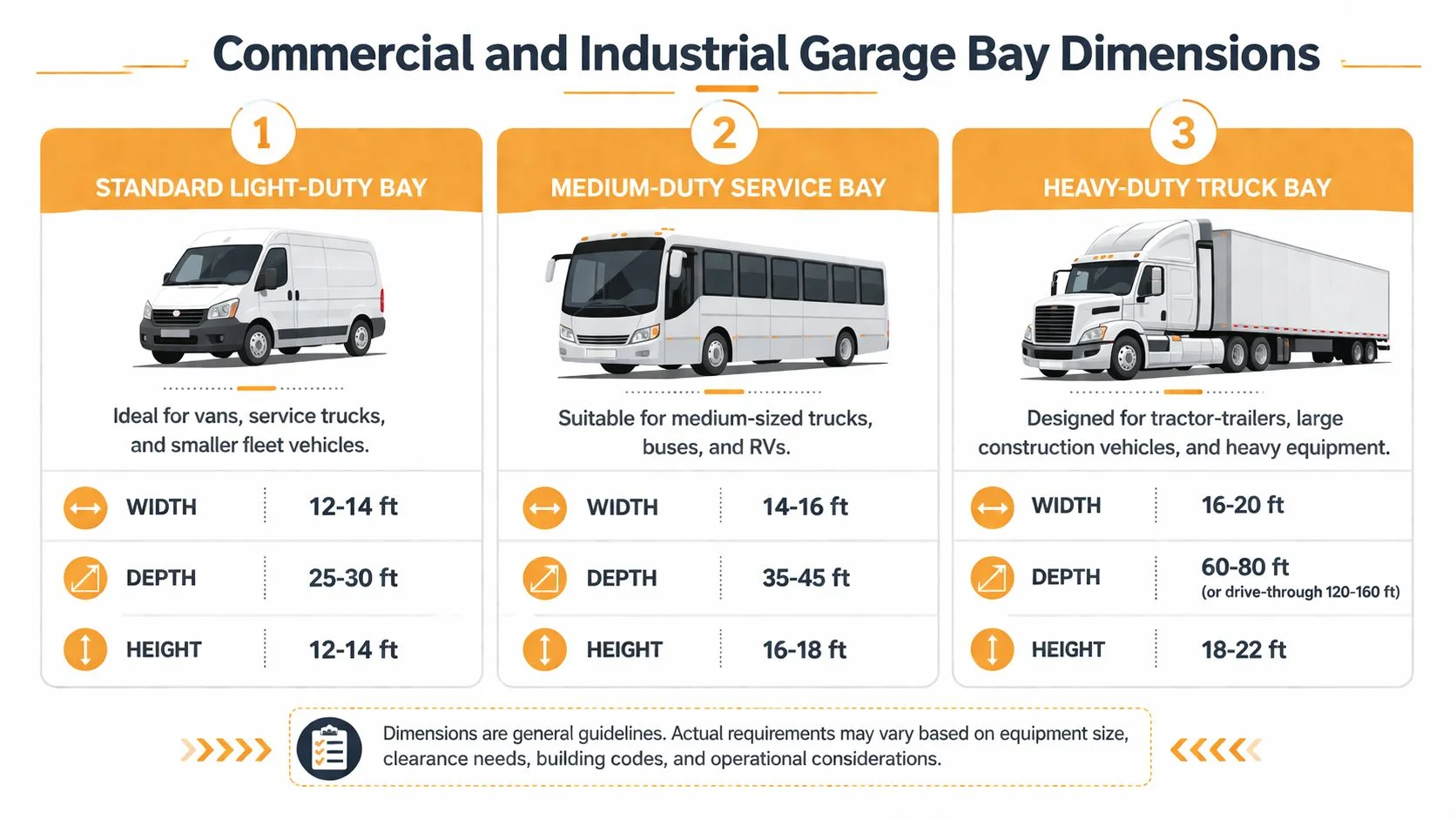
What a workable bay looks like
Conestoga also notes that a 24×32 ft layout can provide a 2 to 3 ft walking buffer per side. That margin matters in a commercial setting. Staff need room to step out with tools, open compartments, connect chargers, or move around parked units without drifting into the track zone or brushing the wall.
Depth matters just as much. A shallow bay pushes vehicles too close to the opening, which creates several predictable problems:
- Drivers stop inconsistently, so the operator sees more partial closes and reversals.
- Forklifts, carts, and pedestrians end up sharing the same narrow zone near the threshold.
- Bottom seals and perimeter weatherseals wear faster when vehicles idle close to the opening and the door cycles against pressure changes.
- Heated air escapes faster in winter because the door stays open longer while drivers correct their position.
In cold Canadian conditions, those small mistakes show up on the utility bill and in maintenance logs.
Door openings set the real minimum
The footprint can work and the opening can still be wrong. In commercial and industrial applications, clear opening width and height usually drive the final decision because they affect vehicle fit, approach speed, and how much tolerance drivers have during busy periods.
Clopay’s commercial overhead door guide outlines common commercial door categories that typically range from 8 to 12 feet wide for smaller commercial applications, with larger industrial openings specified beyond that based on vehicle and equipment requirements. In practice, many facility managers treat 8 to 10 feet as the lower end for light commercial single-vehicle access, 16 feet as a common double-width reference point, and then step up from there for fleet, warehouse, or equipment bays.
That is why teams comparing a standard double opening against a larger unit should review actual use, not just nominal fit. A double size garage door for commercial applications may clear the vehicle body, but you still need enough side and height tolerance for mirrors, ladder racks, snow buildup, door hardware, and repeatable entry by different drivers on different shifts.
Practical differences by facility type
A service fleet bay has different sizing pressure than a distribution bay or a washdown area.
- Service vans and light fleet: Bay depth often becomes the problem first. Roof equipment, shelving access, and technician movement usually need more room than the van itself.
- Warehouse and distribution traffic: Opening width and approach alignment matter more because cycle counts are higher and drivers are operating under time pressure.
- Dock-adjacent bays: Door size has to coordinate with restraints, dock equipment, shelters, and trailer swing. The opening cannot be chosen in isolation.
- Conditioned industrial space: Insulated doors, tighter sealing, and faster close speeds affect rough opening, headroom, and side room requirements under the National Building Code of Canada and related fire separation provisions.
Facility managers should also check the exterior approach before signing off on the door package. Tight turning radii, short queueing distance, or poor striping outside the opening can cancel out the benefit of a properly sized bay. For that reason, parking lot design standards are useful context when vehicle alignment outside the building is already a constraint.
A commercial bay should support daily traffic with margin. That margin protects safety, reduces energy loss, and gives the door system a better chance of reaching its expected service life.
For teams reviewing sectional, rolling, high-speed, or specialty openings, Wilcox provides a factual reference through its commercial and industrial door services, including applications for docks, fleet access, and conditioned spaces.
Sizing for Oversized and Specialty Applications
Specialty applications are where “standard garage sizes” usually fail first.
A municipal fleet bay, a food distribution cooler, and an EV delivery depot can all be called garages or bays in project discussions. They don’t behave the same way. The vehicle profile changes, the door cycle count changes, and the consequence of a tight opening gets much more serious.
EV fleets are changing the height conversation
Recent Canadian trend data points to that shift. In some provinces, EV truck registrations increased 40% year over year, and required door heights are moving from 7 to 9 ft up to 10 to 12 ft, according to Reolink’s standard garage size article. The same source notes that 22% of industrial facilities are retrofitting bays to be wider to handle larger EV mirrors and battery-related packaging.
That tracks with what facility teams are seeing on the ground. The vehicle itself may not be dramatically wider at the body, but mirrors, charging hardware, clearance preferences, and future procurement standards all push the opening upward and outward.
Cold-chain and regulated environments need more margin
A food and beverage operator has different concerns than a parcel depot. Insulated doors take space. Seal performance matters more. Fast closing speeds matter more. A door that technically clears the vehicle but leaves little room for thermal separation usually creates a long-term operating problem.
In these environments, it’s smarter to size around the full system:
- door curtain or panel thickness
- track and hardware arrangement
- insulated frame requirements
- air movement at the opening
- dock interface equipment
- vehicle changes over the next procurement cycle
A practical example from planning work
Consider a distributor replacing older bays that were originally built for smaller straight trucks. The current fleet includes taller vehicles, some with EV platforms under consideration. If the team settles for swapping the old doors for the same dimensions, they lock in the same alignment issues, the same seal gaps, and the same restrictions on future vehicles.
A better approach is to confirm the largest planned vehicle envelope, then review whether a larger opening and deeper bay will also improve staging, pedestrian movement, and thermal control. For buildings that still use a narrow double opening, comparing options like a double size garage door can help clarify whether a wider opening solves the underlying problem or whether the entire bay geometry needs to change.
The costly retrofit is usually the one you knew was coming but sized around today’s vehicle anyway.
What works better in specialty settings
For oversized and evolving applications, the safer choice is usually to oversize with purpose, not guesswork. That means planning around:
- Current fleet dimensions: Include mirrors, roof units, and any mounted equipment.
- Future procurement: If EVs or taller trucks are coming, don’t build around a retiring fleet.
- Door type: High-speed fabric, rolling steel, insulated sectional, and fire-rated systems all have different space demands.
- Environment: Cold storage, washdown, pharma, and secure government sites each add different constraints.
Essential Clearance and Approach Measurements
A bay can have the right footprint and still be wrong in use. That happens when the team only measures width and depth, then ignores the three-dimensional space the door system needs.
The practical measurements are headroom, side room, backroom, and the approach path. If one of those is off, the opening may still look fine on a plan while being awkward, unsafe, or impossible to service in the field.
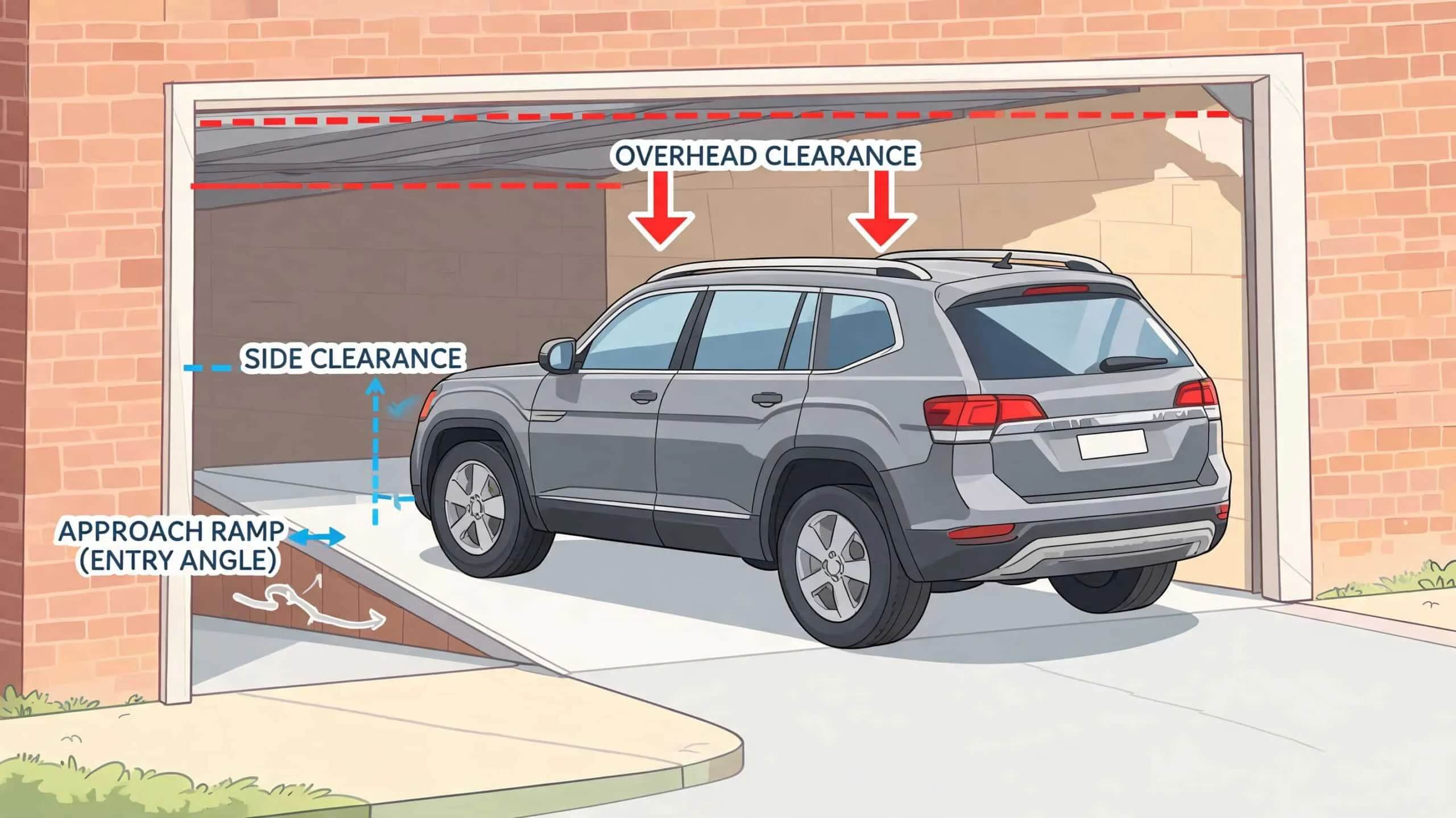
The four measurements that get missed most often
Here’s the plain-language version:
- Headroom: The vertical space above the opening needed for tracks, springs, operators, or roll-up components.
- Side room: The space at each side of the opening for tracks, mounting surfaces, and maintenance access.
- Backroom: The interior depth required for the door to travel fully open.
- Approach angle: The path a vehicle takes as it reaches the opening. Slopes and ramps change how much effective clearance the vehicle really has.
Why headroom isn’t the same as door height
A door may be tall enough for the vehicle, but the building still needs enough room above that opening for the hardware. A lack of such space often leads to issues once concrete and steel are already set.
If the headroom is tight, the installer may need a different track configuration or operator arrangement. That’s possible in many cases, but it’s better to design for it than recover from it later. Teams comparing standard opening heights can use Wilcox’s garage height dimensions guide to match the opening to the vehicle and the door type.
Side room and backroom affect serviceability
Side room isn’t only about installation. It also affects whether technicians can safely access components later. A bay that squeezes the tracks against walls, shelving, conduit, or sprinklers usually turns routine service into a longer shutdown.
Backroom matters for the same reason. If the interior depth is consumed by racking, lighting, or equipment, the door may not open into a clean travel path.
A bay that can’t be serviced without moving building contents is already undersized in practice.
Approach slope changes the usable opening
The driveway or ramp can steal clearance even when the door itself is tall enough. Trucks pitch as they climb or descend. Long wheelbases exaggerate that movement. Roof units and top corners can end up dangerously close to the opening sooner than expected.
For loading dock areas, this is one reason door sizing should be reviewed together with loading dock equipment, not in isolation. The dock face, leveler position, trailer geometry, and restraint location all affect how the vehicle meets the opening.
A clean plan review usually checks the full movement path, not just the opening dimensions on the wall.
How Canadian Building Codes Influence Garage Sizing
Code is where a lot of cross-border confusion starts. Many online guides are written for US residential garages. Canadian commercial and industrial work follows a different framework, and that changes what counts as a practical standard.
According to Viking Steel Structures’ discussion of standard garage dimensions in Canada, Canadian commercial facilities are heavily influenced by the National Building Code of Canada, which can require minimum clear widths of 3.0 m (9.8 ft) for vehicle access in parking garages and specific headroom considerations for insulated doors in cold storage.
Why Canadian projects often need more space
That NBC influence shows up in several ways:
- Vehicle access requirements: Openings may need to be wider than a generic US guide suggests.
- Cold-storage conditions: Insulated doors and their assemblies can affect headroom and opening strategy.
- Fire separation: Attached or adjacent occupancies may drive door type and wall design.
- Provincial variation: Local code adoption and interpretation can add regional requirements.
The result is simple. A size that seems “standard” in a US article may not satisfy a Canadian building official, or it may meet the bare minimum while still creating operating issues in winter.
Provincial context matters in real projects
The national code sets the baseline, but provincial requirements and local enforcement still matter. In practice, teams need to confirm how the project jurisdiction handles structural, fire, and energy provisions before finalising opening sizes.
That matters even more in retrofit work. Existing framing, slab elevations, sprinklers, and fire separations can limit the door types available. A replacement may need a different configuration than the original opening if the facility is trying to correct compliance or performance issues at the same time.
Code minimums are not the same as operating minimums
This is the distinction that saves money. Code can tell you the minimum acceptable condition. It doesn’t always tell you the dimension that gives your operation enough room to avoid damage, maintain thermal performance, or service the equipment easily.
That’s why facility teams should treat code as the floor, not the target.
For Canadian reference on opening ranges and common applications, Wilcox’s standard door sizes in Canada guide is a useful starting point before detailed design review with your engineer, architect, or authority having jurisdiction.
Your Planning Checklist for a Perfect Fit
The best garage sizing decisions don’t start with a catalogue dimension. They start with the largest real use case, then work backward through the opening, the clearances, and the code requirements.
That approach prevents a common problem in commercial projects. The building technically works on day one, but every month after that it costs more to run, repair, and work around.
A short checklist that catches the costly misses
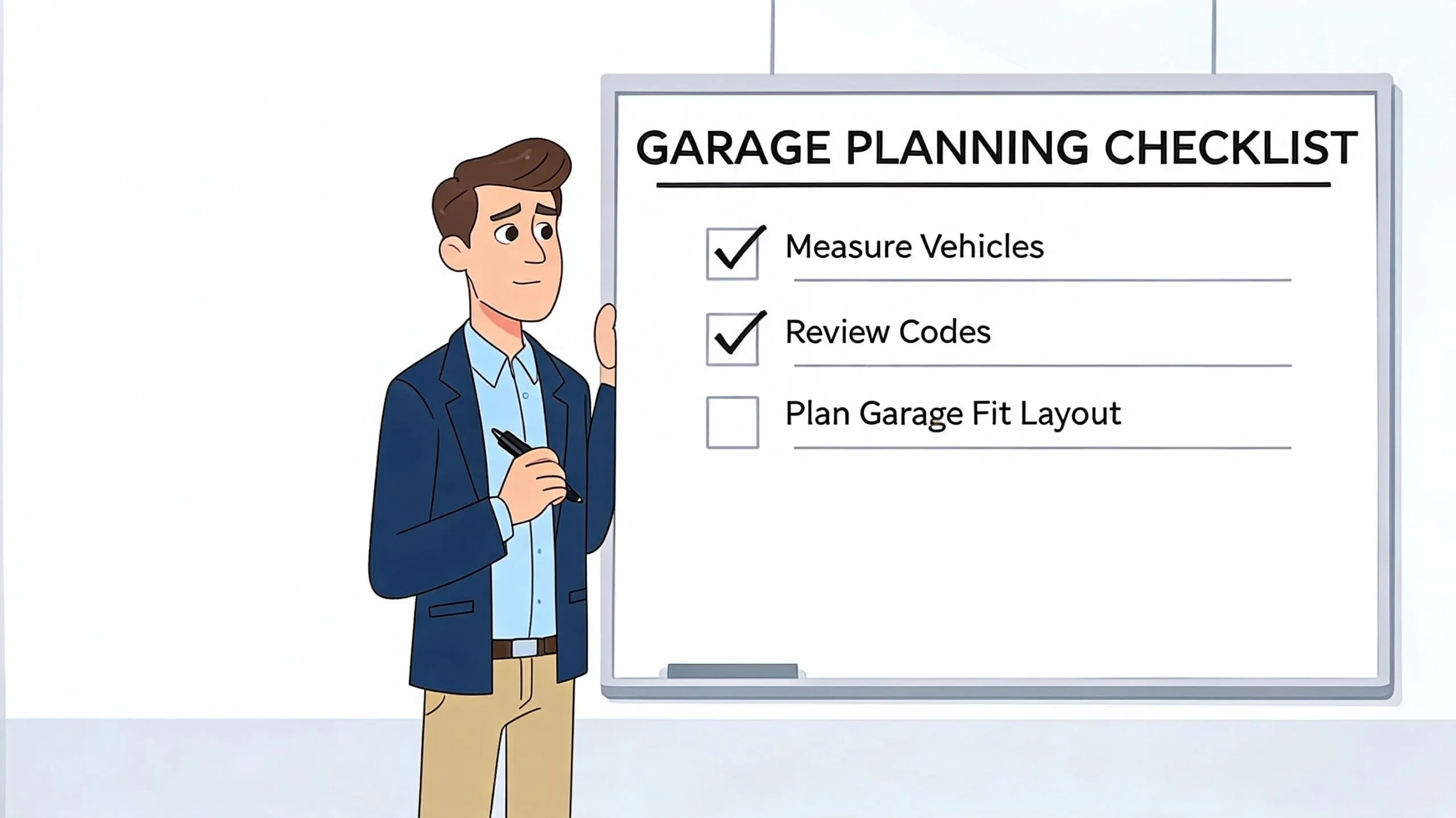
Use this before approving a new bay, retrofit, or replacement door package:
Confirm the actual vehicle envelope
Measure the longest, widest, and tallest unit that will use the opening. Include mirrors, roof gear, liftgates, and future fleet plans.Define how the space will be used
Parking only is one thing. Loading, service access, pedestrian traffic, washdown, and cold storage all require more room and different door choices.Measure the full opening environment
Don’t stop at width and height. Check headroom, side room, backroom, and the vehicle approach path.Review code and local conditions early
Canadian code requirements can change what counts as a workable minimum, especially for cold-storage, attached occupancies, and industrial applications.Choose the door system to suit the operation
Sectional overhead doors, rolling steel doors, fire-rated rolling doors, and high-speed fabric doors all solve different problems.Plan maintenance into the design
If the system can’t be serviced safely and quickly, the layout is too tight.
Where outside guidance helps
For home-oriented projects, mixed-use developments, or owners comparing residential layouts before moving into commercial design, Domicile Construction's garage guide is a useful companion resource.
For ongoing commercial operations, a structured maintenance approach often matters as much as the original sizing decision. A planned maintenance programme helps teams catch seal wear, alignment drift, operator strain, and hardware issues before they turn into unplanned downtime.
Good sizing prevents avoidable problems. Good maintenance keeps the original sizing decision working the way it should.
If you’re planning a new opening, resizing an existing bay, or trying to fix repeated damage at a door, the most reliable next step is a field review that looks at the building, the vehicle, and the operation together.
If you need help validating dimensions before a retrofit or new build, Wilcox Door Service Inc. can review your opening conditions, door type, and operating requirements so the final size supports safety, uptime, and compliance. Respected Partners, Reliable Service.
Frequently Asked Questions
What is a standard single-car garage size in Canada?
A standard single-car garage in Canada is typically 12′ wide by 22′ deep, with a door opening around 8’–9′ wide. Commercial and industrial bays are significantly larger to accommodate trucks and equipment.
How big should a commercial garage bay be?
Commercial bays generally range up to 20′ wide by 20’+ deep depending on vehicle type, with door openings sized to the largest vehicle plus clearance for safe entry, exit, and maintenance access.
What building code governs garage sizing in Canada?
The National Building Code of Canada (NBC) sets minimum dimension and clearance requirements, which are further refined by provincial codes for commercial and industrial facilities.
Why does garage door sizing matter for facility operations?
Undersized bays cause frame scrapes, poor seal contact, awkward approach angles, and increased downtime and repair calls — all of which affect safety and operating costs over time.