


A facility manager usually starts looking at handicap door openers when a door becomes a problem. Staff are reporting accessibility complaints. Tenants are asking for touchless entry. A retrofit is tied to a lobby refresh, washroom upgrade, loading dock office renovation, or compliance review. At the same time, operations can't stop, budgets aren't unlimited, and nobody wants to install the wrong system and revisit it a year later.
Looking for commercial installation or service? See our commercial automatic door opener installation guide.
That’s why handicap door openers should never be treated as a simple hardware add-on. In Canadian commercial and industrial buildings, they affect accessibility, user safety, traffic flow, energy use, service calls, and the long-term reliability of the opening itself. A poor specification can create nuisance reversals, premature arm wear, weak performance in cold weather, or ongoing code questions. A well-planned system does the opposite. It makes the entrance easier to use, easier to maintain, and easier to defend from an operations and compliance standpoint.
Canadian facility teams also need guidance that fits Canadian conditions. U.S. accessibility content can be useful background, but it often stops short of the National Building Code, provincial requirements, retrofit challenges in older buildings, and the practical realities of maintaining powered pedestrian doors across multi-site portfolios. That’s where a policy-driven, operations-focused approach matters. For teams reviewing broader accessibility obligations, Wilcox’s Accessible Customer Service Policy is a useful reference point.
Your Guide to Enhancing Facility Accessibility
Handicap door openers sit at the intersection of compliance and daily operations. They help people move through a building safely, but they also shape how an entrance performs during a busy day. In a warehouse office, that might mean steady traffic from drivers, supervisors, and visitors carrying documents or equipment. In a commercial tower, it can mean avoiding congestion at the main entry or washroom corridor. In a healthcare or government setting, it often means reducing physical effort for users who already face barriers elsewhere in the facility.
The practical question isn’t just whether you need a powered operator. It’s whether the system will hold up under real conditions. That includes traffic volume, door weight, frame condition, actuator placement, winter air movement, and the quality of follow-up service when something drifts out of adjustment.
Practical rule: If a door is important enough to automate for accessibility, it’s important enough to specify, install, and maintain properly.
The strongest projects usually start with a wider view of the opening. Facility teams that get good long-term results don’t look only at the operator. They review the door, frame, hinges, closer, latch, clear width, signage, power availability, and user path all at once. That’s how you avoid a common mistake: installing a new operator on an opening that already has alignment, clearance, or hardware problems.
A good handicap door opener should do four things well:
- Reduce effort: The user shouldn’t have to fight the door.
- Operate predictably: Opening and closing should feel controlled, not abrupt.
- Protect uptime: The system needs to survive daily use without constant call-backs.
- Support compliance: The opening must work for real people, not just pass an initial inspection.
That’s the lens used here. The focus is on what works in Canadian facilities over time, what tends to fail, and how to make decisions that protect both accessibility and operating budgets.
Understanding Handicap Door Openers
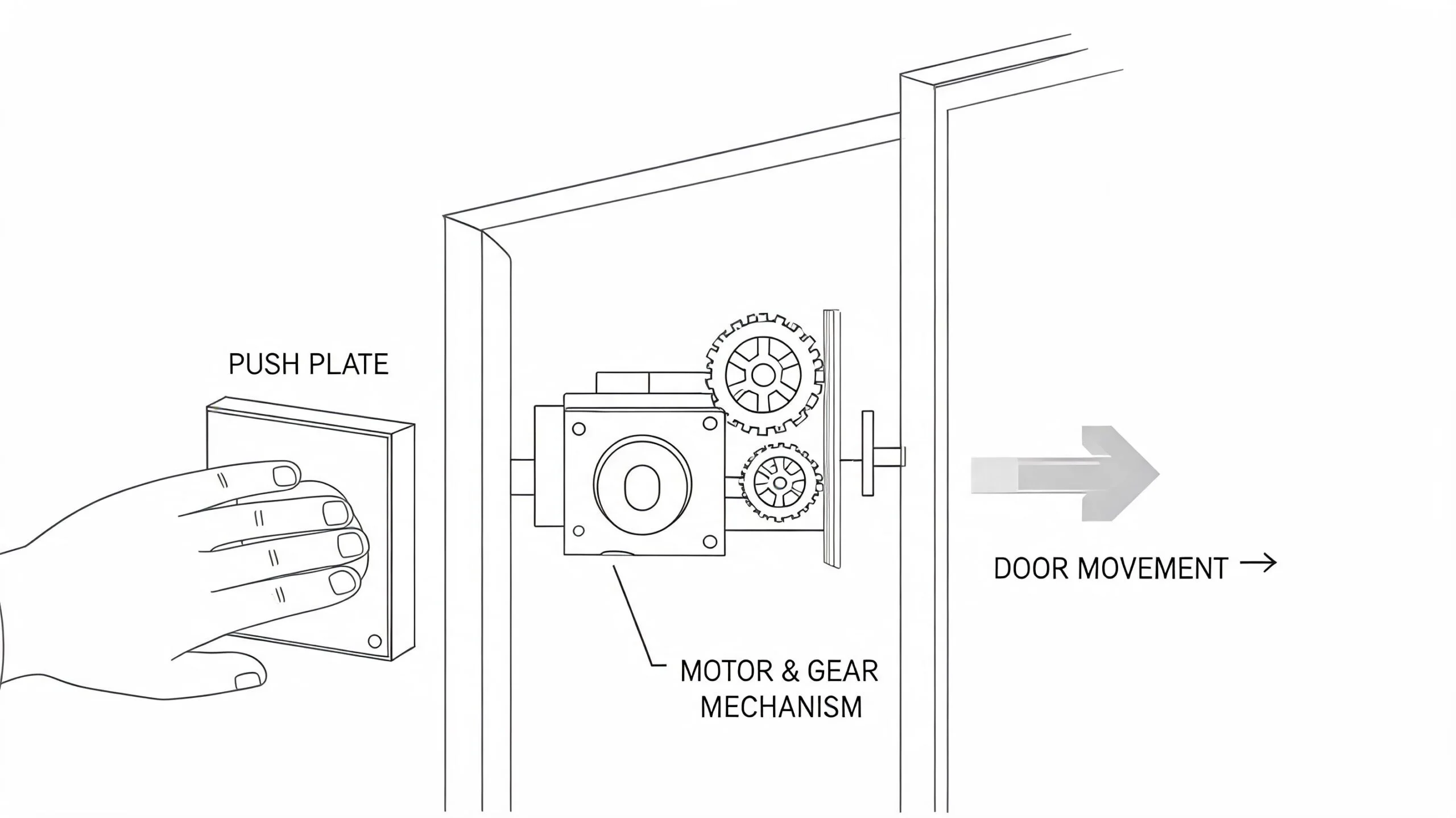
A handicap door opener is best understood as an automated doorman. It receives a signal, decides what action to take, and moves the door in a controlled way. For the user, the experience is simple. Press a plate, wave at a sensor, or activate the system through an access device, and the door opens with less physical effort.
The basic parts that matter
Most facility managers don’t need to know every internal component, but they should know the three pieces that drive performance:
- The operator: This is the motorised unit mounted on the door or frame. It provides the force that moves the door.
- The actuator: This is the trigger. Common examples include push plates, push buttons, touchless wave sensors, and integrations with card readers.
- The controller: This is the logic system that manages opening speed, hold-open time, closing behaviour, and safety inputs.
If any one of those is chosen poorly, the whole opening becomes frustrating. A strong operator with badly placed activation plates still creates accessibility problems. A good actuator tied to poor controller settings can leave the door closing too fast or staying open too briefly.
Low-energy versus full-energy systems
This is one of the most important distinctions in any specification.
Low-energy operators are the most common choice for handicap door openers in commercial settings. They open in a controlled, assisted manner and are typically suited to offices, washrooms, tenant entries, and many interior pedestrian openings. In practical terms, they’re often the right answer when you need accessibility without the complexity of a full automatic entrance.
Full-energy operators are different. These are more like the fully automatic entrances people associate with retail, hospitals, or major public buildings. They are designed for heavier duty operation and more continuous automation.
What works best depends on use. In a low-traffic corridor, a low-energy operator usually gives the best balance of code compliance, simplicity, and maintenance burden. At a main entrance with frequent use, carts, visitors, and environmental exposure, a heavier-duty automatic solution may be the better fit.
A short visual can help if you're comparing operator layouts and retrofit conditions:
What facility teams should watch for
The language around handicap door openers can make the products sound interchangeable. They aren’t. Two operators may look similar on a submittal sheet and behave very differently in the field.
Watch the details that affect actual use:
- How the door is triggered: Push plate, wave sensor, or integrated access control all create different user experiences.
- How the arm is configured: The arm style has to match the frame reveal and swing condition.
- How the opening is used: A front office door and a plant corridor door may both be accessible openings, but they don’t need the same setup.
A good handicap door opener doesn’t call attention to itself. People use it without thinking, and maintenance teams don’t have to babysit it.
Navigating Canadian Accessibility Compliance
Canadian compliance starts with a basic reality. You can’t rely on U.S.-only guidance when you’re planning handicap door openers for a Canadian facility. The legal framework, technical standards, and inspection expectations are different, especially for owners managing public-facing buildings or multi-site portfolios.
One core requirement comes from the National Building Code. Accessible doors in public buildings must provide a minimum clear width of 850 mm (33.5 inches) and an interior opening force not exceeding 30 N (6.7 lbs), as noted in the ADA National Network factsheet on opening doors for everyone. For facility managers, those aren’t abstract design numbers. They directly affect whether a user can approach, activate, and pass through the opening without excessive effort.
The code picture in Canada
Canadian projects often involve several layers of review at once:
- National Building Code requirements: These shape the core accessibility expectations for the opening.
- Provincial accessibility rules: In Ontario, teams often need to align accessibility work with AODA obligations. Other provinces have their own frameworks and enforcement culture.
- Product and safety standards: Hardware, sensors, and operator behaviour still need to line up with the applicable technical standard and the intended use of the opening.
That combination is where projects get tripped up. A door may have an operator installed, but if the clear width is wrong, the force is too high, the hold-open timing is poorly set, or the approach area is awkward, the opening still underperforms from an accessibility standpoint.
Why Canadian specifics matter in practice
A lot of online content compares everything to ADA requirements. That’s useful only up to a point. If your team works across jurisdictions, it can help to see a U.S. example such as Florida ADA parking requirements because it shows how accessibility rules change by location and asset type. The lesson for Canadian facility managers is simple. Local code drives the decision, not the nearest U.S. checklist.
Another point that often gets missed is that the opening itself has to be assessed, not just the operator. Width, frame geometry, latch condition, signage, and user approach all affect compliance. If you need a quick primer on one of the most overlooked dimensions, this guide on door width for wheelchair access is a practical place to start.
Field insight: The easiest way to create a compliance problem is to automate a door that was never properly reviewed as a complete opening.
What a compliant opening should feel like
Facility teams usually recognise a good accessible opening immediately. The user doesn’t need to lean into the door. The activation point is easy to find. The opening cycle feels calm and predictable. The hold-open period gives enough time for a wheelchair user, a person using a walker, or someone moving carefully through the doorway.
A poor opening feels rushed or awkward. People hesitate. They brace against the leaf. Staff prop it open because they don’t trust it. Those are all warning signs that the opening may not be delivering what the code intends, even if a motor operator is present.
Common compliance mistakes
The recurring issues tend to be straightforward:
- Wrong opening assumptions: Teams assume any powered door is automatically compliant.
- Incomplete retrofit scope: The operator is upgraded, but the rest of the opening is left as-is.
- Poor placement of activation devices: The user has to back up, twist, or reach awkwardly after triggering the door.
- No follow-up verification: Force, speed, and timing drift over time if no one checks them.
The strongest approach is to treat accessibility compliance as an operational standard, not a one-time install event. That mindset prevents expensive corrections later and gives property teams a cleaner record when questions come up from tenants, inspectors, or internal risk managers.
Selecting the Right Door Opener for Your Facility
A poor operator choice usually does not fail on day one. It shows up six months later as repeat service calls, door timing complaints, actuator damage, and staff workarounds at the busiest opening in the building. That is why selection should start with the door’s daily job, the people using it, and the cost of keeping it running in a Canadian facility over time.
A washroom entrance, a vestibule door, a secure staff corridor, and an airport side entry can all require accessible operation. They do not need the same operator, activation method, safety setup, or service strategy.
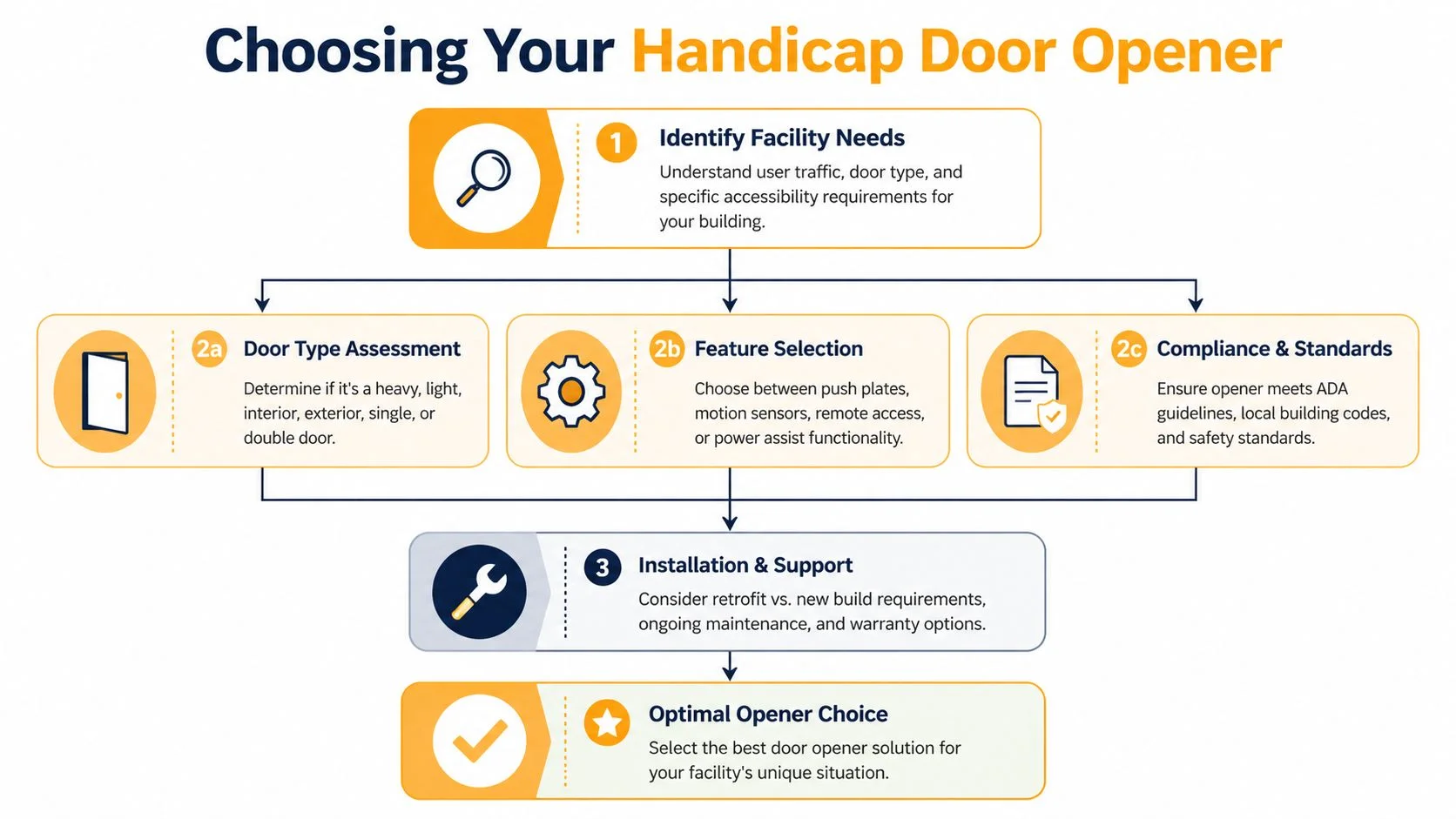
Start with actual use conditions
Begin with what the opening does all day, not what the catalogue highlights.
A low-traffic office washroom door usually calls for a low-energy operator with clearly placed push plates. Quiet operation matters there. So does easy adjustment, because small timing issues are noticed quickly in smaller interior spaces.
A busy corridor or main entrance needs a different specification. People may arrive in groups, carry boxes, push carts, or stop mid-path. Exterior doors add wind load, stack pressure, slush, temperature swings, and harder daily cycling. In Canadian buildings, those factors affect not only performance but also long-term maintenance cost.
The operator has to suit the opening’s duty cycle. An undersized unit may meet the drawing and still become expensive to own.
Safety package and traffic pattern need to match
For commercial applications in Canada, handicap door openers must include dual entrapment protection, meaning an inherent reversal system plus an external sensor such as an electric eye, and compliant systems can reduce entrapment-related injuries by over 90%, according to Stanley Access on swinging door openers. In practice, that means the door has to detect a person or obstruction and respond before contact becomes a hazard.
Openings with unpredictable movement need closer attention. A manufacturing office entrance, a healthcare corridor, or a public lobby often has people crossing the swing path at different speeds and from different angles. More extensive sensor coverage is often justified in those locations because it reduces nuisance calls, protects users, and lowers the chance of a shutdown after an incident.
Cutting safety inputs to lower the quote usually creates a larger operating cost later.
Activation method affects reliability as much as convenience
The trigger method changes how people use the opening and how often service gets called.
- Push plates: Familiar, durable, and often the simplest choice for retrofit work
- Touchless wave sensors: Useful where hygiene matters or where users commonly approach with occupied hands
- Card reader integration: A practical fit for secure staff doors that need accessibility and access control to work together
- Remote or managed activation: Best reserved for controlled environments where staff supervision is part of the process
Touchless activation is not automatically the better answer. In some buildings, a well-located push plate is clearer for visitors and easier for maintenance staff to troubleshoot. In others, touchless activation improves traffic flow and reduces surface contact. The right choice depends on user behavior, wall space, wiring path, and how the opening is approached.
Automatic Door Opener Specification Matrix
| Specification Criteria | Consideration for Low-Traffic Areas (e.g., Office, Washroom) | Consideration for High-Traffic Areas (e.g., Main Entrance, Corridor) | Wilcox Pro-Tip |
|---|---|---|---|
| Operator type | Low-energy operator is often the practical fit | Heavier-duty automatic solution may be needed depending on use | Match the operator to actual daily cycles, not just code minimums |
| Door weight and size | Standard interior leaf is usually straightforward | Heavier, wider, or exterior doors need closer review | Confirm the complete opening condition before approving hardware |
| Activation method | Push plates are often clear and dependable | Touchless or integrated activation may improve flow | Place actuators based on approach path, not empty wall space |
| Safety package | Basic compliant safety setup may be sufficient | More extensive sensor coverage is often justified | Don’t cut safety devices to protect budget |
| Environmental exposure | Interior conditions are more forgiving | Wind, temperature, and air pressure affect behaviour | Exterior openings need field-aware adjustments after install |
| Security integration | Stand-alone operation may work well | Card access and scheduling may be required | Coordinate access control and door automation early |
| Serviceability | Simpler setup often means easier maintenance | Busy openings need components that can be accessed fast | Choose hardware your service team can support over the long term |
Questions that lead to better specifications
Before approving a model, ask a few operational questions.
- Who uses this door most often? Visitors, staff, tenants, patients, delivery drivers, or the public.
- What are they doing when they arrive? Carrying bags, pushing carts, managing documents, or using mobility devices.
- Is the opening interior or exterior? Exterior conditions change the specification immediately.
- Does it need to work with access control? If yes, wiring, relays, and opening logic need to be planned together.
- What does failure cost? Some doors create minor inconvenience. Others interrupt security, patient flow, or tenant operations.
For teams comparing configurations, this overview of commercial automatic door operator options is a useful reference point for the operator types commonly specified in the field.
One final point. Do not choose only by initial hardware cost. On a busy opening, the wrong arm, the wrong activation method, or an operator that is marginal for the application will produce service calls for years. Total cost of ownership is usually decided after installation, not at bid time.
Installation Planning for Retrofits and New Builds
Installation quality decides whether a handicap door opener works like part of the building or behaves like an add-on. The planning process looks very different for retrofits than it does for new construction, and that difference affects schedule, disruption, and long-term reliability.
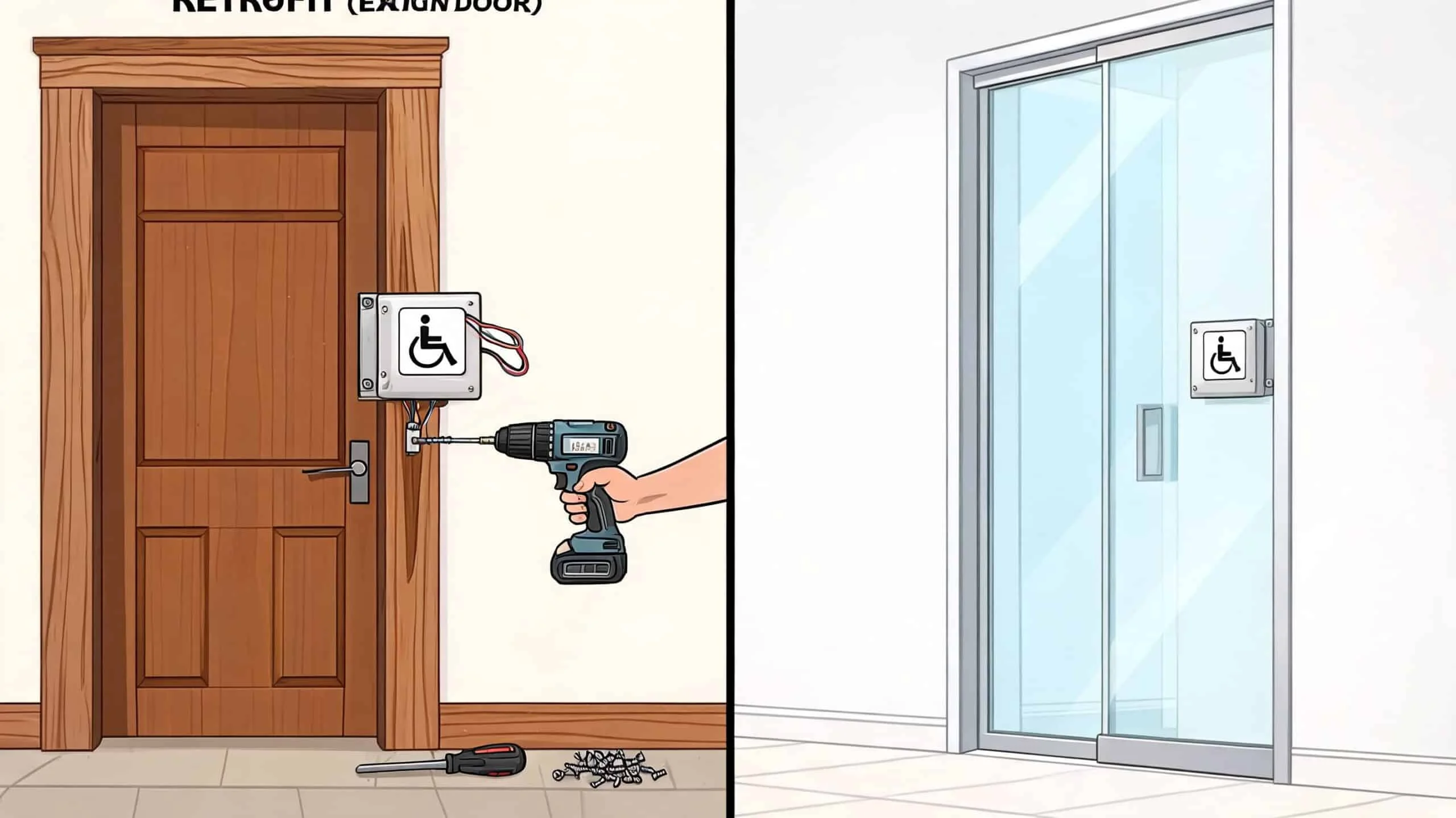
Retrofits in existing buildings
Retrofits are where most of the hidden problems show up. The opening may look simple until the technician starts measuring reveal depth, checking frame condition, tracing power routes, and reviewing the wall construction for actuator mounting.
A common issue in older Canadian buildings is the deep reveal, sometimes over 200 mm (8 inches). Improper arm selection or mounting in these conditions is a leading cause of premature failure and non-compliance, and some government audits have found failure rates as high as 18% due to incorrect adjustments, as referenced in the video on handicap door opener installation conditions. In practical terms, this is why experienced field assessment matters. If the geometry is wrong, the operator can’t perform the way the spec sheet suggests.
Other retrofit challenges show up regularly:
- Limited power access: Running power cleanly can be harder than expected in finished spaces.
- Weak substrate conditions: Some older frames or adjacent wall surfaces need reinforcement.
- Door condition issues: Worn hinges, sagging leaves, or poor latch alignment should be corrected before automation.
- Operational constraints: Lobbies, washrooms, and office corridors often have to remain usable during the work.
New construction brings different advantages
New builds are easier to coordinate when the operator is considered early. Architects, electrical trades, access control contractors, and door suppliers can align backing, power, clearances, and activation locations before finishes are complete.
That early coordination reduces compromise. It also improves aesthetics because conduit paths, wall reinforcement, and device positions can be planned instead of improvised. On larger projects, it helps avoid the familiar late-stage problem where the accessibility hardware package collides with millwork, glazing details, or security layouts.
The cheapest place to solve an automatic door problem is on the drawing. The most expensive place is after occupancy.
Side-by-side installation realities
Here’s the practical comparison facility teams should keep in mind:
- Retrofit projects: Better for targeted upgrades, but more likely to uncover frame, wiring, and mounting issues.
- New construction: Easier to integrate cleanly, but only if the operator isn’t left to the end of the coordination list.
For both conditions, a proper site assessment should confirm:
- Mounting clearances
- Swing path
- Power availability
- Activation device location
- Compatibility with existing hardware
- Any fire-rating or life-safety considerations
The installer’s job isn’t just to fasten hardware to the frame. It’s to ensure the opening performs reliably according to the building's actual circumstances. That’s where experienced technicians earn their keep.
A Practical Maintenance and Troubleshooting Checklist
A handicap door opener rarely fails without warning. The opening usually starts telling you something is off. Cycle speed changes. The latch starts dragging. Push plates work on one try, then miss the next. By the time occupants stop trusting the automatic function, the problem has already become operational.
Good maintenance protects safety, keeps the entrance available, and slows wear across the whole opening. Properly maintained, code-compliant handicap door openers can extend door lifecycle by up to 30%, such as from 10 to 13 years, according to Quad Automatic Doors on handicap door openers. In day-to-day facility work, that matters less as a headline number than as a budgeting reality. An operator that stays in adjustment puts less strain on hinges, arms, latches, and staff time.
What good preventive maintenance looks like
Daily observation can catch a surprising number of problems early. Annual service still belongs with a qualified technician, especially where force, speed, sensors, and safety functions need to be verified and documented.
The opening has to be maintained as a system. If the door sags, the weatherseal drags, or the strike alignment is off, the operator compensates until it cannot. That is why recurring service calls often trace back to the condition of the door and frame, not the automation package alone.
Preventive Maintenance Checklist for Handicap Door Openers
| Frequency | Check Point | Desired State | Action if Deviated |
|---|---|---|---|
| Daily | Activation device response | Door responds consistently when triggered | Remove from service if unsafe and report for inspection |
| Daily | Opening and closing movement | Smooth motion with no jerking, scraping, or hesitation | Check for obstructions and arrange service if condition continues |
| Daily | User path and threshold area | Clear, unobstructed, and safe for approach | Remove obstacles and monitor user complaints |
| Monthly | Push plates or wave sensors | Clean, secure, and functioning reliably | Clean sensors, tighten hardware, and test operation |
| Monthly | Door leaf and frame condition | No sagging, rubbing, or visible hardware looseness | Correct mechanical issues before they affect operator performance |
| Monthly | Safety devices | Reversal and detection functions respond as expected | Stop use if safety function appears unreliable and call for service |
| Quarterly | Force and speed settings | Within code-compliant operating range | Have a qualified technician verify and adjust settings |
| Quarterly | Arm and mounting hardware | Tight, aligned, and free of unusual wear | Replace worn parts and correct alignment |
| Annually | Full operator inspection | Controls, power, hardware, and safety package all verified | Schedule full preventive service |
| Annually | Documentation review | Service records and deficiencies logged clearly | Update maintenance history and address recurring issues |
Basic troubleshooting in the field
Some problems can be screened before you place a service call, and doing that helps separate a minor issue from an opening that needs to be shut down.
- Door doesn’t respond to activation: Check for power loss, a disconnected device, an isolated circuit, or a blocked sensor face.
- Door closes too abruptly: Take the opening out of normal use if it feels unsafe. Have the settings checked by a qualified technician.
- Operator runs but door movement is poor: Inspect for hinge wear, dragging at the threshold, latch resistance, or loose hardware. The fault may be mechanical.
- Intermittent behaviour: Look for loose wiring, inconsistent sensor performance, moisture exposure, or temperature-related issues at the opening.
One field sign gets ignored too often. If staff or visitors start avoiding the automatic function and use the door manually instead, treat that as a fault report.
A planned maintenance program usually costs less than repeated reactive calls, especially on busy Canadian openings exposed to salt, temperature swings, and heavy seasonal traffic. Wilcox outlines the same operating logic in its Planned Maintenance Programs for commercial doors. The practical goal is stable performance, cleaner compliance records, and fewer disruptions to the people who rely on the entrance every day.
Analyzing Costs ROI and Choosing a Service Partner
A facility manager usually feels the cost of an automatic opener twice. First at purchase. Then over the next several years when service calls, tenant complaints, and avoidable downtime start to show up on the operating budget.
Hardware price matters, but it is rarely the number that decides whether the project performs well. Total cost of ownership is shaped by the opening condition, wiring and mounting complexity, traffic volume, weather exposure, service response time, and how stable the operator stays after adjustment. In Canadian facilities, freeze-thaw cycles, salt, moisture, and heavy winter use change the economics quickly. An opener that looks affordable on bid day can become expensive if it needs repeated adjustments or if the underlying door problems were never corrected.
That is why low first cost can be misleading. A weak specification on a high-use opening often leads to more call-backs, more staff workarounds, and a shorter service life. A properly matched operator on a sound opening usually carries a higher upfront number and a lower ownership cost over time.
What ROI actually looks like in the field
ROI for accessible door automation is usually operational, not just financial. Facility teams see it in fewer interruptions at key entrances, less strain on hinges and closers when the opening is set up correctly, and fewer complaints from occupants who depend on the door working every time.
There is also a risk and labour component. If a main entry fails, staff get pulled into traffic control, temporary signage, tenant communication, and urgent service coordination. In healthcare, education, commercial offices, and industrial support areas, that disruption can cost more than the repair itself.
For multi-site owners, standardizing operator types and service procedures can improve purchasing, simplify parts stocking, and make maintenance records easier to manage across the portfolio. That tends to produce better budget control than buying different equipment site by site based only on the lowest quote.
How to evaluate a service partner
The service partner has a direct effect on long-term performance. Good operators still fail early when the opening was misread at survey stage, installed on poor geometry, or handed over without a realistic maintenance plan.
Look for a provider that can do more than install the unit:
- Canadian code familiarity: The contractor should understand the accessibility and life-safety requirements that apply in your province and municipality.
- Retrofit judgement: They should be willing to say when the frame, hinges, latch, or clearances need correction before automation is added.
- Service response capacity: Critical entrances need realistic response times, not vague promises.
- Multi-site consistency: National and regional facility teams benefit from standard recommendations, clear documentation, and repeatable service practices.
- Qualified technicians: The people adjusting the opening should know commercial pedestrian door systems and automatic operator behaviour in the field.
For teams reviewing service support more broadly, Wilcox also provides commercial door service and repair information built around the same operating priorities discussed here. Wilcox Door Service Inc. is one example of a company that supplies and installs commercial automatic door operators for pedestrian openings.
A good partner helps you avoid patchwork spending. Sometimes the right recommendation is a better-prepared opening, a different activation method, or less equipment than originally requested. That advice usually saves money later, which is what experienced facility managers care about most.
Frequently Asked Questions for Facility Managers
Can a handicap operator be installed on a fire-rated door
Sometimes, yes, but the full opening has to be reviewed carefully. The operator, arm, hardware, and installation method all need to respect the fire-rated assembly. Don’t assume any automatic setup is acceptable just because the door itself is labelled.
How long does a retrofit installation usually take
That depends on the opening condition, power access, wall construction, and whether corrective work is needed first. A simple, prepared opening moves much faster than an older frame with hidden wiring or alignment issues. Site review matters more than generic timelines.
Does a wave-to-open sensor satisfy accessibility needs
It can, if it is specified and located properly as part of a compliant opening. Touchless activation can work very well in washrooms, healthcare spaces, and other areas where hygiene matters. It still has to be intuitive, reachable in the approach path, and coordinated with safe operator settings.
What shortens operator life the fastest
Poor geometry, neglected door hardware, loose arms, inconsistent maintenance, and trying to automate a door that already has mechanical problems. Operators don’t fail in isolation. Most of the time, the opening gives warning signs first.
When should facility staff call for service instead of adjusting things themselves
Call for service when the door feels unsafe, the safety function appears unreliable, the cycle changes noticeably, or the opening starts behaving inconsistently. Staff can handle basic observation and reporting. Force, speed, safety inputs, and operator adjustments should be handled by qualified technicians.
What should be documented after installation
Keep records of the installation scope, settings, any deficiencies corrected at the opening, service history, and future inspection dates. Good documentation makes future troubleshooting easier and helps when questions arise from property teams, tenants, or compliance reviewers.
If you need project-specific guidance, unusual retrofit advice, or support across multiple facilities, the next step is simple. Contact us and review the opening with a qualified team before you commit to hardware.
If you're planning handicap door openers for a warehouse, office, plant, government site, or multi-building portfolio, Wilcox Door Service Inc. can help you assess the opening, match the right solution to the application, and set up a maintenance approach that protects compliance and uptime. That’s the value of working with respected partners and reliable service.
Frequently Asked Questions
What type of door opener is required for AODA compliance?
AODA compliance typically requires a powered pedestrian door operator with a push-button, motion-sensor, or wave-activated actuator, sized and installed per manufacturer and code specifications for the door’s weight and traffic volume.
How much does a handicap door opener cost installed?
Installed costs vary based on door size, power requirements, and integration with access control, but budgeting should account for the opener, actuators, wiring, and professional installation and commissioning.
Do handicap door openers need regular maintenance?
Yes — powered door operators require scheduled maintenance to prevent nuisance reversals, arm wear, and reduced performance in cold weather, which are common failure points in Canadian climates.
Can existing doors be retrofitted with automatic openers?
Most commercial doors can be retrofitted with automatic openers, though older buildings may require additional structural or electrical work to properly support the operator and actuator system.