


The call usually comes early. A manager opens the store, sees damaged glass, and starts asking the same questions every operations team asks after a breach. What should we have installed? Would a different gate have stopped it? And if we’re retrofitting multiple locations, how do we avoid buying the wrong system twice?
That’s where retail store security gates stop being a simple product choice and become an operations decision. The gate at the entrance affects theft exposure, fire code compliance, after-hours access, cleaning routines, storefront appearance, and how often your maintenance team gets dragged into emergency repairs.
In Canada, the retail sector faces shrink estimated at over CAD 5 billion annually as of 2023, with organized retail crime and shoplifting up 25 to 30% in major provinces such as Ontario and British Columbia, according to this storefront security gates market analysis. For facility managers, that means the entrance line has become part of loss prevention, not just a building finish.
Good gate selection comes down to four things. Match the gate type to the opening. Specify materials that can survive real use. Make sure the installation meets Canadian code and fire requirements. Then look at total cost of ownership, not just the quote.
Securing Your Facility Starts at the Entrance
A security problem at the storefront rarely stays at the storefront. Once an entrance is vulnerable, teams start changing staffing patterns, limiting merchandising near the front, adding temporary barriers, and reacting instead of operating. That’s expensive, and it wears people down.
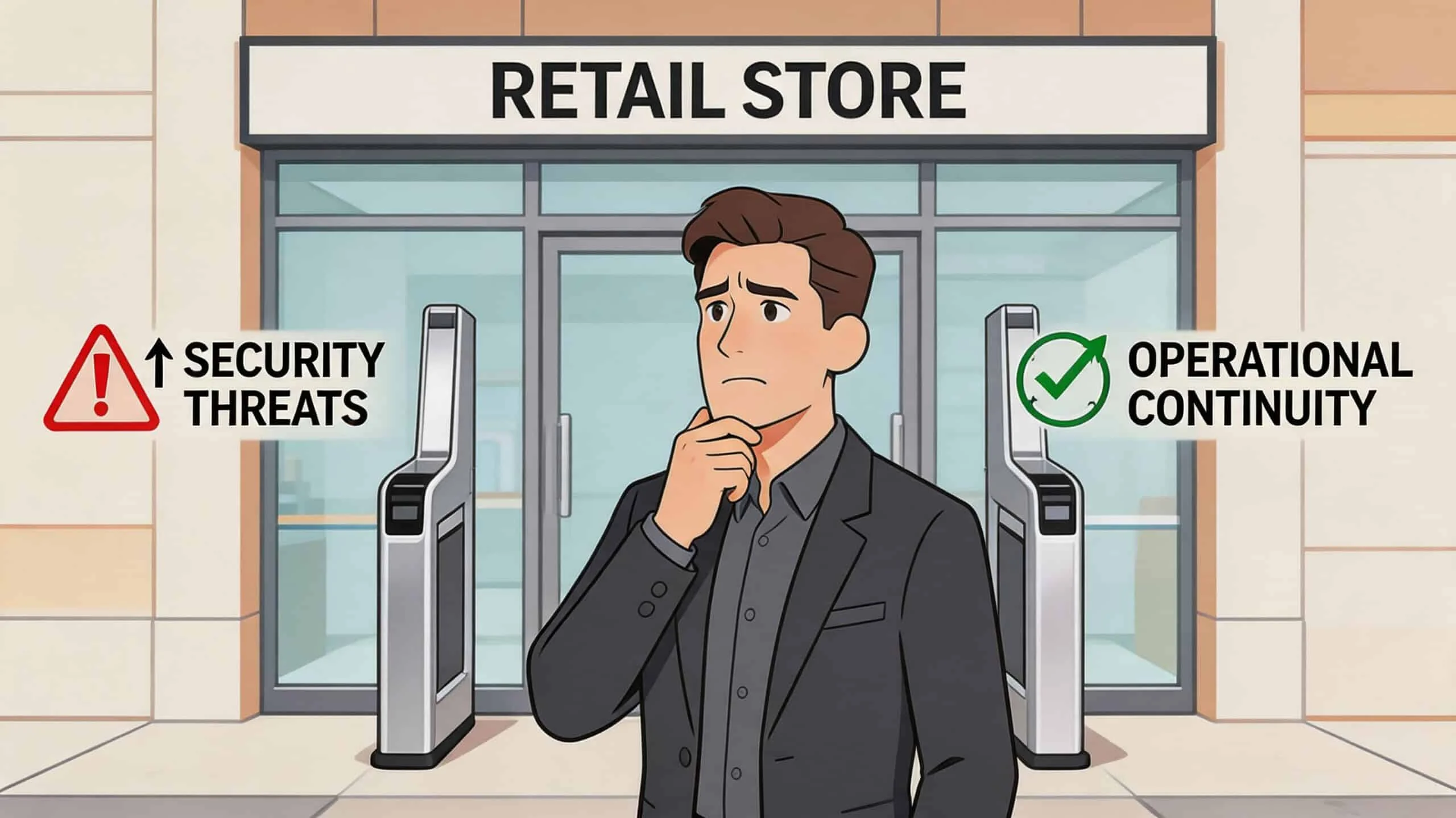
The entrance has to do several jobs at once. It needs to deter forced entry, preserve safe egress, fit the daily opening and closing routine, and hold up through weather, impacts, and repeated cycles. In many retail settings, it also has to protect merchandise without turning the storefront into a blank metal wall.
That balance matters even more during a retrofit. A gate that looks fine on paper can create problems fast if it interferes with fire alarm interfaces, track placement, or floor traffic. Teams often discover too late that they bought for purchase price instead of for uptime.
What operations leaders usually need to solve
Most projects start with one of these situations:
- A recent break-in or attempted entry: The business wants a stronger barrier without a drawn-out renovation.
- A new location or tenant fit-out: The team needs a gate that matches branding, landlord rules, and code requirements.
- A portfolio refresh: Property managers want consistency across sites so maintenance, parts, and training are easier to manage.
- A warehouse-connected retail operation: The front-of-house gate needs to align with broader access control and shipping security.
Practical rule: If the gate choice creates daily friction for staff, people will work around it. The right system gets used properly because it fits the operation.
Store security also works best when it supports the overall layout. If you’re reviewing traffic flow, display placement, and sightlines at the same time, this short resource on retail display best practices is useful context. Security equipment performs better when it doesn’t fight the way customers and staff move through the space.
What works in the field
Teams get the best results when they treat the gate as part of the full entrance system. That includes glazing, locking, alarm integration, operator choice, and service access. It’s the same thinking used on commercial door and dock equipment. Components last longer when they’re selected as a system instead of pieced together by trade.
That approach also makes budgeting cleaner. You can compare options based on risk reduction, maintenance load, and expected operating conditions rather than on a simple line-item price.
Exploring the Main Types of Retail Security Gates
Most buyers don’t need more product names. They need a clear way to sort options by function. In practice, retail store security gates usually fall into four main categories, and each one solves a different problem.
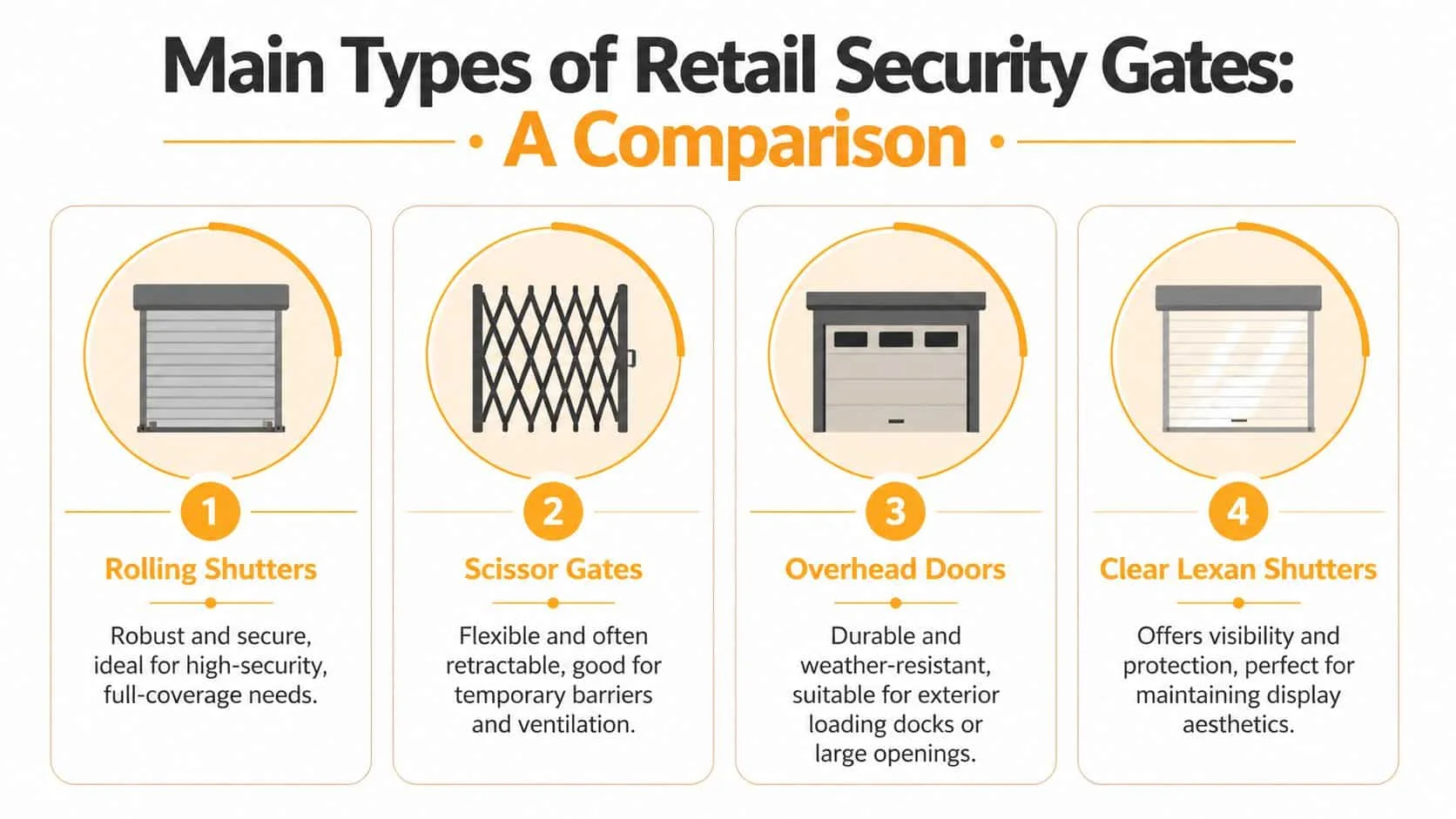
Rolling shutters
A rolling shutter works like a storefront version of a garage door. Slats coil up into a barrel above the opening and drop down to create a full barrier when closed.
These are a strong fit where privacy and full coverage matter. Pharmacies, electronics stores, stock rooms, and after-hours service counters often use them because they block both access and visibility.
Best fit: high-risk retail, back-of-house openings, exterior-facing locations.
Main advantage: solid coverage. You’re securing the opening and concealing what’s behind it.
Main trade-off: once it’s closed, merchandise disappears from view. For retailers that rely on after-hours window display, that can be a drawback.
Grille gates
A grille gate is the open-pattern option many people picture in shopping centres. It rolls or stacks away but leaves visibility through the opening when closed.
This type is useful when the store wants security without hiding displays. It also helps where airflow and sightlines matter. Mall tenants often prefer grilles because the storefront still looks active after hours.
Best fit: shopping centres, fashion, specialty retail, interior concourse storefronts.
Main advantage: visibility. Customers, security staff, and property teams can still see through the gate.
Main trade-off: it won’t provide the same visual privacy as a solid shutter.
For openings that need a collapsible front-line barrier, folding security gates are one common approach. They’re often chosen for storefronts, service counters, and areas where retractability matters as much as security.
A gate that preserves sightlines can be the right answer in one store and the wrong answer in the next. The merchandise mix matters.
Sliding or scissor gates
Scissor gates open sideways like an accordion. They’re simple, familiar, and useful across a wide range of retail and light industrial settings.
These gates often make sense where the opening is wide, the budget is controlled, and the team wants a visible, mechanical barrier without a large overhead housing. They’re also practical for internal separations such as stock area closures, receiving areas, and storefronts inside multi-tenant buildings.
A few points matter with scissor-style systems:
- Space at the side: The gate has to stack somewhere when open.
- Daily handling: If staff open and close it often, hardware quality and smooth tracking become important fast.
- Floor conditions: Uneven floors and debris can create operating issues over time.
High-security roller doors
This is the heavy-duty end of the category. High-security roller doors are built for harsher use, larger openings, or higher-risk environments such as distribution points, warehouse-connected retail, and loading areas with direct exterior exposure.
They’re less about storefront presentation and more about impact resistance, cycle durability, and integration with the broader building security plan. If a receiving area handles valuable product, this style of closure usually makes more sense than a lighter retail grille.
Quick comparison for common applications
| Gate type | Where it fits best | What it does well | What to watch |
|---|---|---|---|
| Rolling shutter | Exterior storefronts, stock rooms, service windows | Full coverage and privacy | Hides display area when closed |
| Grille gate | Mall storefronts, display-driven retail | Maintains visibility | Less visual concealment |
| Scissor gate | Wide interior openings, counters, back-of-house separations | Compact, familiar, flexible | Needs proper side stack space |
| High-security roller door | Loading docks, warehouse-facing retail, high-risk openings | Handles tougher use and stronger impacts | Heavier system, more installation planning |
What usually fails
The wrong choice is often obvious in hindsight. A decorative-looking grille gets installed at an opening that really needed a stronger loading-area closure. Or a solid shutter is selected for a premium storefront where after-hours visibility drives sales presentation. Another common mistake is using a light-duty gate at a location with rough daily handling, carts, pallets, or repeated open-close cycles.
The gate has to match the opening, the environment, and the people using it. If any one of those is off, maintenance costs show up before the capital budget has even faded from memory.
Understanding Key Materials and Performance Specs
Two gates can look similar from ten feet away and perform very differently in the field. The material specification tells you which one you’re buying.
For folding systems, the details matter. Gates built with 18-gauge tubular steel in the scissor mechanism and 16-gauge hot-rolled U-channel steel in the guides are a stronger choice when forced entry resistance is the priority. According to this technical folding gate specification, that construction can withstand impact forces up to 1,500 lbs, and independent testing found gates with those specs reduced smash-and-grab break-ins by 67% in urban Toronto retail districts.
What those specs mean in plain language
Gauge refers to thickness. In simple terms, lower gauge steel is thicker than higher gauge steel. So when you compare structural pieces, gauge isn’t a cosmetic detail. It affects how much the gate flexes when someone pries, pushes, or strikes it.
The scissor mechanism is the moving lattice that expands and contracts. If that assembly twists easily, the gate may still look closed while becoming easier to defeat. The U-channel guide is the track or support path that keeps the gate aligned. Better guide strength helps the whole assembly stay square under pressure.
How material choice affects daily use
Security performance gets most of the attention, but daily wear is where cheaper gates often give themselves away.
Look closely at these practical factors:
- Rigidity under load: A stiffer gate resists racking. That means it stays aligned instead of binding after an impact or rough handling.
- Wear at pivot points: Rivets, bushings, and fittings take constant movement. Poor hardware can turn a smooth gate into a service call.
- Finish quality: In Canada, coatings matter. Salt, slush, humidity, and temperature swings punish exposed metal.
- Track design: Dirt, snow, and debris collect where the gate travels. Track style affects both operation and cleaning.
If the opening sits near an exterior entrance, receiving area, or draft-prone vestibule, corrosion resistance matters even more. A gate that degrades slowly but steadily becomes a reliability problem before it becomes an obvious security problem.
Don’t buy on appearance alone
A showroom sample can hide weak internals. Ask how the product is built, not just how it looks when extended.
Strong gate performance usually comes from boring details. Steel gauge, guide strength, hardware quality, and finish consistency are what keep a gate operating after the first hard season.
For projects weighing enclosed systems as well as open-pattern gates, it helps to compare them with door roller shutters because shutters and folding gates solve different problems even when they occupy the same opening.
Questions worth asking a vendor
A few specification questions cut through marketing quickly:
- What material is used in the moving lattice and in the guides?
- Is the gate intended for light retail use or repeated daily operation?
- How is corrosion resistance handled for Canadian conditions?
- What parts typically wear first, and how are they serviced?
- If the opening takes an impact, what components are most likely to need replacement?
Those answers usually tell you whether the gate was designed for sustained use or priced to win a quote.
How to Select the Right Gate for Your Retail Environment
The right gate depends less on product category and more on the job the opening has to do. A fashion tenant in a shopping centre doesn’t face the same risks as a warehouse-connected retail pickup zone. Treat them the same and one of them will end up with the wrong system.
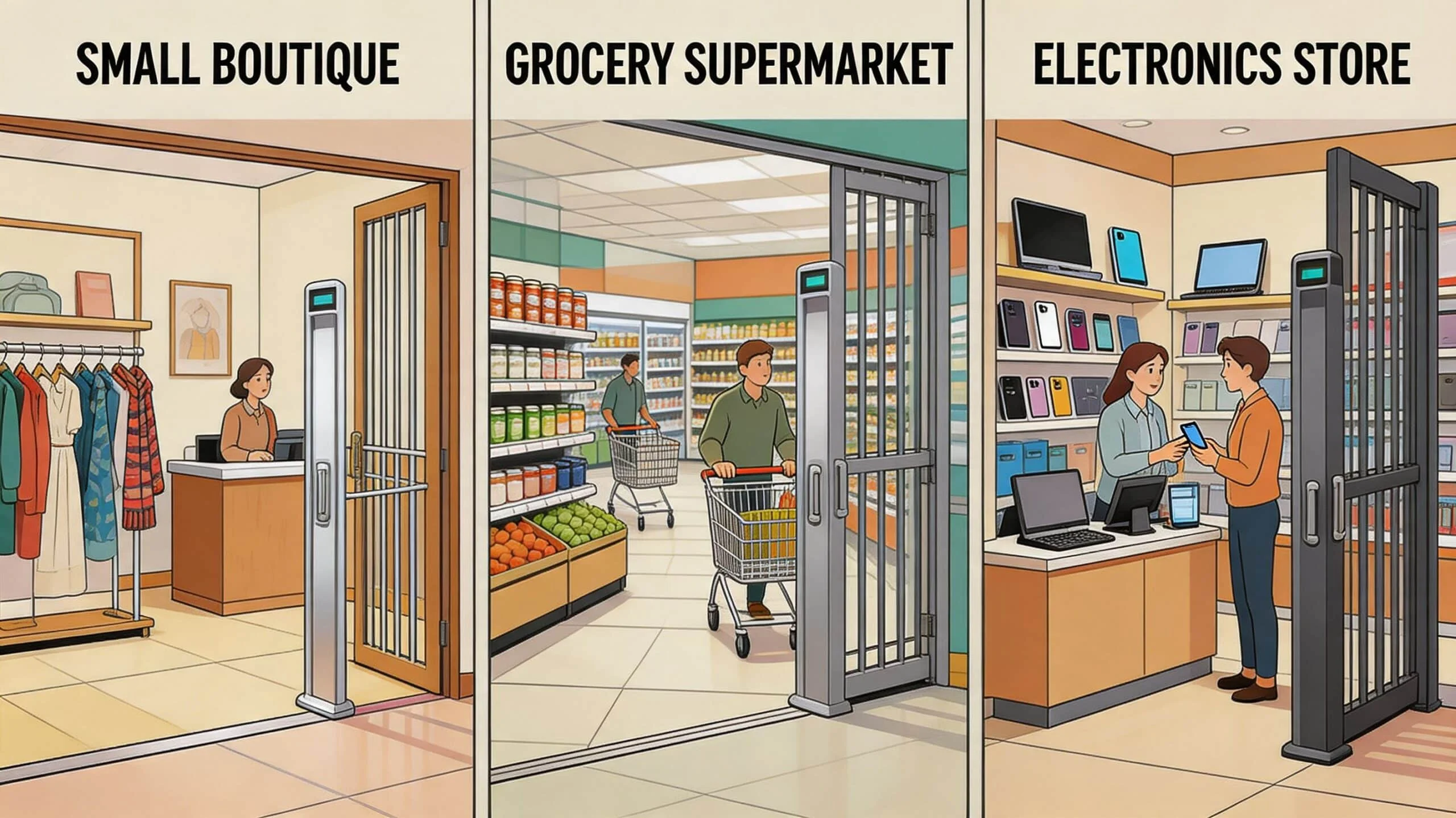
The high-street boutique
This location usually cares about storefront appearance almost as much as after-hours protection. The merchandise is visible, branding matters, and the front elevation often carries the store’s identity.
A grille-style closure often works well here because it secures the opening while preserving sightlines into the display. If the location is street-facing and exposed to higher risk, some owners move toward stronger rolling solutions or hybrid designs, but they should do it knowingly. The gain in barrier strength may come with a loss in visual merchandising.
The big-box retailer
A large-format entrance creates a different set of problems. The opening is wide, daily traffic is heavy, and the team may need to manage carts, vestibules, or after-hours access for cleaning and stocking.
In these spaces, gate selection has to account for traffic patterns and abuse tolerance. Light retail hardware tends to suffer if staff move carts through the area, if floor conditions are inconsistent, or if the opening is shut and reopened by multiple teams each day. Simpler operation usually wins. The more complicated the process, the more likely it is that someone will leave the barrier unsecured or use it improperly.
The shopping centre tenant
Mall stores often need a closure that works with landlord standards, preserves the storefront, and fits life safety requirements for a multi-tenant environment. That’s a narrower lane than many buyers realise.
The gate has to close securely, look appropriate, and coordinate with the building’s safety expectations. Tenants also need to think about service access. If one failed lock or track issue can stop opening on a Saturday morning, the maintenance response matters just as much as the hardware selection.
The warehouse and distribution centre retail edge
The complex nature of certain security points often leads to many procurement mistakes. A retail-facing opening connected to warehouse operations may look like a storefront problem, but it behaves more like an industrial security point. Product value is higher, impacts are harsher, and the consequences of unauthorized access are more serious.
For those conditions, hybrid systems can make sense. According to this hybrid storefront gate overview, hybrid gates built with twice the steel gauge of standard models and continuous framing reduced unauthorized access by 82% in recent Canadian pilot programs. Their higher impact tolerance also makes them well suited to loading-dock-adjacent areas and other openings that see tougher use.
If pallets, carts, or dock equipment move anywhere near the opening, choose the gate as if the space were industrial. Because in practice, it is.
For teams comparing stronger solutions across different applications, commercial security gate options provide a useful reference point for how product types differ by environment.
A practical selection filter
Use these questions before you ask for pricing:
- What are you protecting? Front display merchandise, controlled stock, pickup inventory, or a path to the warehouse all call for different barriers.
- Who uses the opening every day? Sales staff, cleaners, receiving crews, security, and property management teams don’t all operate equipment the same way.
- What kind of abuse will the opening take? Foot traffic is one thing. Carts and dock-adjacent impacts are another.
- Does visibility matter after hours? For some retailers, yes. For others, concealment is a benefit.
- Will the system integrate with broader access control? If so, specify that early rather than adding it later.
Good selection starts with the operation, not the catalogue.
Navigating Installation Compliance and Safety Requirements
A gate can be secure and still be wrong for the building. That’s the part many projects miss.
In Canadian facilities, compliance isn’t paperwork at the end. It shapes the whole installation. The opening may need to satisfy the National Building Code of Canada, local and provincial requirements, fire protection expectations, emergency egress needs, and product-specific standards such as ULC-S358 where fire-rated assemblies are involved. If the gate interferes with any of those, the problem doesn’t disappear because the equipment looks substantial.
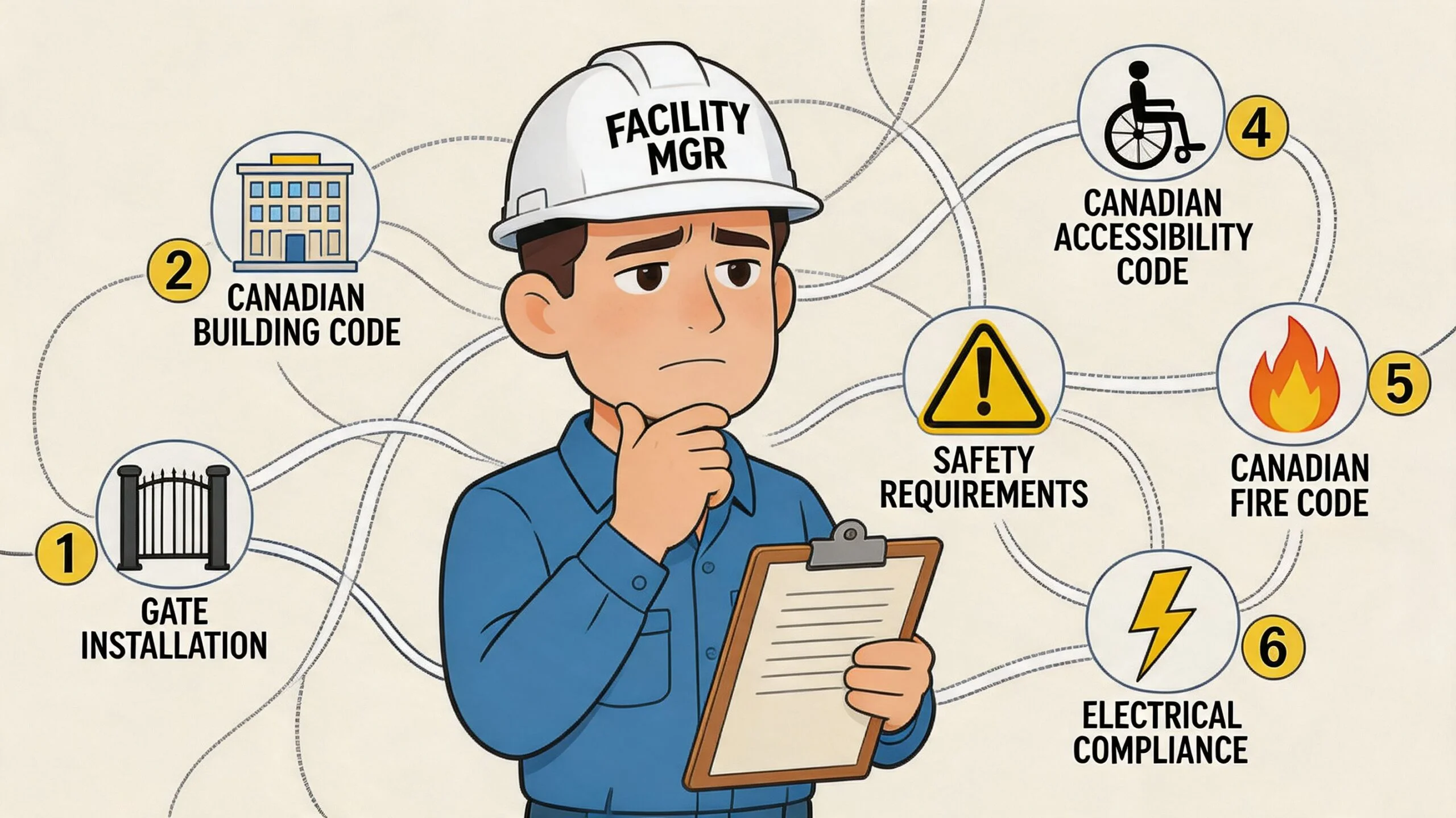
Why compliance belongs at the start
Retrofits are where teams most often get caught. The opening already exists, the leasehold is active, and the schedule is tight. Someone chooses a gate based on dimensions and price, only to discover later that egress, fire integration, or assembly ratings weren’t properly addressed.
That’s not a minor snag. A 2023 Retail Council of Canada report noted that 28% of Canadian retailers faced code violations in security retrofits, with fines averaging $15,000 per incident in Ontario and BC due to failures to meet National Building Code and ULC fire door standards, as cited in this Canadian security gate compliance article.
The compliance points that matter most
A practical review usually includes these items:
- Egress requirements: Occupants must still be able to exit safely in an emergency. A gate can’t compromise that path.
- Fire alarm integration: Some openings require the closure to respond appropriately to alarm conditions.
- Rated assembly compatibility: If the opening is part of a fire-rated separation, the gate or door assembly may need to meet a specific standard.
- Accessibility: Hardware placement, operation, and path conditions must support accessible use where required.
- Installation method: The way tracks, housings, anchors, and operators are mounted can affect both code compliance and performance.
A non-compliant installation often looks acceptable until an inspection, an alarm event, or an incident exposes the gap.
New construction and retrofit are not the same job
New construction gives the design team room to coordinate structure, electrical, alarm interfaces, and clearances from the beginning. That usually leads to cleaner installations and fewer compromises.
Retrofit work is tighter. Existing slab conditions, ceiling obstructions, glazing, and tenant improvements all limit your options. In those environments, field verification matters more than catalogue assumptions. An experienced installer should measure the opening, confirm surrounding conditions, and flag conflicts before equipment is ordered.
What operations teams should ask before approval
Use simple questions:
| Question | Why it matters |
|---|---|
| Is this opening part of a rated separation? | It determines whether a standard security gate is even appropriate. |
| How does the gate affect egress? | Security can’t interfere with safe exit. |
| Does it connect to alarm or life safety systems? | Integration affects both compliance and operation. |
| Who verifies the final installation? | Clear accountability reduces inspection surprises. |
This is one area where cutting corners rarely saves money. It usually shifts cost into rework, delays, inspection issues, or a forced replacement.
Calculating Cost Maintenance and Long-Term ROI
The cheapest gate on bid is often the most expensive gate to live with. Purchase price is only one part of the cost. A complete cost figure includes installation quality, maintenance frequency, downtime risk, emergency repair exposure, parts availability, and how well the system supports loss prevention over time.
That’s why total cost of ownership matters more than sticker price. A gate that costs less upfront but binds, corrodes, or fails after routine use usually creates a larger bill through service calls, operating disruption, and shortened replacement cycles.
What goes into ownership cost
For most facilities, the cost picture includes five buckets:
- Capital and installation: The gate itself, operator choice, structural support needs, and electrical work.
- Maintenance labour: Inspections, adjustments, lubrication, testing, and wear-part replacement.
- Downtime: Delayed opening, restricted access, security exposure, or after-hours emergency dispatch.
- Loss prevention impact: How much the gate contributes to reducing theft opportunity.
- Building interaction: How the gate works with access control, HVAC containment, and the rest of the opening.
One reason automated systems continue to gain ground is that they support cleaner operation and better integration. According to this security gates market analysis, automated security gate systems account for 60% of new deployments in North America and can reduce theft incidents by up to 30% when integrated with access control systems.
Where buyers underestimate cost
The hidden costs usually show up in ordinary weeks, not major incidents. Staff struggle with a stiff manual gate and stop using it correctly. A low-grade finish starts showing corrosion. A track issue forces a service call right before opening. Parts are non-standard, so repairs take longer than expected.
Those aren’t dramatic failures. They’re operational drags. Over time, they matter as much as the original invoice.
A helpful outside read on this mindset is this guide on lowering ownership costs. It’s not specific to doors and gates, but the procurement logic is familiar. Assets that are easier to maintain and more reliable in daily use usually cost less over their service life.
A simple ROI lens for operations teams
You don’t need a complicated model to compare options. Start with these questions:
- Will the gate reduce theft exposure at this opening?
- Will it lower the frequency of service calls?
- Will staff use it consistently because operation is straightforward?
- Will it integrate cleanly with current access control and building procedures?
- Will the vendor support preventive maintenance and emergency response?
If the answer is yes to most of those, the higher-priced option may still be the better value.
Maintenance shouldn’t start after the warranty issue appears. It should start when the gate enters service.
One practical example is a planned maintenance arrangement that includes inspection, adjustment, and testing on a schedule suited to the opening’s use. That reduces surprise failures and helps teams spot wear before a Saturday opening or overnight closure becomes a problem. In this category, Wilcox Door Service Inc. is one provider that installs and services security gates alongside broader commercial door and dock equipment, which can simplify support for facilities managing multiple access points under one maintenance plan.
Your Procurement Checklist for Security Gates
Most gate problems can be traced back to one of three mistakes. The buyer didn’t define the risk clearly, didn’t verify compliance early enough, or didn’t ask how the system would behave after the install crew left. A short checklist helps avoid all three.
Security and operational fit
Bring these questions into the vendor conversation:
- What are we securing at this opening? Ask whether the recommended gate is meant for visible retail display, stock protection, loading-dock adjacency, or interior separation.
- How often will this gate cycle? Daily use affects operator choice, hardware wear, and maintenance planning.
- Will carts, pallets, or cleaning equipment pass nearby? If yes, the gate needs to tolerate more abuse than a light-duty storefront system.
- Do we need after-hours visibility? Grilles and solid shutters solve different business problems.
Materials and build quality
Don’t settle for broad descriptions like heavy-duty or commercial grade. Ask for specifics.
- What are the steel gauges and guide materials?
- How is corrosion resistance handled for Canadian conditions?
- Which parts wear first, and how are replacements managed?
- What happens after a minor impact? Good systems are easier to reset and repair.
Compliance and installation
Many bids appear similar until better questions are posed.
- Is the opening subject to NBC, provincial fire, or ULC requirements?
- How is egress protected?
- Does the installation need alarm integration or rated assembly coordination?
- Who is responsible for field verification before fabrication?
Vendor and service support
A gate is only as useful as the service behind it.
- What does the maintenance program include?
- How quickly can emergency repairs be dispatched?
- Are parts standardized across multiple sites?
- Can the vendor support retrofits and new construction under one service model?
Procurement goes better when you buy for the opening’s full life, not just for the tender deadline.
If you’re comparing quotes now, use this checklist to force a more useful discussion. It will quickly separate vendors who understand openings, compliance, and service from vendors who are only pricing hardware.
If you’re planning a retrofit, replacing a failed gate, or standardising security across multiple sites, contact Wilcox Door Service Inc. to schedule a site review and discuss code-compliant options that support safety, uptime, and long-term ownership value. Respected Partners, Reliable Service.