


A failed overhead door garage opener usually becomes urgent at the worst possible time. A trailer is waiting, a forklift is idling, staff are standing by, and one stuck door turns into a shipping delay, a security gap, and a safety problem in a matter of minutes.
That’s why commercial openers need to be treated like operating equipment, not like an afterthought. In a warehouse, plant, or multi-tenant commercial property, the opener affects daily cycle speed, service access, security, compliance, and how often your team gets pulled into avoidable repairs.
Facility managers usually start by asking which opener is “best.” The better question is which opener fits the door, the traffic pattern, the building conditions, and the code requirements you’re dealing with in Canada. What works over a small service bay often won’t work over a high-lift warehouse door. What seems cheaper on day one can cost more in downtime, nuisance faults, and shortened hardware life.
This guide lays out the practical side of choosing and managing an overhead door garage opener for business use. You’ll see how the main opener types differ, why jackshaft operators are so common in busy warehouses, what selection criteria matter most, how smart controls fit into facility operations, where Canadian compliance issues tend to catch people, and what daily or monthly checks prove helpful.
The goal is simple. Help you make a choice that protects uptime, controls long-term cost, and keeps the door system safe for the people using it every day.
Your Essential Guide to Commercial Overhead Door Openers
Commercial doors don’t fail in isolation. When an opener stops working, the problem spreads fast. Shipping schedules slip, dock flow gets messy, drivers start waiting, and staff often try to force a door that should never be forced. That’s when a simple operator problem becomes a damaged door, a bent track, or an injury risk.
A commercial overhead door garage opener is the working control centre of the opening. It starts and stops the door, manages the movement pattern, communicates with safety devices, and has to repeat that process reliably through heavy daily use. In a distribution setting, that means the opener has to do more than lift a door. It has to do it consistently, safely, and in a way that matches the door’s track configuration and the facility’s operating pace.
Practical rule: If the opener was selected only on price, there’s a good chance someone ignored the door layout, the cycle demand, or the building conditions.
The ultimate trade-offs show up over time:
- Lower upfront cost: Can make sense on a lighter-use opening, but it often brings more wear, more noise, and less flexibility.
- Faster, smoother operation: Helps traffic flow and reduces stress on hardware when matched correctly to the door.
- Wrong mounting style: Can turn a straightforward installation into a chronic service issue.
- Poor system integration: Leaves managers blind to faults until the door stops during a busy shift.
Canadian facilities have another layer to think about. Cold weather, insulated doors, outage risk, and code requirements change what a sensible opener decision looks like. A unit that seems acceptable in a mild, low-cycle environment may not hold up well at a loading dock in winter or in a retrofit where fire-safety integration matters.
That’s where a practical approach matters most. Start with the door style and lift type. Match the operator to use intensity. Make sure the control and safety devices fit the site. Then look at maintenance access, not just brochure features. Facilities that do this well usually spend less time reacting to failures and more time keeping traffic moving.
Understanding Commercial Opener Fundamentals
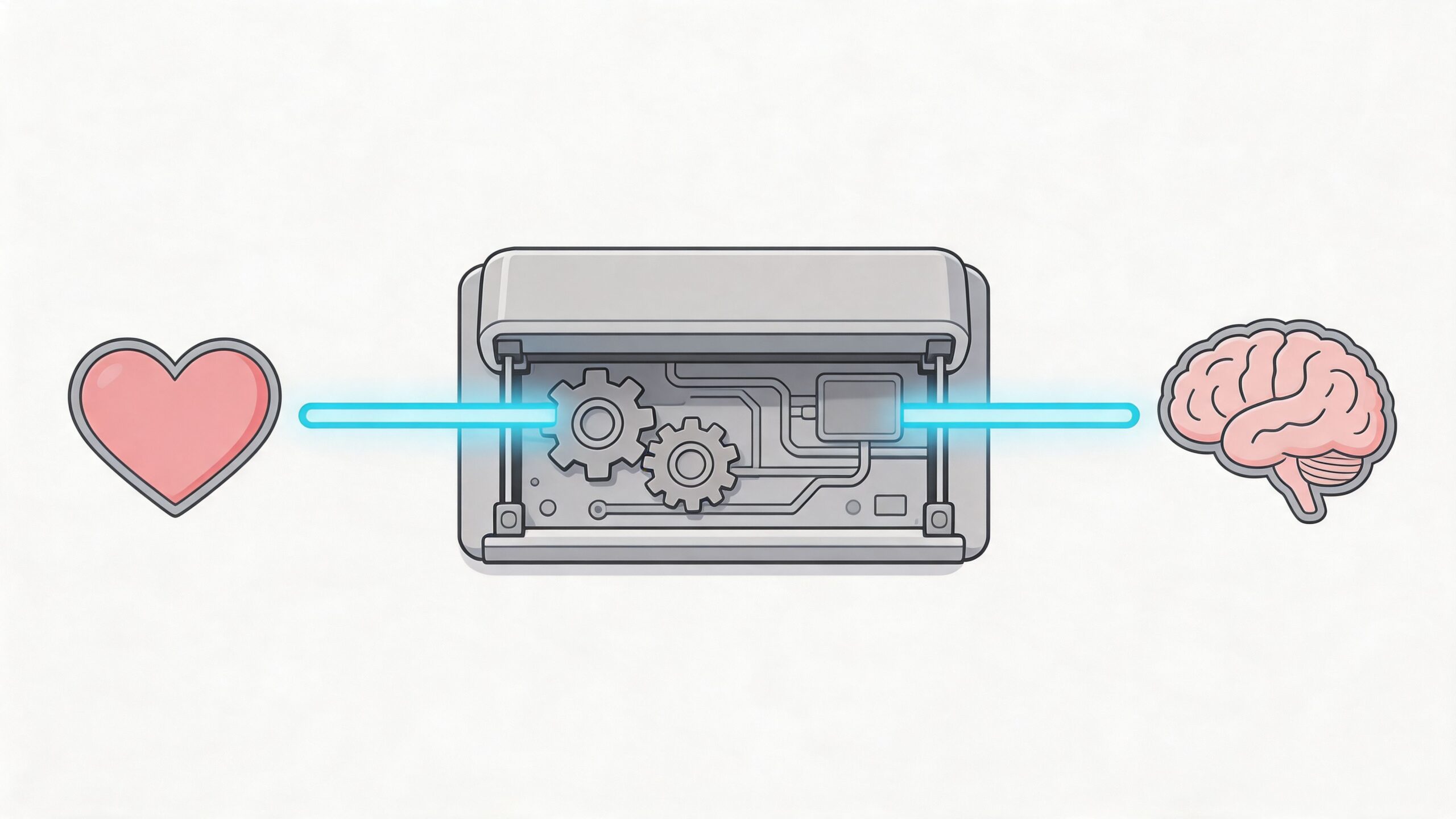
A commercial opener is the heart and brain of the whole door system. The motor supplies the force. The control logic tells the system when to run, when to stop, and when to reverse. If either side is mismatched or failing, the entire opening becomes unreliable.
The parts that matter most
Every commercial opener has a few core components, even if the mounting style changes.
- Motor: This is the power source that moves the door. In commercial settings, the motor has to handle heavier loads and more frequent cycles than a residential unit.
- Drive mechanism: This transfers power from the operator into door movement. Depending on the operator type, that may be done by a rail and trolley or by direct torque on the torsion shaft.
- Control panel or logic board: This is the decision-making side of the system. It handles open and close commands, limit settings, timers, and safety responses.
- Safety devices: Photo eyes, monitored entrapment protection, edge devices, and reversing functions help prevent a closing door from striking a person, vehicle, or material.
If any one of those elements is poorly installed or out of adjustment, the opener won’t behave properly. People often blame the motor when the problem is a bad sensor alignment, a worn door, or a control fault.
Commercial duty versus residential duty
The easiest comparison is a delivery truck versus a passenger car. Both move people or goods, but they aren’t built for the same workload. A residential opener may work fine for a few cycles a day on a lighter door. A commercial operator is expected to work with larger openings, heavier construction, and repeated daily use without overheating or losing adjustment.
That difference shows up in several ways:
- Build quality: Commercial operators are designed for sustained use and heavier door systems.
- Power options: Facilities may use single-phase or three-phase electrical service depending on the site and the operator.
- Control flexibility: Commercial settings often need timers, external activation devices, lockouts, and integration with broader building systems.
- Serviceability: Technicians need room to inspect, adjust, and replace parts without dismantling half the opening.
The operator also has to match the door itself. A sectional overhead door, rolling steel door, and fire door all place different demands on the opener. If you’re reviewing operator options alongside the actual door assembly, it helps to compare them with the door types used in commercial overhead door applications.
A reliable opener won’t compensate for a bad door. If the springs, tracks, or balance are wrong, the operator ends up doing work it was never meant to do.
That’s the starting point most new facility managers need. The opener isn’t a standalone box with a wall button. It’s part of a mechanical and electrical system, and it only performs well when the whole assembly is matched and maintained properly.
Choosing Your Opener Type Trolley vs Jackshaft
The two operator styles most facility managers run into are trolley operators and jackshaft operators. They solve the same basic problem in very different ways. Choosing between them usually comes down to door geometry, available headroom, traffic demands, and whether ceiling space matters.
When a trolley operator fits
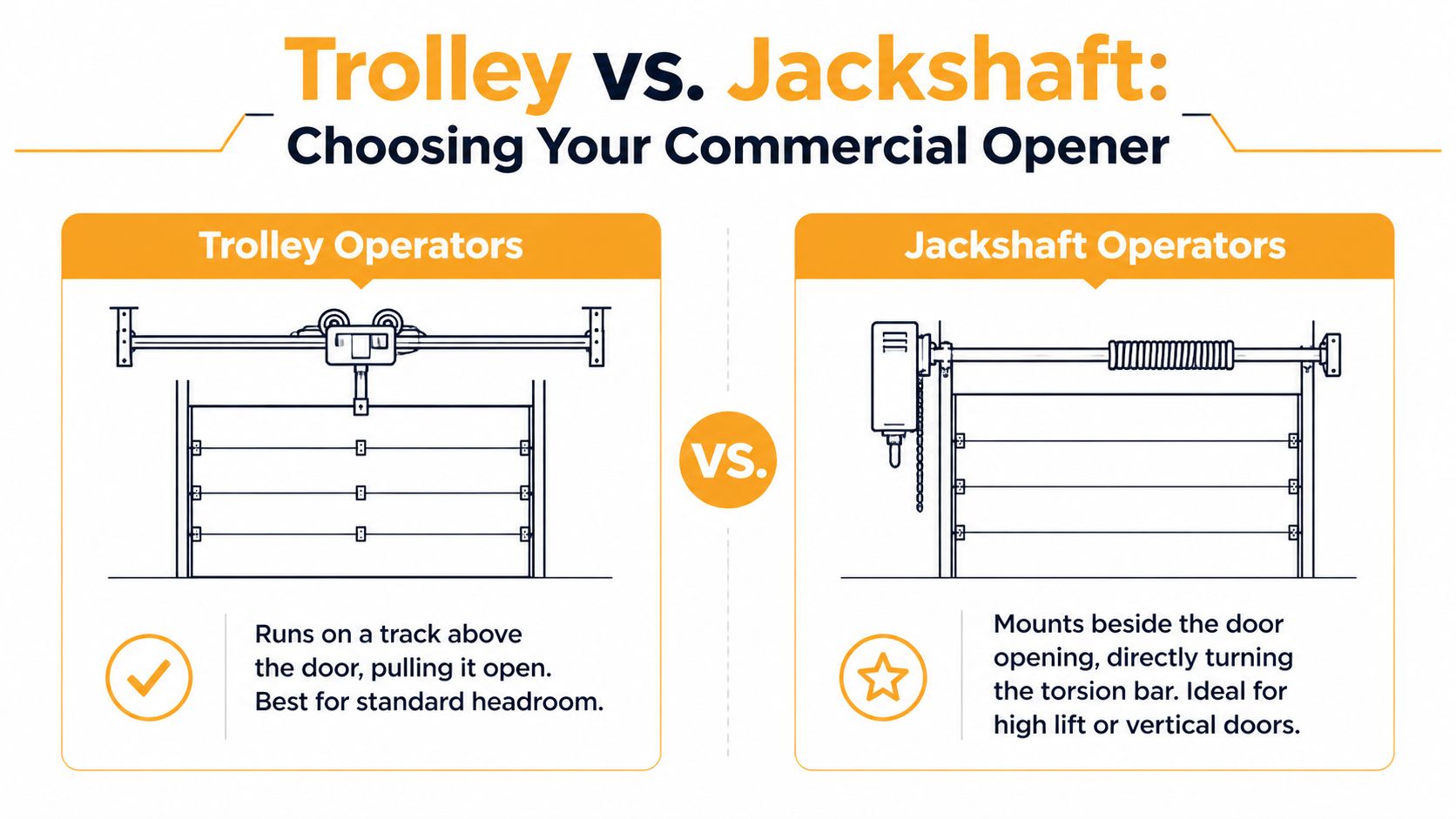
A trolley operator runs on a rail above the door opening. The operator pulls or pushes the door through that track arrangement. This style is common where the door has a more standard lift path and where there’s enough overhead room to install the rail properly.
There are two familiar versions:
- Chain-drive trolley: Better suited to tougher industrial settings where noise isn’t a major concern and straightforward mechanical durability matters more than refinement.
- Belt-drive trolley: A better fit when the opening is near offices, production rooms, or occupied spaces where quieter operation is worth paying for.
A trolley setup can be perfectly appropriate on service bays, light commercial units, or buildings with standard sectional doors and predictable clearance. It’s also familiar to many maintenance teams, which can make routine observation easier.
Still, trolley operators have limitations. They take up overhead space. They rely on a rail path above the opening. They also don’t suit many modern warehouse configurations where the door travels high up the wall or vertically toward the roof structure.
Why jackshaft is the common warehouse answer
In busy warehouses, jackshaft operators are usually the practical choice because most facilities don’t have standard-lift sectional doors. They have high-lift or vertical-lift doors that need to keep overhead space open for forklifts, racks, sprinklers, lights, and ductwork.
A jackshaft mounts beside the door and turns the torsion shaft directly. That changes everything about the installation. There’s no trolley rail running across the ceiling, and the operator works with the door’s shaft system instead of trying to pull the door along an overhead rail.
That’s why a standard trolley system often won’t work in those environments. The track path and door movement don’t match what a trolley operator is designed to control.
For facilities evaluating this style, it helps to review a dedicated jackshaft garage opener option and compare it against the actual lift configuration on site.
If the building needs ceiling clearance, a side-mounted operator usually solves problems before they start.
What the trade-off looks like in practice
Jackshaft operators are rarely chosen because they look cleaner. They’re chosen because they fit the way the door travels. In a distribution centre, that matters more than almost anything else. Clear ceiling space improves forklift movement, protects overhead services, and keeps the opening compatible with tall storage systems.
Trolley units still have a place. If the opening is smaller, the lift is standard, and the environment is less demanding, a trolley operator can be a sensible and economical fit. The mistake is assuming all sectional doors can use the same operator style.
Here’s the practical comparison.
Trolley vs. Jackshaft Openers A Comparison
| Feature | Trolley Operator (Chain/Belt) | Jackshaft Operator |
|---|---|---|
| Mounting position | Mounted overhead with rail above the door | Mounted on the wall beside the door |
| How it moves the door | Pulls or pushes via trolley on a track | Turns the torsion shaft directly |
| Best fit | Standard-lift sectional doors with available headroom | High-lift or vertical-lift sectional doors |
| Ceiling space impact | Uses overhead space | Preserves ceiling clearance |
| Noise considerations | Chain is louder, belt is quieter | Depends on site and setup, but avoids trolley rail movement overhead |
| Maintenance focus | Rail alignment, chain or belt condition, attachment points | Shaft connection, wall mounting, coupler and brake-related components |
| Typical warehouse suitability | Often limited | Common choice |
| Retrofit concern | Can be difficult where overhead obstructions exist | Better where headroom and building services are tight |
A simple rule for deciding
If the door is a standard sectional opening in a lower-demand environment, a trolley operator may be enough. If the door is high-lift, vertical-lift, or installed where overhead space is valuable, start with jackshaft.
That’s the pattern technicians see repeatedly in the field. The opener that works on paper isn’t always the opener that works after six months of daily dock traffic. The right choice follows the door path first, then the budget.
Key Selection Criteria for Your Facility
Once the operator type is narrowed down, the actual selection work starts. The opener has to match the way the opening is used, not just the way the opening looks. A door at a quiet service entrance and a door cycling all day at a shipping lane may be similar in size, but they don’t need the same operator.
Start with the operating demand
Duty cycle is how often the door opens and closes. That sounds basic, but it’s where many operator choices go wrong. If the opening serves a warehouse lane, receiving area, or high-traffic internal bay, the opener needs to tolerate repeated use without drifting out of adjustment or running hot.
Ask these questions:
- How many cycles does the opening see in a normal shift
- Does traffic spike at certain hours
- Will one failed opener stop shipping or production
- Is the door part of a staffed area, or does it need reliable unattended operation
A low-use operator in a high-use environment usually creates nuisance shutdowns first, then mechanical wear issues after that.
Match the opener to the actual door
Door size, weight, insulation, and track style all matter. A heavily insulated door behaves differently from a lighter non-insulated door. In Canadian facilities, that matters even more because insulated commercial doors are common in cold storage and weather-sensitive spaces.
Overhead Door models such as the Legacy 850 and Odyssey 1000 use 140V DC motors that can reach up to 10 inches per second, with variable-speed soft starts and stops that reduce acceleration load by 25 to 40 percent and may extend rail and gear life by up to 50 percent, according to Overhead Door product information for the Legacy 850. In practical terms, smoother starts matter because the opener isn’t shocking the hardware every time the door moves.
That kind of operation is useful where openings cycle often, where insulated doors add load, or where rough starts have already been hard on the system.
Field note: Fast opening is useful. Controlled opening is what usually saves hardware.
Review power and building conditions
Some sites have straightforward electrical service. Others are dealing with older panels, limited room for new feeds, or environments that are hard on equipment. Moisture, dust, wash-down conditions, corrosion, and temperature swings all affect what style of operator and enclosure make sense.
Use this checklist during specification or replacement:
- Electrical supply: Confirm whether the opening is set up for single-phase or three-phase service before choosing the operator.
- Surrounding environment: Food, beverage, chemical, and wash-down areas may need different operator protection than a dry warehouse.
- Access for service: If a technician can’t safely reach controls, limits, and moving parts, maintenance becomes slower and more expensive.
- Door balance and hardware condition: A new opener won’t fix worn springs or poor balance. It will just inherit those problems.
Consider noise and occupied space
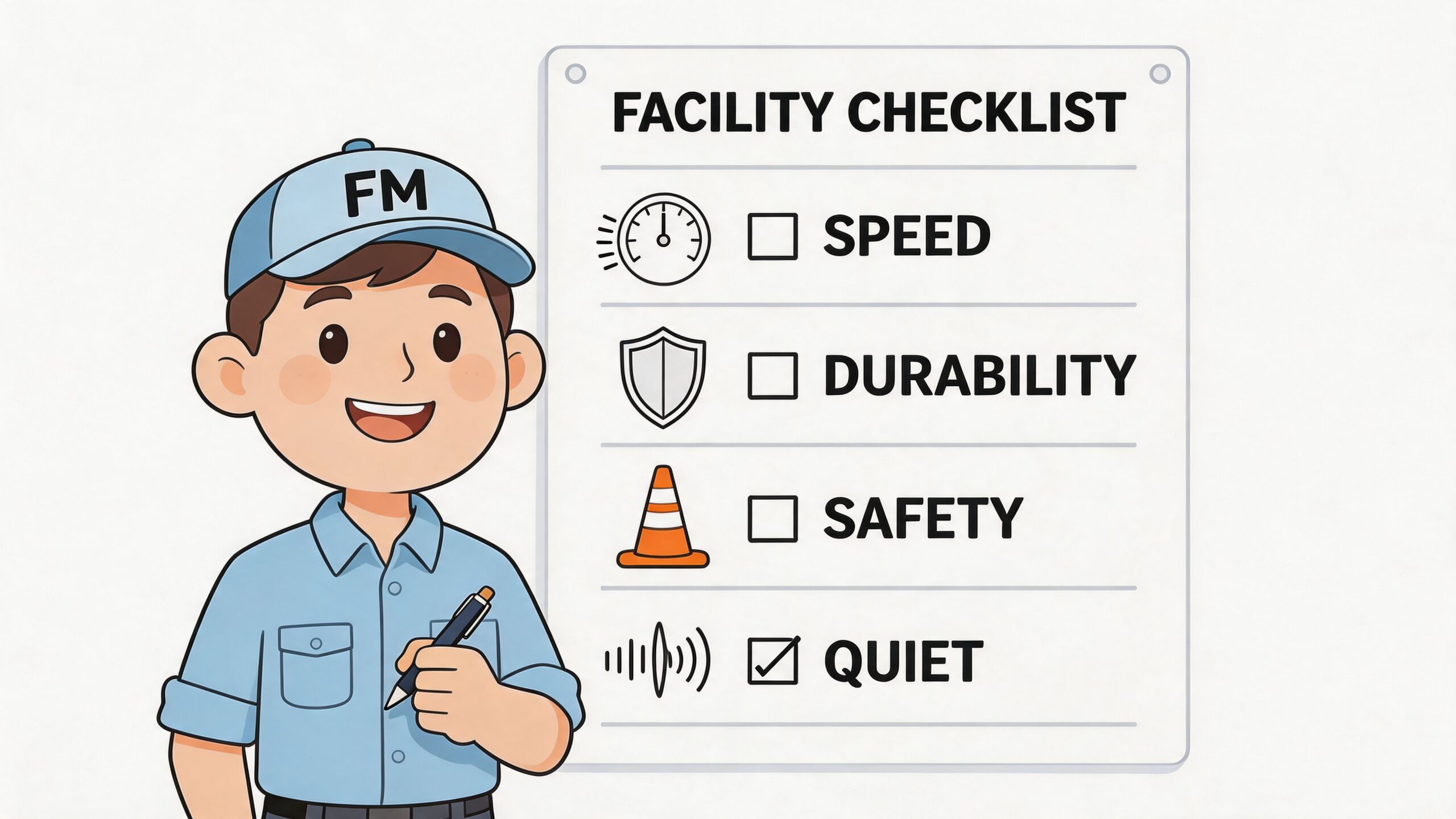
In mixed-use facilities, noise can matter more than people expect. If the door is near offices, tenant areas, or production spaces where sound carries, belt-driven trolley setups may be preferable to chain-driven ones. The opener should fit the building, not annoy the people working beside it.
A good specification balances four things at once. The door’s movement path, the cycle demand, the site conditions, and the ease of service. Miss one of those, and the overhead door garage opener may still run, but it won’t run well for long.
Integrating with Access Control and Smart Technology
A modern commercial opener shouldn’t operate like an isolated box on the wall. In most facilities, it needs to work with security, access permissions, service planning, and remote visibility. That’s where the value of smart integration shows up.
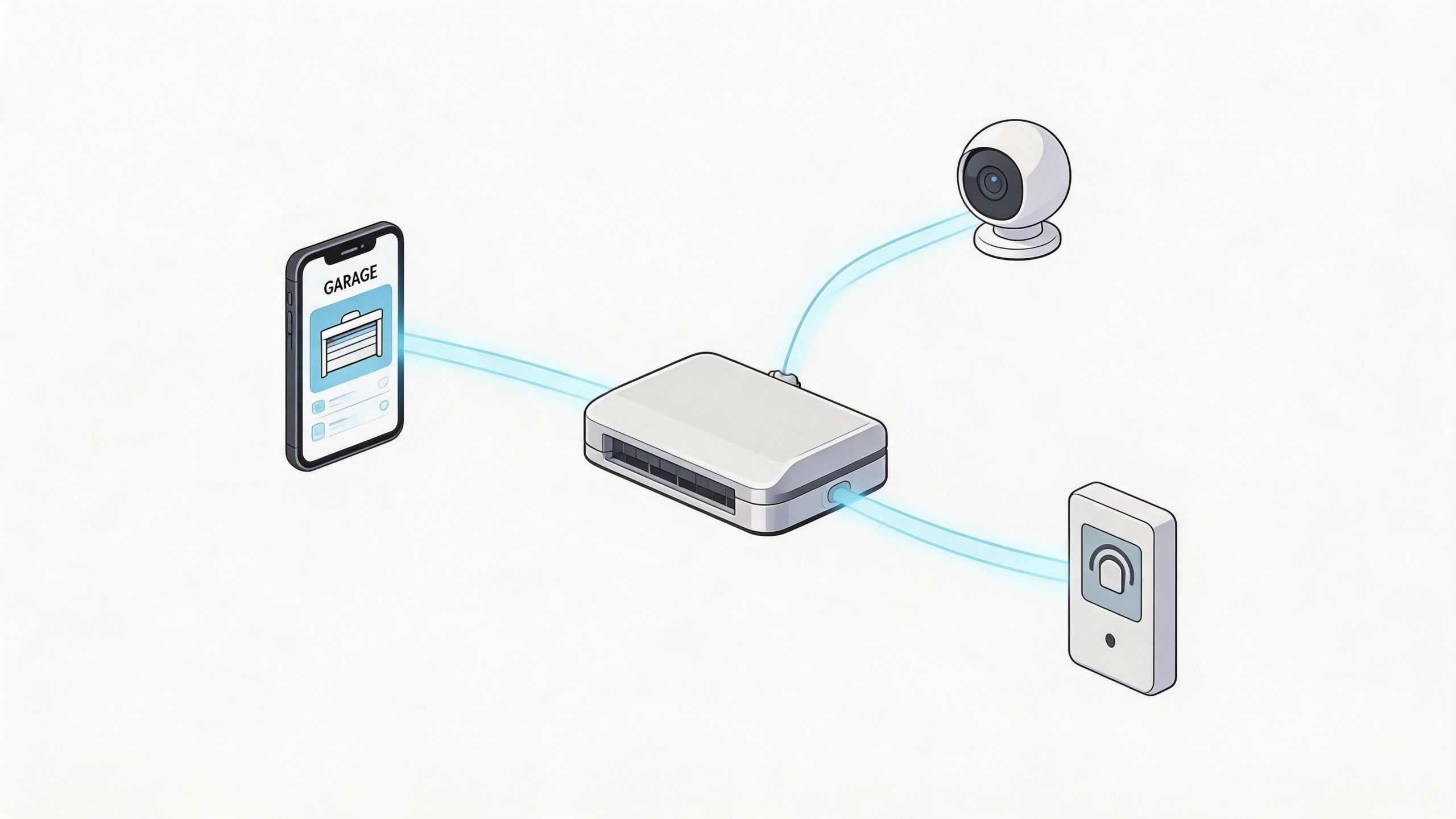
An integrated overhead door garage opener can connect to card access, vehicle detection, remote monitoring, and operator diagnostics. For a facility manager, that means fewer blind spots. You can see whether a door was left open, spot fault trends sooner, and reduce the number of times staff are using workarounds because a door control setup is clumsy.
Security and control need to work together
A good opener installation doesn’t just open and close a door. It also controls who can trigger it, when they can do it, and what the system records. That matters at shipping doors, service entrances, and tenant-accessed openings where an unsecured or poorly controlled operator can create a building risk.
Some facilities tie operator controls into broader access control system installation work so they can manage door permissions from the same security structure used elsewhere in the building.
One example from current product literature is CodeDodger® rolling code technology. It uses 2^28 combinations and can reduce break-in risk by 99.9 percent versus fixed codes, while OHD Anywhere® adds remote diagnostics and cycle counting that can support ROI in as little as two years through reduced downtime and energy savings, according to the Odyssey 1000 brochure.
That matters in practice because fixed, simple access methods tend to linger for years after a site has outgrown them.
Common integrations that actually help
The most useful integrations are usually the least flashy:
- Remote status monitoring: Lets managers confirm whether an opening is open, closed, or faulted without walking the site.
- Cycle counting: Helps service teams plan maintenance before wear turns into failure.
- Vehicle detection loops: Reduces accidental closing when traffic is moving through the opening.
- Timer-to-close and supervised controls: Useful where doors are often left open after deliveries.
- Centralized access permissions: Important in multi-site property management and facilities with rotating staff.
Here’s a quick visual example of how connected controls fit together in the field.
Smart features only pay off if someone uses the data. A cycle counter is valuable when it drives planned service, not when it sits ignored in a menu screen.
The practical goal isn’t novelty. It’s control. If a manager can catch unusual cycling, recurring faults, or after-hours activity before it becomes a larger problem, the opener starts contributing to uptime instead of just consuming maintenance budget.
Navigating Installation Safety and Compliance in Canada
Commercial opener installation is not a do-it-yourself task. The operator has to be mounted correctly, wired correctly, adjusted correctly, and matched to the full door assembly. If any part of that chain is wrong, the site takes on safety risk and compliance risk at the same time.
In Canada, that gets more complicated when the opening is part of a fire-rated assembly, a loading dock system, or a retrofit with low headroom and limited structural space. The opener isn’t judged on convenience alone. It has to work with the building’s safety requirements and with the hardware already attached to the opening.
Where facilities get caught
The trouble spots are usually retrofits and multi-system openings. A property manager replaces an operator, but the replacement doesn’t properly integrate with the fire door function, the truck restraint sequence, or the seal arrangement at the dock. The door may still move, but the installation can fail a deeper compliance review.
A 2025 Facilities Management Canada report noted that 42 percent of multi-site property managers in Canada faced non-compliance fines averaging $15,000 CAD per incident for untested or improperly installed operators, especially where fire safety and truck restraint integration were missed under recent NBC amendments, as cited in this low-overhead installation guide.
That’s why commercial retrofits need more than a parts swap. They need a proper site review.
The Canadian details that matter
The National Building Code of Canada and related standards create real obligations around installation and testing. In low-headroom industrial settings, the mounting method, support structure, and compatibility with surrounding equipment can affect whether the installation is acceptable.
Key issues include:
- Fire door compliance: Fire door operators need to meet the applicable fire-door testing and installation standards, and they require proper drop-testing.
- Structural attachment: In retrofit work, mounting details matter. A wall or joist connection that seems “good enough” can fail review if it doesn’t suit the load and site condition.
- Accessibility and safety devices: Controls need proper placement, and entrapment protection has to function as intended.
- Integrated dock systems: The opener may need to work in sequence with restraints, levelers, seals, or other loading dock equipment.
In seismic regions and in more complex retrofit environments, certified and properly trained technicians are often required because the work affects life-safety functions, not just convenience.
A commercial operator can be mechanically sound and still be a compliance problem if it was installed without regard to the full opening.
Why electrical verification matters too
Opener reliability also depends on the supply side. Poor power quality, incorrect protection, or questionable wiring can create intermittent faults that look mechanical at first. For managers dealing with broader building condition reviews, it can help to understand how formal electrical inspections work. A good example is the process used to get an EICR certificate, which shows how electrical condition reporting is used to verify safety and identify defects in building systems.
That same mindset applies here. The opener should be reviewed as part of a complete mechanical and electrical access system, not as a standalone motor replacement. When that approach is taken early, facilities avoid failed inspections, service disputes, and expensive rework later.
Proactive Maintenance and Basic Troubleshooting
Most opener failures give warning before they stop the door completely. The problem is that those warnings are easy to ignore during a busy week. A little observation from the facility team can catch changes early and help a technician arrive with the right plan.
What your team can check safely
In-house checks should stay simple and visual. Staff shouldn’t adjust springs, force settings, shaft connections, or limit systems unless they’re qualified to do it.
Safe routine checks include:
- Look for wear: Inspect chains, belts, mounting points, and visible fasteners for slack, fraying, or movement.
- Watch the travel: A door that starts jerking, hesitating, or stopping unevenly is telling you something has changed.
- Keep the path clear: Debris near tracks, sensor zones, or floor-level controls can create faults and unnecessary service calls.
- Test safety devices: Confirm that photo eyes and related protection devices are clean, aligned, and reacting properly during normal testing procedures.
- Listen for new noise: Grinding, popping, or sharp vibration usually means parts are wearing or the door is no longer moving smoothly.
Trouble signs that need a technician
Some symptoms should trigger a service call right away:
- Door won’t fully close: Could be sensor trouble, limit issues, or an obstruction signal.
- Grinding or skipping sounds: Often points to wear in drive components or load problems in the door system.
- Operator strains or stalls: The opener may be fighting poor balance, damaged hardware, or electrical issues.
- Door reverses unexpectedly: A safety input or force setting may need professional diagnosis.
- Visible mounting movement: If the operator or supports are shifting, stop using the opening until it’s inspected.
For planned service support, a structured garage door maintenance program helps keep inspections consistent and service history organized. In practice, that matters more than people think. Patterns like repeat faults, increasing noise, or gradual slowdown are easier to catch when someone is documenting them.
Don’t judge an opener by whether it still runs. Judge it by whether it runs smoothly, predictably, and without new warning signs.
A commercial overhead door garage opener usually lasts longer when the facility team focuses on reporting symptoms early, and leaves adjustments and repairs to qualified technicians.
Partnering for Long-Term Operational Reliability
The right opener choice affects more than door movement. It affects safety, shipping flow, maintenance planning, compliance exposure, and how often your team gets interrupted by avoidable failures. In most commercial settings, the smartest decision is the one that fits the door path, the traffic level, and the building conditions from the start.
If you’re comparing replacement options across sites, it can also help to get a free garage door estimate as part of your budgeting process so you can benchmark scope and installation assumptions before committing. For Canadian facilities that need a site-specific review, a qualified commercial assessment is the next practical step.
If you want a second opinion on operator selection, retrofit constraints, or recurring door issues, contact Wilcox Door Service Inc. for a site assessment and expert recommendation. Respected Partners, Reliable Service.