


A new facility manager usually spots the weak points fast. The loading dock that stays busy after hours. The parts cage with a tired accordion gate. The exterior vehicle entrance that works fine until weather, traffic, or a sensor issue turns it into a bottleneck.
That’s where door security gates move from a simple product choice to an operations decision. The right gate protects inventory, controls traffic, supports life safety, and holds up under constant use. The wrong one creates service calls, audit headaches, and downtime at the exact moment your team needs reliability.
Most articles treat security gates as a catalogue item. In practice, they sit at the intersection of security, fire code, access control, energy performance, and maintenance planning. Canadian facilities feel that more sharply because climate, compliance, and operating hours put more stress on every opening.
Your Comprehensive Guide to Commercial Door Security Gates
Door security gates matter most where access is valuable and traffic is messy. That usually means shipping doors, storefront openings, service corridors, interior inventory rooms, and perimeter vehicle entry points. In those locations, a gate has to do more than close an opening. It has to match the way the building operates.
A distribution centre, for example, might need visible separation at one opening and heavy perimeter control at another. A manufacturing plant may need a gate that secures a tool crib without blocking airflow or sightlines. A property manager may need a system that locks down common areas after hours without creating problems for tenants, cleaners, or emergency egress.
The practical questions are straightforward:
- What are you protecting: stock, equipment, vehicles, staff access, or a combination.
- How often will it cycle: occasional after-hours use or repeated opening through the day.
- What can’t be compromised: visibility, fire separation, speed, clearance, or environmental control.
- What systems must it work with: card readers, intercoms, truck restraints, alarms, or fire release.
Practical rule: Start with the opening’s job, not the product brochure. A gate that looks strong on paper can still be the wrong fit if it slows traffic, blocks sightlines, or conflicts with code.
Good gate decisions usually come from looking at the full lifecycle. Type and material come first. Then compliance, integration, installation conditions, and maintenance requirements. That’s the difference between buying hardware and putting a dependable access solution in place.
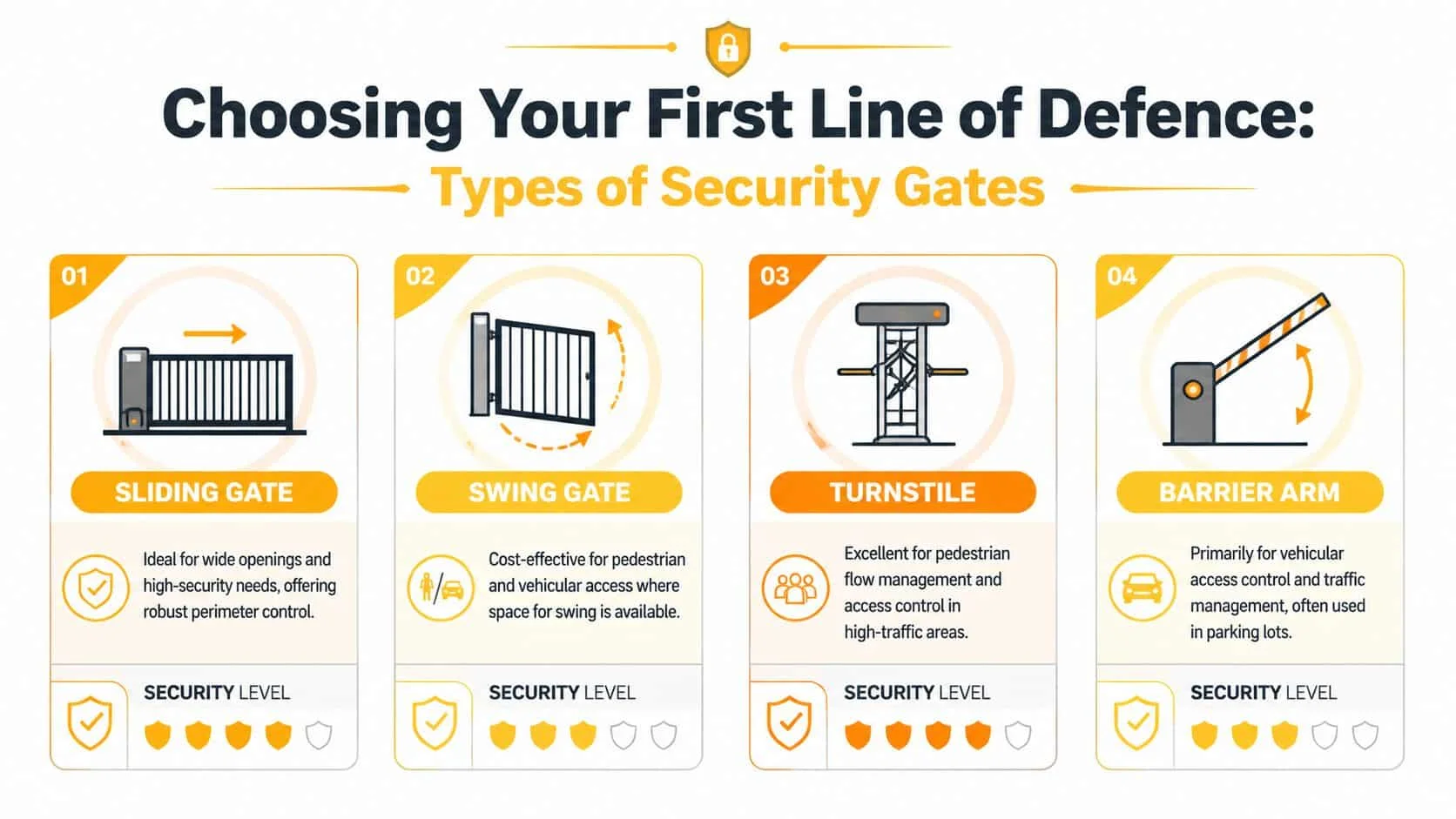
Choosing Your First Line of Defence Types of Security Gates
The first choice is the gate style. Different openings demand different mechanics. A retail grille, a dock opening, and an exterior truck entrance may all be called “security gates,” but they solve very different problems.
Rolling grilles
Rolling grilles coil upward into a barrel above the opening. They’re common in retail storefronts, concession areas, parking structures, and interior commercial openings where you want security without losing visibility.
They work well when people need to see into the secured area after closing. That’s useful for merchandising, security patrols, and spaces where airflow matters.
- Best fit: Storefronts, service counters, parking garage openings, common-area closures
- Pros: Maintains visibility, uses minimal side room, suits frequent opening and closing
- Cons: Doesn’t provide insulation, can be noisy if neglected, needs overhead room for the coil
Sectional security doors
A sectional security door looks and operates more like a standard overhead door. Panels travel on track and rest overhead when open. These are often chosen where the opening needs stronger separation and a familiar service profile.
In industrial settings, this style suits facilities that already maintain overhead doors and want similar hardware, track layouts, and repair practices.
- Best fit: Warehouse openings, service bays, mixed-use industrial spaces
- Pros: Sturdy construction, familiar operating system, can support stronger environmental separation than open grille styles
- Cons: Reduces visibility, needs track and headroom, can interfere with lights, sprinkler lines, or dock equipment if planned poorly
Scissor and accordion gates
Scissor gates, often called accordion or folding gates, expand across an opening and collapse to the side when not in use. They’re practical for interior applications where a permanent wall or full overhead assembly doesn’t make sense.
They’re popular for hallways, parts rooms, receiving areas, and secondary dock zones. Folding security gates are especially useful where the opening changes function through the day and needs quick manual control after hours.
- Best fit: Hallways, stock rooms, cage areas, interior loading and service spaces
- Pros: Simple operation, good for retrofits, preserves visibility and ventilation
- Cons: Limited weather resistance, less suitable for large exterior spans, can become misaligned if the floor or support structure shifts
Sliding gates
Sliding gates move horizontally along a fence line or wall. For large exterior openings, they’re often the most practical option because they don’t need swing clearance into traffic lanes.
For Canadian industrial perimeters, high-security chain link gates in the 32 31 13.53 specification can be designed to resist 2,500 lbs (11.1 kN) horizontal load using 11-gauge galvanized steel mesh with a 2-inch diamond weave, according to security gate specification guidance. That matters at sites with trucks, snow storage, and high wind exposure.
Hinged swing gates
Swing gates are familiar and cost-effective when there’s room for the leaf to open safely. They can work for pedestrian lanes, service yards, and lower-complexity vehicle entrances.
The limitation is usually space. If the gate swings into a traffic path, a snow pile, or a door zone, the lower purchase cost disappears quickly in daily frustration.
Security Gate Type Comparison
| Gate Type | Ideal Application | Pros | Cons |
|---|---|---|---|
| Rolling grille | Storefronts, counters, parking openings | Visibility, compact footprint, good for controlled access | No insulation, overhead coil required |
| Sectional security door | Warehouse and industrial openings | Strong separation, familiar hardware, durable | Less visibility, needs track space |
| Scissor or accordion gate | Interior rooms, hallways, secondary dock areas | Flexible retrofit option, fast manual operation, open sightlines | Not ideal for exposed exterior conditions |
| Sliding gate | Perimeter and vehicle entrances | Handles wide openings, avoids swing conflict, strong perimeter control | Needs lateral run space, track area must stay clear |
| Hinged swing gate | Pedestrian or vehicle access with open apron space | Straightforward design, lower complexity in the right layout | Requires swing clearance, can conflict with traffic and snow |
If an opening serves both people and vehicles, separate the functions. One gate trying to manage both usually creates compromises in safety and flow.
Understanding Gate Materials and Performance Ratings
A gate usually looks fine at handover. The true test comes in February, after forklift contact, freeze-thaw cycles, washdowns, and thousands of openings. Material selection determines whether that gate still runs true three years later or starts consuming service hours and creating security gaps.
Facility managers often focus on the panel and miss the assembly. The frame, posts, rollers, hinges, guides, fasteners, finish, and operator all age together. If one part is undersized, the whole opening becomes harder to secure, harder to maintain, and more expensive to own.
What the common materials really mean
Galvanized steel is still the default choice for many commercial and industrial gates because it balances strength, repairability, and cost. It handles abuse better than lighter materials in yards, service corridors, and exterior openings. In Canadian climates, the quality of the galvanizing and the finish system matters as much as the base metal. Cut edges, field modifications, and exposed hardware are common corrosion starting points.
Stainless steel fits sites where corrosion pressure is constant, such as food plants, wet processing areas, and chemical washdown environments. It costs more up front, and that premium only makes sense when the environment would shorten the life of coated steel. It is also heavier on some assemblies, which can affect operator sizing and hardware wear if the design is not matched properly.
Aluminum works well for lighter grilles and some interior or sheltered applications where lower weight helps with operation and support loads. That advantage has limits. At high-abuse openings, aluminum can deform sooner under impact, and the repair path is not always as straightforward as steel.
How to read gauge and structural strength
Gauge is only one part of the story, but it is a useful warning sign. Lower gauge numbers mean thicker steel. If a specification highlights heavy infill but says little about posts, hinge mounts, track supports, or locking points, review it closely. Many disappointing installations start with a decent curtain or panel and weak supporting hardware.
Ask for the full load path. How is force transferred from the gate leaf into the frame, then into the wall slab or steel support? On a wide opening, post deflection and anchor design often decide long-term performance more than the infill itself.
For facility teams, this matters in daily operation. A gate that flexes too much may still close for a while, but alignment drifts, latches stop lining up, operators work harder, and service calls increase.
Ratings that matter in Canadian conditions
Published ratings are useful only if they match the opening’s real duty and environment.
For exterior and mixed-use facilities, review these items before approval:
- Corrosion resistance: Confirm the finish on panels, welds, fasteners, tracks, and accessories, not just the main frame
- Wind loading: Large exterior gates need enough stiffness and anchorage for the site exposure
- Cycle rating: A gate used all day at a shipping entrance needs hardware and operators rated for frequent use
- Impact tolerance: Forklift traffic, carts, and pallet movement change the design requirements quickly
- Cold-weather reliability: Ice buildup, contraction, sensor performance, and lubricant selection all affect winter operation
Energy performance belongs in the same conversation, especially in Canadian facilities with conditioned warehouses, cold rooms, or heated service areas. An open security grille may provide visibility and access control, but it will not manage air movement the way an insulated closure will. In some openings, the right answer is not a single product. It is a coordinated system that pairs security with thermal separation and fire system requirements.
That trade-off gets overlooked often. A gate can improve theft control and still work against the building if it increases heat loss, creates drafts near occupied areas, or interferes with the opening’s intended fire and life-safety function. At Wilcox Door Service, we usually review material, duty cycle, code exposure, and building use together because those decisions affect service life far more than brochure features do.
A durable gate is not just hard to force open. It stays aligned, operates in winter, resists corrosion, and fits the building’s safety and energy demands over time.
Navigating Canadian Codes and Compliance Requirements
The first code problem many facility managers run into is simple. A gate gets approved for security, then fails review because the opening is also part of egress, a fire separation, or an automated access route.
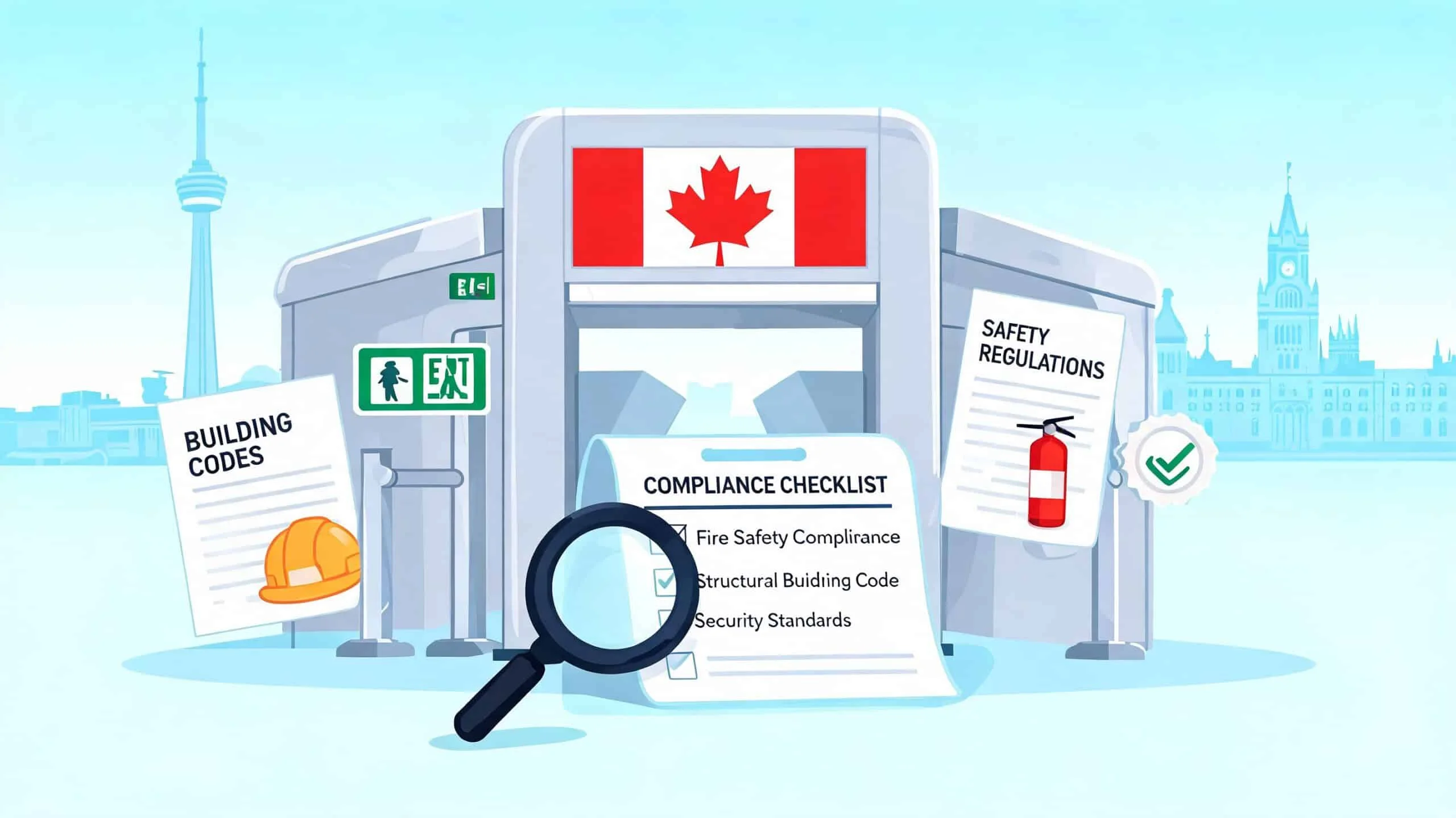
In Canadian facilities, gate compliance has to be checked against three things at the same time. The opening’s use, the operator and safety hardware, and the building code or fire code conditions tied to that location. If one of those is missed, the gate can create inspection problems, unsafe operation, or expensive rework after installation.
Gate operators and safety compliance
Powered gates need listed, properly configured operators and functioning entrapment protection. That includes the safety devices, force settings, and reversal logic the operator was designed to use. A commercial gate that opens and closes all day at a yard entrance has a very different risk profile than a low-cycle gate inside a secured storage area.
The practical issue is not paperwork. It is injury exposure and shutdown risk. If the operator, photo eyes, edges, loops, or release controls are not installed and maintained as a system, the opening becomes unpredictable under daily use.
For facility teams planning upgrades, it helps to review the gate together with the building’s access control system installation requirements. That usually surfaces conflicts early, especially where credentials, emergency release, and operator logic all meet at one opening.
Canadian code review needs to start at the opening
Security gates are often treated like add-ons. They are not. Once installed, they become part of the opening assembly and can affect egress width, required release functions, visibility, and the way people move during an alarm or power loss.
That matters in warehouses, service corridors, retail back rooms, parking structures, and mixed-use buildings. A grille that works well for after-hours security may be the wrong choice if the opening also needs rated separation or a clear emergency exit path. A full site review should confirm the occupancy, the opening classification, the authority having jurisdiction, and any provincial or municipal requirements before equipment is ordered.
At Wilcox Door Service, we usually find the costly mistakes are basic ones. The wrong operator class. A gate installed where the fire plan requires a different assembly. Access hardware that works during normal hours but does not release the way the life-safety design expects.
Fire-rated openings need closer attention
Fire safety is where many gate projects get off track. Security grilles, shutters, and related closures can look similar from the floor, but their listing, release method, and test requirements are not interchangeable.
If the opening is part of a rated wall or fire separation, the gate or closure has to match that condition. The rating belongs to the full assembly, not just the curtain or grille. Inspection and testing requirements also continue after installation. Facility managers who already oversee doors and barriers across multiple openings often find All Well's fire door inspection tips useful as a general reminder of how quickly small inspection misses turn into larger compliance issues.
For Canadian sites, this is also where ULC requirements come into the conversation. A fire-rated closure may have release, reset, drop-test, and documentation obligations that a standard security gate does not. That affects staffing, maintenance planning, and operating procedures, not just product selection.
The operational takeaway
Code review should happen before procurement, not after the gate arrives. Confirm the opening function, operator listing, safety devices, fire rating needs, egress requirements, and integration points early.
That approach protects more than compliance. It helps the opening work reliably through inspections, winter operation, tenant changes, and future system upgrades.
Integrating Gates with Access Control and Fire Systems
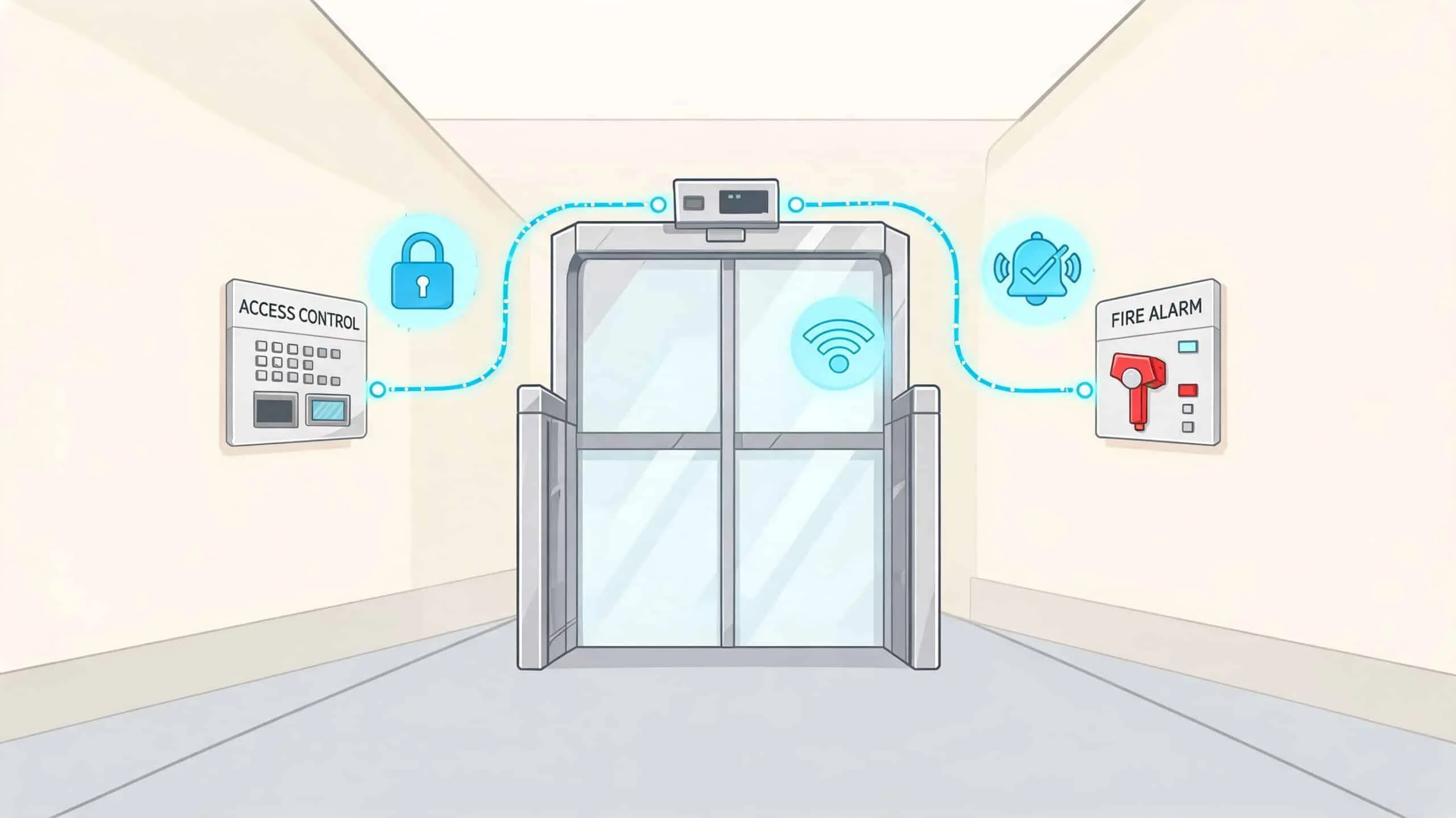
A gate on its own is just a barrier. Once it’s tied to credentials, alarms, sensors, and release logic, it becomes part of the building’s control system.
That’s the easiest way to understand integration. The gate is the hands. The access panel, readers, detectors, and fire system are the central nervous system telling those hands what to do and when.
Access control that matches the opening
Different openings need different credentials. A pedestrian interior gate may use card readers or keypads. A restricted lab or records area may require biometric readers. A vehicle entrance may rely on long-range tags, intercom verification, and loop detection.
The key is matching the reader method to traffic speed and risk. If a credential method slows the line or creates tailgating, people will work around it. That usually means propping, piggybacking, or calling for manual overrides too often.
A practical design usually includes:
- Reader placement: Keep it reachable without unsafe stretching, backing, or exposure
- Safe opening logic: Prevent activation when a path is obstructed
- Event logging: Capture who accessed the opening and when
- Manual override: Allow controlled response during service or emergency conditions
For facilities planning upgrades, commercial access control system installation can connect gates, doors, and related entry hardware into one managed workflow.
Fire alarm override is not optional
A secured opening on an egress route must respond correctly during an alarm condition. The fire system has to override security when life safety requires release, disengaging the lock, or automatic opening, depending on the assembly and code path.
That’s where coordination matters. Electricians, fire alarm technicians, gate installers, and facility staff need the same sequence of operation on paper before wiring starts. Otherwise, the gate may secure properly in daily use but behave incorrectly during testing.
This external resource on fire door inspection tips from All Well Property Services is useful because it reinforces the inspection mindset facility teams need around rated openings, release hardware, labels, and closing behaviour.
When a gate, a card reader, and a fire alarm all touch the same opening, nobody should be guessing about the release sequence.
A short example helps. At a loading area, a security gate may need to stay locked until the access system verifies the user, while the truck restraint confirms trailer securement before related dock equipment can operate. In another part of the site, a parking or service grille may need to change state when ventilation or safety systems call for it.
Here’s a visual overview of how connected systems work together in the field:
Planning for Installation and Site Preparation
Most gate installation problems start before the crate arrives. The opening wasn’t measured correctly. The wall can’t support the loads. Power is missing. Conduit is in the wrong place. The travel path is blocked by bollards, sprinkler piping, dock lights, or stored material.
The smooth installs happen when site prep gets treated like part of the project, not an afterthought.
Structural readiness
Start with the basics. The supporting wall, jambs, header, slab, or posts must carry both the static weight of the gate and the operating forces created during movement, stopping, and wind exposure.
For larger exterior assemblies, foundation quality matters as much as the gate itself. If your project involves new posts, yard structures, or free-standing support elements, this guide to lasting shed foundations from Firm Foundations is a helpful plain-language reference on why stable footings and soil conditions affect long-term alignment.
Electrical and controls planning
Security gates rarely need only one wire. Most openings require power for the operator plus low-voltage pathways for safety devices, access readers, intercoms, loops, or signal accessories.
Use a pre-installation check that covers:
- Power supply: Confirm voltage, disconnects, and circuit capacity before scheduling installation
- Conduit routes: Set pathways early so readers, sensors, and operator connections land where the equipment needs them
- Control locations: Verify mounting heights and weather protection for keypads, card readers, stations, and intercoms
- Safety devices: Leave room and wiring paths for photo eyes, reversing edges, loop detectors, and warning devices
Clearance and work area control
Every gate type needs a clean movement zone. Sliding gates need side room. Rolling grilles need headroom. Swing gates need a full arc free of parked equipment, snow buildup, and pedestrian conflict. Accordion gates need a folding pocket that won’t be blocked by shelving or stored pallets.
A simple walk-through before installation should answer one question. Can the gate open and close every day without the building fighting it?
Lifecycle Costs and Proactive Maintenance Best Practices
A facility manager usually notices gate costs on the day something stops working. A delivery queue builds at the perimeter. Staff prop open an interior grille because the operator is acting up. In winter, a door that does not close properly can also dump heated air into the yard for hours.
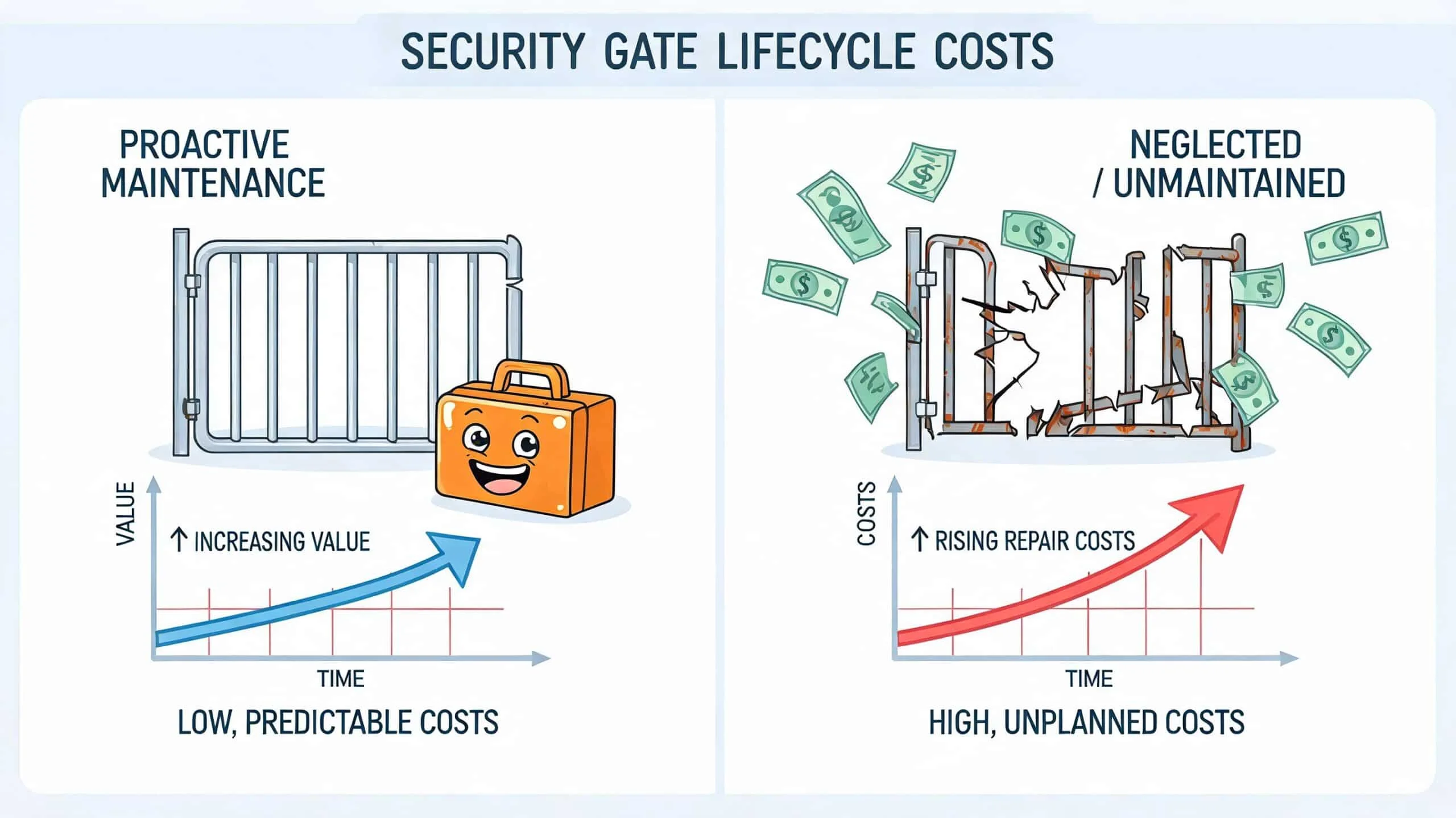
That is why lifecycle cost matters more than purchase price. A lower quote can turn into a more expensive opening if the gate needs frequent adjustments, parts are hard to get, or the assembly was never suited to the site’s traffic, weather, or control system.
Where lifecycle costs usually show up
Over a gate’s service life, cost tends to come from five places:
- Repairs and replacement parts: Rollers wear, tracks drift out of alignment, sensors fail, chains stretch, and operators age out
- Operational disruption: Delayed trucks, blocked access, after-hours callouts, and staff workarounds all add labour and risk
- Energy performance: Openings that do not close properly, or gates paired with poor environmental separation, can increase heating demand in Canadian winters
- Compliance work: Failed tests, missing documentation, and unresolved safety issues create extra service visits and administrative work
- Early capital replacement: Neglect turns serviceable equipment into a replacement project years ahead of schedule
In practice, the expensive failures are rarely dramatic at first. They start small. Slow travel, noisy movement, nuisance reversals, ice-related binding, and latches that need a push are all early signs that wear is getting ahead of maintenance.
Canadian facilities also need to look beyond the gate itself. If the opening ties into fire alarm release, smoke control, or other life-safety functions, missed testing or poor adjustments can create both reliability problems and code exposure. That is one reason we advise clients to review lifecycle cost through three lenses at once: security performance, compliance obligations under the applicable ULC and related requirements, and building operating cost.
Reactive repairs versus planned maintenance
Reactive service has its place. Impacts happen. Motors fail. Weather causes problems no one can fully prevent.
But a gate program built around breakdowns costs more to run and is harder on operations. Emergency calls come at the worst time. Parts decisions get rushed. Small alignment issues become operator damage because nobody corrected the root cause early.
Planned service is usually the better operating model for commercial and industrial openings. A structured inspection program gives technicians time to catch wear, adjust hardware, verify safety functions, and flag end-of-life components before they create an outage. Many facility teams apply that same approach through a planned garage door maintenance program because the service logic is similar across many gate and door systems.
A useful maintenance visit should cover:
- Operators and controls: Confirm limit settings, response time, current draw, and signs of overheating or erratic behaviour
- Safety devices: Test photo eyes, monitored edges, loops, reversing functions, and warning devices
- Mechanical components: Inspect rollers, hinges, bearings, guides, chains, sprockets, track condition, and hardware tightness
- Structure and anchorage: Check posts, welds, fasteners, mounting surfaces, and any impact damage or movement
- Weather and environmental condition: Look for corrosion, water intrusion, snow or ice interference, and seal-related issues that affect energy loss
- Records and follow-up: Document deficiencies, completed adjustments, test results, and parts that should be budgeted before failure
Good records matter. For larger Canadian sites, they help maintenance teams coordinate with EHS staff, security managers, and anyone responsible for inspections tied to fire and life-safety systems.
Reliability comes from disciplined upkeep
Reliable gates are usually boring. They open, close, reverse when they should, and do not force staff to improvise. That outcome comes from correct specification, proper installation, regular inspection, and timely repair.
At Wilcox, we see the same pattern repeatedly. Facilities that budget for preventive service usually get longer useful life, fewer access interruptions, and fewer winter reliability complaints. Facilities that defer maintenance often pay more later through emergency labour, damaged components, and avoidable replacement work.
A gate should protect the opening without becoming another recurring problem to manage. Proactive maintenance is how that happens.
Your Security Gate Selection Checklist and Next Steps
The right door security gate is the one that fits the opening’s real job, not the one with the longest feature list. Facility managers make better decisions when they screen options against operations, compliance, and maintenance from the start.
Use this checklist before approving a gate for any commercial or industrial site.
Selection checklist
Define the threat and traffic pattern
Decide whether the opening is controlling pedestrians, vehicles, inventory access, after-hours entry, or all of them.Match the gate type to the opening
Use rolling grilles where visibility matters, accordion gates where retrofit flexibility matters, and sliding or swing gates where perimeter control is the main job.Check the environment
Look at wind, washdown exposure, cold weather, snow storage, corrosion risk, and whether the opening needs environmental separation.Review structural and space conditions
Confirm headroom, side room, swing arc, track path, slab condition, and support capacity before design is finalized.Confirm code requirements early
Verify operator certification, fire-rating needs, release requirements, and inspection obligations before procurement.Plan integration, not just installation
Make sure the gate will work with readers, intercoms, truck restraints, alarms, and life-safety controls where required.Ask about serviceability
A good gate should be maintainable with accessible hardware, available parts, and a clear inspection routine.Price the lifecycle, not just the invoice
Include energy performance, maintenance effort, compliance testing, and downtime risk in the decision.
A gate that satisfies all eight points usually performs better over time than a cheaper assembly chosen on unit price alone. That’s the practical standard experienced facility teams use.
If you’re reviewing multiple openings across a site, start with the most critical failure point first. That may be the loading dock, the parts cage, the storefront closure, or the perimeter vehicle entrance. Once that opening is specified properly, the rest of the site becomes easier to standardise and maintain.
For a facility review, quote, or maintenance assessment, contact Wilcox Door Service Inc.. We help Canadian facilities evaluate door security gates with the full picture in mind: security, code compliance, uptime, and long-term value. Respected Partners, Reliable Service.