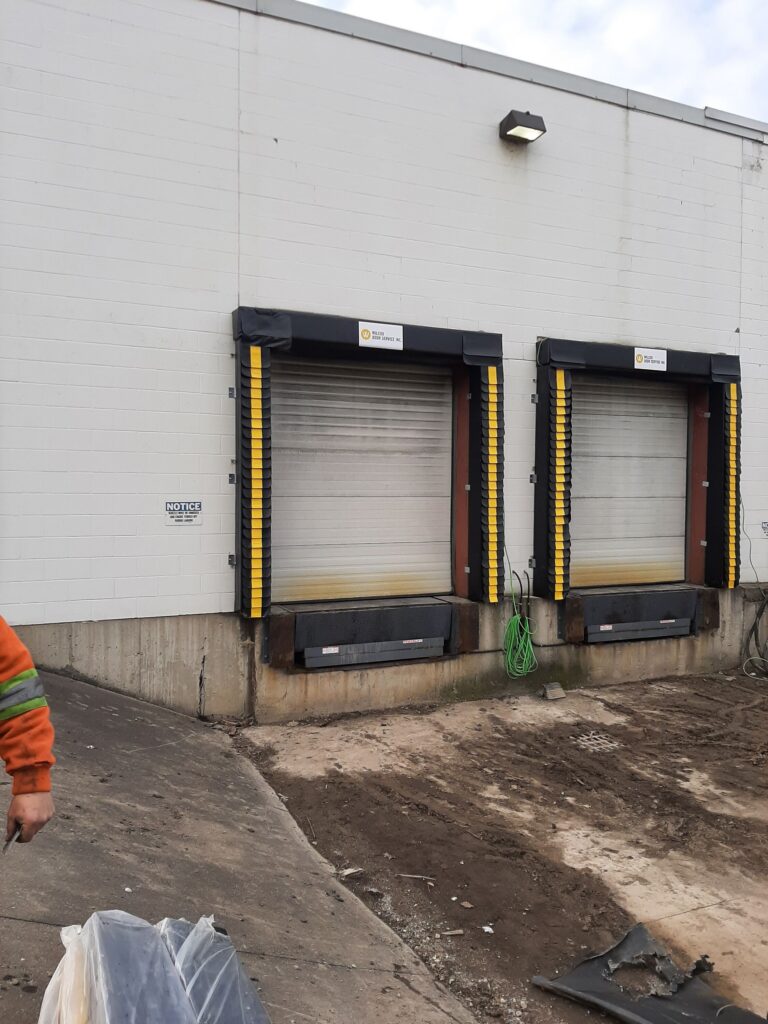
Choosing the right façade for your commercial building is a critical decision with long-term impacts on performance, cost, and safety. This guide will help you understand the key differences in the curtain wall vs window wall debate. You’ll learn how each system is constructed, how they perform under real-world conditions, and how to choose the right one for your facility’s specific needs—from high-rise towers to loading dock operations.
A curtain wall is a non-structural façade that hangs from the building’s frame like a curtain, while a window wall is a system of window units installed between the concrete floor slabs. This core distinction drives every other difference, from installation and cost to energy efficiency and maintenance.
What’s the Real Difference?
Let’s break down the core concepts in simple terms. While both systems create a glass-dominant exterior, their relationship with the building’s structure couldn’t be more different. This is where you find the major variations in performance, application, and cost.
A curtain wall is a self-supporting exterior cladding system. It runs continuously past the floor slabs and is attached directly to the building frame. Because it hangs from top to bottom, it creates a seamless, uninterrupted building envelope. Think of it as a single, protective skin for the building that carries only its own weight.
On the other hand, a window wall (sometimes called “slab-to-slab” glazing) is a system of pre-glazed window units supported directly by the floor slabs. Each floor has its own independent wall of windows, which results in a stacked, floor-by-floor appearance with a visible cover over the slab edge.
A groundbreaking study from the University of Toronto’s Building Tall Research Centre highlights these performance differences in Canadian high-rises, which directly impact facility uptime and safety. Read the full research about these findings. Understanding these distinctions is crucial, especially when considering different types of commercial door glass and how they integrate with the overall facade.

alt text: Architectural diagrams showing the construction differences between a curtain wall and a window wall system.
Curtain Wall vs Window Wall At-a-Glance
To simplify the choice between a curtain wall and a window wall, here’s a high-level comparison of their primary characteristics. This table provides a quick reference to help guide your decision-making process.
| Characteristic | Curtain Wall | Window Wall |
|---|---|---|
| Structural Load | Self-supporting; hangs off the building frame | Supported by each floor slab |
| Installation | Exterior installation, often with cranes | Interior installation, floor-by-floor |
| Typical Use | Mid- to high-rise commercial buildings | Low- to mid-rise residential & commercial |
| Performance | Superior resistance to water & air infiltration | Good performance, but more joints |
| Initial Cost | Higher upfront cost | Lower upfront cost |
| Appearance | Seamless, continuous glass aesthetic | Stacked, floor-delineated look |
This table gives you the basics, but the real story is in the details. This foundational knowledge sets the stage for a deeper analysis of how these structural differences translate into real-world performance metrics for your facility.
Comparing Structural Integrity and Performance
Moving beyond simple definitions, the real difference between a curtain wall vs. window wall comes down to how they handle the pressures of the real world. Their fundamental structural designs lead to major differences in a building’s resilience, energy efficiency, and long-term operating costs.
A curtain wall’s main structural benefit is that it acts as an independent envelope. Since it hangs on the outside of the floor slabs, it creates a continuous, uninterrupted barrier. This design is far better at handling heavy wind loads and seismic movements, making it the go-to system for high-rise towers and critical facilities like airports or data centres where structural failure is not an option.
In contrast, a window wall is installed between the concrete floor slabs, which means you have a separate installation for each floor. While perfectly sound for their intended use, this design introduces more joints and potential failure points at every single floor line.

alt text: Diagram illustrates the superior thermal performance of a curtain wall compared to a heat-losing window wall.
Thermal Performance and Energy Costs
For any facility manager, thermal efficiency is one of the most important performance metrics. This is where thermal bridging comes into play. A thermal bridge is essentially a highway for heat to escape your building through conductive materials like concrete slabs or metal frames.
Because a curtain wall is a single continuous unit, it allows for a much more consistent layer of insulation right over the edge of the floor slab, dramatically cutting down on thermal bridging. The result is a higher overall R-value (the measure of thermal resistance), which means better energy conservation.
As a facility manager, here’s the bottom line: a better building envelope means lower operating costs. A well-designed curtain wall can significantly lighten the load on your HVAC system, leading to real, measurable savings on heating and cooling bills every year.
Window walls, on the other hand, are broken up by a concrete slab at every floor. That intersection is a massive thermal bridge, which can cause significant heat loss and even condensation problems if it isn’t managed correctly.
That said, modern, high-performance window walls have come a long way in closing this performance gap. They now incorporate sophisticated features to fight back against heat loss:
- Thermal Breaks: These are low-conductivity materials inserted into the aluminum frame to stop heat from escaping.
- High-Performance Spandrel Panels: These are insulated, opaque panels designed specifically to cover the slab edge, adding a critical layer of insulation exactly where it’s needed most.
- Triple-Glazed Units: Using three panes of glass gives the entire system a major boost in its R-value and overall energy performance.
For instance, a food processing plant in a moderate climate might prioritize fresh air circulation, making a high-performance window wall with operable vents the perfect fit. The vents provide necessary airflow, while advanced spandrel panels keep thermal performance in check.
Impact of Climate on System Choice
In Canada’s diverse climate, this choice becomes even more critical. Thermal modeling consistently shows that curtain walls outperform window walls in R-value, especially at slab intersections. This is a huge deal in regions where heating can account for over 60% of a building’s total energy consumption. By accommodating thicker glass units and creating fewer thermal weak spots, a curtain wall can potentially slash energy bills by 10-25% in a retrofit. Learn more about these performance findings.
This performance gap is why you see curtain walls dominating the skyline on commercial towers in downtown Toronto, where bitter winter cold makes energy efficiency a top priority. Conversely, a mid-rise hotel in a milder climate might find that a modern window wall offers the ideal mix of cost, performance, and the guest-friendly feature of operable windows.
Picking the right system means looking beyond just the building’s height. You need to weigh its intended use and the specific demands of the local climate to ensure your facility’s envelope is both structurally solid and financially smart.
Analyzing the Total Cost of Ownership
When it comes to curtain walls vs. window walls, the budget often drives the conversation. But making a smart decision means looking beyond the initial price tag. You need to take a deep dive into the total cost of ownership, weighing the upfront capital expense against the long-term operational costs.
For many projects, the immediate savings from a window wall system are hard to ignore. Their simpler, slab-to-slab design generally means they’re less expensive to purchase and faster to install. That translates into lower initial labour costs and can help speed up project timelines.
But the story completely changes when you look at the building’s entire lifecycle. This is where operational expenditure (OPEX) enters the picture, and where a curtain wall’s higher initial investment often starts to pay for itself.
Upfront Capital vs Long-Term Operations
The choice between these two systems is a classic financial trade-off. Window walls typically come with a lower capital expenditure (CAPEX)—the initial investment—making them a go-to option for projects with tight upfront budgets. Because they’re installed from the interior, floor by floor, logistics can be simpler, reducing the need for expensive exterior equipment like cranes.
On the flip side, a curtain wall’s superior thermal performance has a direct and significant impact on operational expenditure (OPEX), or your day-to-day running costs. By minimizing thermal bridging and creating a much more airtight building envelope, it takes a considerable load off your HVAC system. Over 10, 20, or even 30 years, the savings on heating and cooling bills can deliver a powerful return on investment that easily justifies the higher initial cost.
The most cost-effective solution isn’t always the one with the lowest initial price. A holistic financial analysis means calculating how energy savings and reduced maintenance will offset a higher upfront investment over the life of your facility.
These cost dynamics are reshaping retrofit strategies right across Canada. Recent data shows that window walls can offer up to 50% savings over curtain walls in certain applications—a huge factor for energy-saving upgrades in large facilities. A University of Toronto report noted that while unitized curtain walls cost around $104.9 per square foot, modern, enhanced window walls with insulated features were significantly less. This is thanks in part to pre-engineered systems that can slash installation labour by 30%.
Maintenance Costs and Lifecycle Value
Maintenance is the third critical piece of the total cost puzzle, and this is where the construction of each system creates very different long-term demands.
-
Curtain Walls: Unitized curtain wall systems are largely fabricated and sealed in a controlled factory environment. This precision manufacturing drastically reduces the chance of on-site errors, leading to fewer leaks and seal failures over time. With fewer joints exposed to the elements, they generally demand less frequent service calls for issues like water infiltration.
-
Window Walls: Since window walls have joints at every single floor slab and often include operable vents, they present more opportunities for wear and tear. Gaskets, seals, and the flashing around the slab bypass need regular inspection to prevent water and air leaks, which can lead to higher maintenance costs over their lifespan.
For a facility manager, this means a curtain wall often provides a more predictable, lower-touch maintenance schedule. That reliability contributes directly to a lower total cost of ownership and ensures the building envelope performs as designed for decades. To better understand how these choices impact your bottom line, consider our insights on reducing the total cost of ownership for your facility’s critical systems. Ultimately, balancing immediate budget constraints with long-term asset value is the key to making a financially sound decision.
Navigating Installation and Maintenance Demands
The decision between a curtain wall and a window wall goes far beyond looks and performance—it gets right down to the practical, on-the-ground realities of installation and long-term upkeep. Getting a handle on these logistical differences is essential for planning any new build or retrofit, as it shapes your project timeline, site coordination, and maintenance budget for years to come.
The two systems are installed in fundamentally different ways.
-
Curtain Walls: These are almost always installed from the building’s exterior. This process usually involves heavy equipment like cranes to hoist and position large, factory-built panels. For new construction with wide-open site access, it’s a highly efficient method that allows the building envelope to be sealed up quickly.
-
Window Walls: By contrast, window walls are set in place from the interior, floor by floor. Glazing crews work from inside the building, fitting the pre-assembled window units between the concrete floor slabs.
This single difference gives window walls a major leg up for retrofits, particularly in buildings that are still occupied. The work can move forward with far less disruption to the people and operations inside, and you can avoid the hassle of extensive exterior scaffolding or crane work that might block loading docks or main entrances.

alt text: Illustrates two methods of large window installation: exterior by crane and interior by workers.
Planning for Site Logistics
Coordinating your facade installation with other trades is key to a smooth project. For instance, if you’re putting up a new curtain wall, the exterior crane work has to be carefully scheduled around the installation of ground-level access points. With a window wall, the interior installation process simplifies this sequencing, letting different trades work at the same time without getting in each other’s way.
For a facility manager, the installation method impacts more than just the schedule; it affects daily operations. An interior-based window wall installation can keep your loading bays fully operational, whereas an exterior curtain wall installation requires careful planning to maintain business continuity.
A Proactive Approach to Maintenance
Once the facade is up, the maintenance needs of each system begin to diverge, directly affecting your facility’s long-term operational budget. Common headaches for any glazed system include seal failure, water infiltration, and damage to the glass units themselves.
Unitized curtain walls often have the edge when it comes to maintenance. Because the panels are built and sealed in a controlled factory setting, there’s a much lower risk of on-site installation errors. This precision work results in a highly durable, weather-tight envelope with fewer joints, which means fewer opportunities for leaks and less need for service down the road. This reliability is a big reason they’re specified for high-performance buildings.
Window walls, on the other hand, require a more hands-on maintenance strategy. With joints at every single floor slab and the potential for operable windows, you have more points of potential failure. The seals at the slab bypass and around any moving parts are critical areas that need regular inspection. Facility managers should build periodic checks into their schedule to catch problems like gasket degradation or water ingress before they become major issues.
Beyond the initial build, a smart maintenance plan is crucial. This includes routine upkeep like professional commercial building window cleaning to preserve the building’s appearance and protect the system’s components. A proactive approach for either system is the best way to protect your investment and ensure the building envelope performs as designed for decades to come.
Understanding Code Compliance and Safety
When you’re weighing a curtain wall vs. a window wall, nothing trumps safety and building code compliance. Following the National Building Code of Canada (NBC) and local standards isn’t just a good idea—it’s mandatory. It’s about protecting occupants and ensuring the long-term integrity of your building.
A key difference between these two systems is how they handle the big three: fire, water, and air. These performance factors directly shape the safety and resilience of your entire facility, from the main facade right down to the loading docks.
Fire Safety at the Slab Edge
In high-rise construction, one of the most critical safety details is fire-stopping. In simple terms, this is how you prevent fire and smoke from travelling vertically between floors through the gap at the edge of the floor slab.
Window walls make this part of the job much simpler. Since they are installed directly between the floor slabs, there’s no continuous gap for flames to climb. The concrete slab itself serves as a built-in fire break, effectively isolating each level.
Curtain walls are a different story. They hang on the outside of the building’s structure, creating a void between the facade and the slab edge on every single floor. This gap is a major concern and must be filled with specialized fire-safing insulation and smoke seals to stop a fire in its tracks.
This is a fundamental difference you can’t overlook:
- Curtain Wall Requirement: You absolutely must install a certified fire-stop system to meet the required fire-resistance rating and block vertical fire spread.
- Window Wall Design: The slab-to-slab installation inherently compartmentalizes each floor, which simplifies the overall fire safety strategy.
Properly installed fire-stopping is a life-safety feature with no room for error. While both systems can certainly meet code, a curtain wall’s design demands meticulous, expert installation of these extra fire protection components. It really highlights the need to work with seasoned installers who understand passive fire protection—a principle that’s just as important for systems like rolling fire shutters for windows.
Defending Against Water and Air Infiltration
Beyond fire, your building envelope has to be a fortress against the weather. How a system performs against wind-driven rain and air leakage is where curtain walls often show their superior engineering.
A curtain wall system, especially a unitized one, is made of large panels that are built and sealed in a controlled factory environment. This factory-first approach means fewer, more reliable joints across the whole facade. The result is an incredibly robust barrier against water and air, which is a massive advantage for buildings in exposed or coastal locations.
In Canada’s booming construction market, the glass curtain wall sector hit USD 1,482.4 million in revenue, showing just how popular it is for modern high-rises. Unitized systems grabbed a commanding 66.67% of that revenue, mostly because they are so resilient against wind-driven rain. Discover more insights about Canada’s glass curtain wall market.
Window walls, with their network of horizontal and vertical joints at every floor and every frame, simply have more potential weak spots for air and water to find their way in. Modern designs are sophisticated, with drainage channels and high-quality seals, but they ultimately rely on more components being installed and sealed correctly on-site.
The distinction is pretty clear. A curtain wall’s continuous, factory-sealed design provides a stronger, more unified defence. This has a direct impact on the building’s durability, cutting down the risk of expensive water damage and energy loss over its lifetime.
How to Choose the Right System for Your Facility
Making the final call in the curtain wall vs window wall debate isn’t about picking a “better” system, but the right system for your specific application. The best choice balances your facility’s unique performance needs, budget realities, and operational goals.
To land on a confident decision, it helps to start by asking a few targeted questions.
Your Facility Decision Checklist
This checklist moves beyond the technical specs to focus on practical, real-world factors that will guide you to the most suitable solution.
-
What is your building’s height and exposure? For high-rise buildings or those in areas with significant wind and rain, a curtain wall is almost always the clear choice. Its continuous, structurally independent design provides superior resistance to harsh weather.
-
What is your primary budget driver? If minimizing upfront capital cost is the top priority, a window wall system often presents a more economical path. However, if your focus is on long-term value and lower operational costs through energy savings, the higher initial investment for a curtain wall can deliver a strong return over the building’s lifecycle.
-
Do you need operable windows for ventilation? Window walls are inherently designed to accommodate operable vents easily and cost-effectively. While curtain walls can certainly include them, it often adds complexity and cost. For facilities like hotels or certain industrial plants where airflow is essential, a window wall holds a distinct advantage.
This decision tree shows how key compliance factors like fire safety, water penetration, and air leakage influence the choice between systems.

alt text: A diagram illustrating building code compliance checks for fire safety, water penetration, and air leakage, with pass/fail outcomes.
The visualization underscores that while both systems can meet code, their inherent designs create different paths to compliance, particularly when it comes to fire-stopping.
Situational Recommendations
Applying these criteria to common facility types provides some clear guidance:
Corporate Headquarters & Airports: Performance is paramount here. The seamless aesthetic, structural integrity, and superior weather resistance of a curtain wall make it the ideal choice for these high-profile, high-performance buildings.
Hotels & Multi-Unit Residential: Functionality and cost-effectiveness are the key drivers. A window wall provides an excellent balance of good thermal performance, lower initial cost, and the crucial ability to include operable windows for guest comfort.
Industrial & Manufacturing Facilities: In this case, the choice depends heavily on specific needs. A durable, low-maintenance curtain wall might suit a high-tech cleanroom facility, while a window wall could be perfect for an office section requiring ventilation and daylighting at a controlled cost. For example, the durability of a curtain wall is ideal for protecting sensitive environments, while a window wall allows necessary airflow near a loading dock without disrupting the main building envelope.
Ultimately, selecting the right facade system is a foundational decision that impacts everything from energy bills to occupant safety. It requires a clear understanding of your building’s purpose and its operational demands.
Frequently Asked Questions
After diving into the structural, financial, and installation details, you probably still have a few things on your mind. Here are some straightforward answers to the questions we hear most often from facility managers trying to decide between curtain walls and window walls.
Can Window Walls Really Hold Up in Cold Climates?
Absolutely. A modern, high-performance window wall can deliver excellent thermal resistance, even when facing a harsh Canadian winter. The secret is in the details: effective thermal breaks built into the aluminum frames, high-quality insulated spandrel panels to cover the slab edge, and triple-pane insulated glass units (IGUs).
While a curtain wall naturally creates a more continuous thermal barrier, a well-engineered window wall can easily meet today’s stringent energy codes. This makes it a perfectly viable—and often more budget-friendly—option for many low to mid-rise buildings.
Which System Is Better for Acoustic Performance?
Both systems can be designed for top-tier acoustic performance, but they get there in slightly different ways. The real heavy lifting is done by the insulated glass unit (IGU). Using laminated glass or varying the thickness of the glass panes can make a huge difference in blocking outside noise.
- Window Walls: Since they are broken up by the concrete slab at each floor, they can sometimes offer a slight edge in reducing sound that travels from one floor to another.
- Curtain Walls: These systems often use thicker glazing and have fewer joints overall, which can be more effective at blocking airborne sound coming from the exterior.
Ultimately, the best choice hinges on what you’re trying to achieve—whether it’s isolating your building from a noisy street or stopping sound from travelling between floors.
How Does the Facade Choice Impact Door Integration?
Integrating entry points like pedestrian doors is a critical planning step that needs to happen right alongside your facade selection. Curtain walls generally give you more design freedom for creating large, seamless entryways because the entire facade is a single, unified system. With window walls, doors are more commonly set within the building’s structural opening.
For larger industrial openings, like the sectional or high-speed doors Wilcox services, careful coordination is a must. Before you lock in a decision, a thorough evaluation is essential. This means a comprehensive engineering assessment and a detailed constructability review to ensure the weather seals and thermal continuity between the facade and the door frame are planned correctly, protecting the integrity of your building envelope. For instance, the framing for a large overhead door near a curtain wall section needs special attention to prevent creating a massive thermal bridge that compromises the envelope’s performance.
Choosing the right building envelope is a major decision, but it’s only one piece of the puzzle in creating a high-performance facility. Integrating your facade with reliable and secure access points is just as critical.
As respected partners providing reliable service, the Wilcox team ensures your commercial pedestrian doors, loading docks, and security systems work in harmony with your building envelope.
Contact us today for an expert consultation to discuss your facility’s unique needs.