Meta description: Double size garage door guidance for commercial facilities. Learn sizing, compliance, insulation, operators, and lifecycle cost decisions.
A loading bay starts to fail long before the door stops moving.
It usually shows up as trucks waiting outside, forklifts pausing inside, cold air rolling across the floor, or maintenance calls that keep repeating for the same opening. Facility managers see the symptom in operations. Contractors see it in retrofits. Maintenance teams see it in worn hardware, bent tracks, and operators working harder than they should.
That’s where the double size garage door becomes a serious commercial decision, not a simple size choice. In an industrial setting, the opening affects traffic flow, energy use, safety compliance, security, and the amount of downtime a building can absorb before service levels slip.
Most problems tied to large openings come from the same root issue. Someone chose a door based on width alone. They didn’t match the opening to the vehicles, cycle demand, building structure, or controls strategy.
A proper specification does the opposite. It starts with how the facility runs. It asks what passes through the opening, how often the door cycles, what temperature the space must hold, and what the building can safely support. That’s how you avoid a door that looks fine on paper and becomes a constant cost in the field.
Introduction Why Your Commercial Door Choice Matters
A warehouse with one undersized or poorly specified door can bottleneck an entire shift.
If straight trucks, forklifts, service vehicles, or pallet traffic all depend on the same opening, the door becomes part of your production system. It’s no longer building hardware. It’s operating equipment.
For many facilities, the phrase double size garage door still sounds residential. In practice, commercial buyers use it to describe a wider opening that handles larger vehicles, two-way movement, or higher-volume traffic without splitting access into multiple smaller doors. That choice changes more than convenience. It affects how quickly vehicles move, how much conditioned air escapes, how often components cycle, and how easily the opening can be secured and maintained.
The commercial question isn’t “Do I want one big door or two smaller ones?” The better question is “What opening gives this building the best mix of uptime, compliance, and operating cost over its service life?”
A good answer usually comes from five checks:
- Traffic reality: What vehicles and equipment use the opening?
- Building fit: Can the wall, header, and clearances support the door system?
- Environmental demand: Does the space need insulation, washdown durability, fire separation, or wind resistance?
- Control strategy: Will operators, sensors, loops, and access controls support the workflow?
- Lifecycle cost: What will this door cost to maintain, repair, and keep compliant over time?
Practical rule: If the opening serves revenue-generating movement, treat the door like a managed asset, not a finish item.
That mindset is where better projects start. It also keeps teams from overbuying the wrong product or underbuying a system that fails under real operating conditions.
Defining the Double Size Garage Door for Commercial Use
In Canadian residential work, the standard two-car opening is 16 feet wide by 7 feet high, and commercial projects often start from that familiar reference point. But industrial buildings rarely stop there. As noted in this overview of standard door sizes in Canada, commercial openings need to match traffic type, not just convention.
What the term means on commercial sites
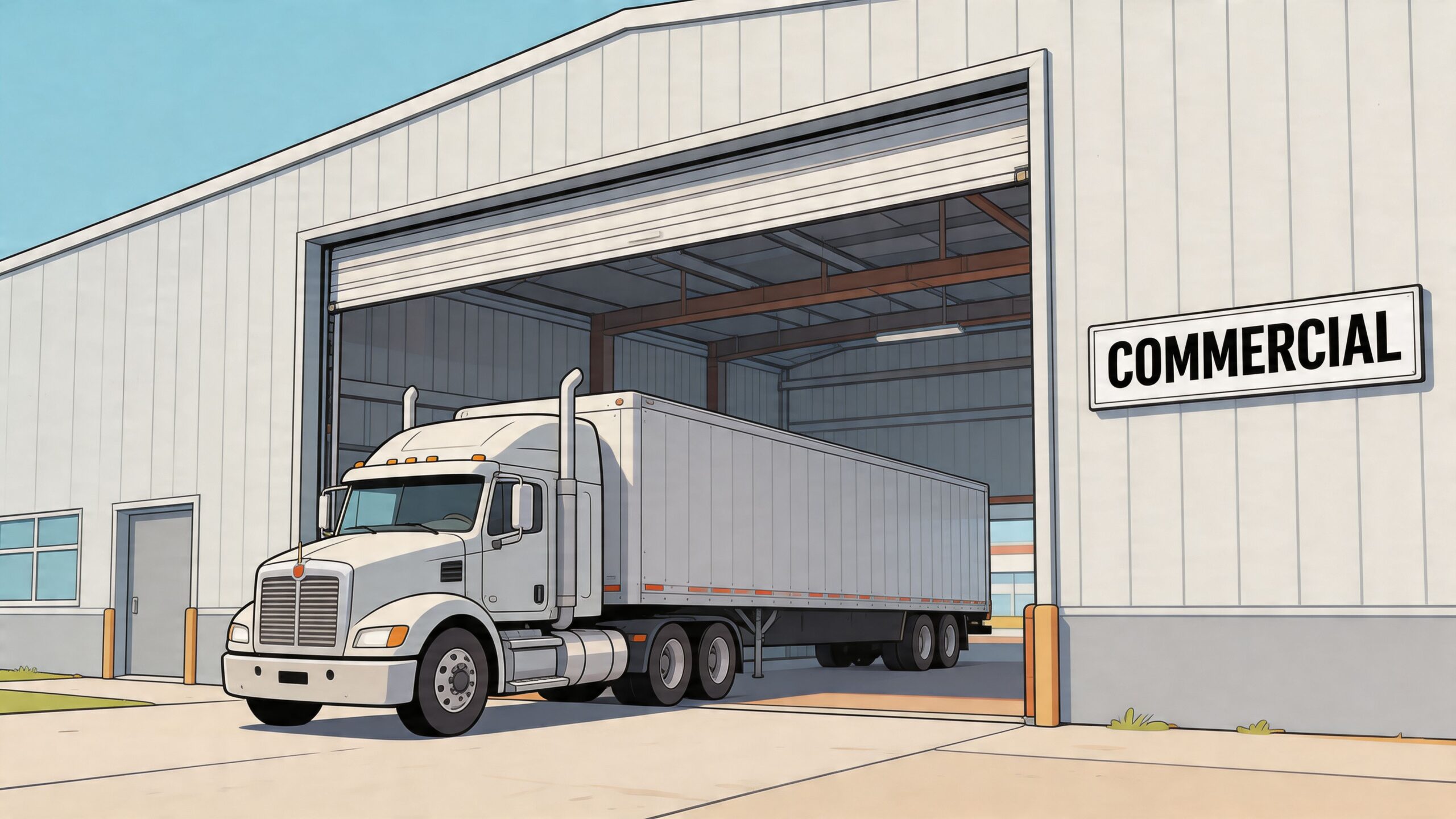
For commercial use, a double size garage door is better understood as a wide-format overhead opening. It may serve delivery vehicles, forklifts, fleet vans, plant equipment, or loading activity where a single narrow opening creates friction.
The residential 16×7 benchmark still matters because it shows where expectations often begin. In Canada, that size is standard for residential use, but commercial applications often need more, and upgrading to insulated double doors with R-16 or higher can reduce heat loss by up to 30% in cold climates like Alberta where winter temperatures average -15°C (reference).
Application should drive the opening
The most common specification mistake is sizing from memory instead of from movement.
A facility with compact service vans needs a different opening than a distribution centre moving pallet jacks and dock traffic. A manufacturing plant with occasional equipment transfer has different needs again. The door should fit the largest routine use case, with enough working clearance for safe, repeatable movement.
Use these field questions before you settle on a width or height:
- Vehicle envelope: What is the tallest and widest unit that uses the opening in normal operations?
- Traffic pattern: Is movement straight in, angled, or shared by people and equipment?
- Frequency: Does the door cycle constantly or only at certain intervals?
- Interior constraints: Will tracks, lift type, lighting, sprinklers, or ductwork interfere?
- Environmental exposure: Does the opening face wind, snow, washdown, or temperature-sensitive space?
Wide doesn’t always mean better
A larger opening can solve clearance issues, but it can also create new ones.
Bigger openings expose more wall area to wind load, place more demand on the operator, and increase the importance of seals and structural support. If the facility only needs moderate width, oversizing the opening can make the system more expensive to build and harder to control thermally.
That’s why the right specification behaves like an engineered fit. It moves what needs to move. It doesn’t ask the door to do more than the operation requires.
The best opening is the one that clears traffic cleanly, seals reliably, and doesn’t turn every cycle into a maintenance event.
For commercial buyers, that’s the shift in thinking that matters most. You’re not choosing a “big garage door.” You’re defining a controlled access point that has to perform every day under load, weather, and schedule pressure.
Comparing Door Types for Wide Openings
Once the opening size is set, the next decision is the door type. That choice determines how the system behaves under traffic, weather, and maintenance pressure.
A wide opening can be fitted with several door styles, but three show up most often in commercial and industrial work: sectional steel doors, rolling steel doors, and high-speed doors.
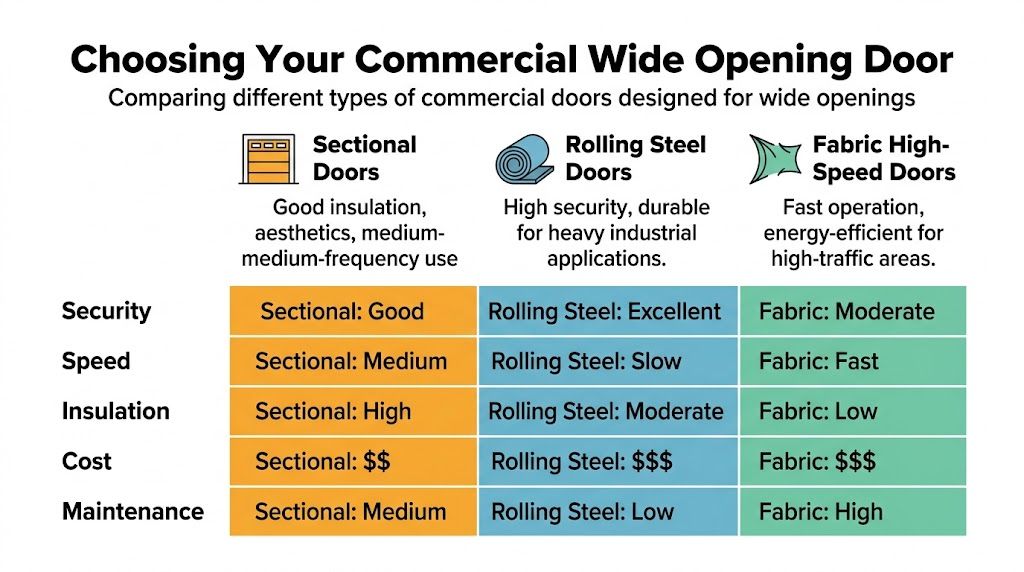
For a broader look at product differences, this guide to sectional vs rolling steel doors is a useful companion. On site, though, the decision usually comes down to operating priorities.
Sectional steel doors
Sectional doors are the most common answer for heated warehouses, service centres, and general industrial openings. The door is made of horizontal panels that travel on tracks and rest overhead.
Why they work:
- Strong insulation options: They’re often the best fit where indoor temperature matters.
- Flexible configurations: They work with standard lift, high lift, and vertical lift arrangements.
- Repair practicality: Technicians can often replace individual components without replacing the full door.
Where they struggle:
- More exposed hardware: Tracks, hinges, rollers, and springs all need regular attention.
- Ceiling space demand: The door occupies overhead space that may compete with lighting or services.
- Damage exposure: Forklift contact can bend panels or tracks quickly.
For many facilities, sectional is the balanced choice. It isn’t always the fastest or most secure style, but it performs well across a wide range of commercial conditions.
Rolling steel doors
Rolling steel doors coil above the opening instead of travelling back along overhead tracks. That makes them attractive where interior ceiling space is limited or where buyers want a tougher security profile.
They tend to suit:
- Industrial plants
- Storage and secure service areas
- Openings that need strong curtain construction
- Locations where overhead obstructions make sectional track layouts awkward
Trade-offs matter here. Rolling steel doors are durable, but they are not usually the first choice when speed and thermal performance are the top priorities for a conditioned logistics space.
High-speed doors
High-speed doors are built for frequent cycling and fast traffic. In some sites they’re fabric. In others they may be rubber or specialty high-performance assemblies. They’re common in food, pharma, temperature-controlled operations, and internal openings where every second of open time matters.
Their advantage is workflow. A fast door reduces waiting, limits air exchange, and keeps moving equipment from stacking up.
They also demand discipline:
- Impact events need quick response.
- Controls need proper tuning.
- The opening environment has to match the product. A fast interior door is not the same thing as a high-security perimeter door.
Side-by-side comparison
| Door type | Best fit | Main strengths | Main watchouts |
|---|---|---|---|
| Sectional steel | Heated warehouses, service buildings, general industrial use | Insulation, configuration flexibility, repairable components | Needs overhead space and routine hardware maintenance |
| Rolling steel | Secure industrial openings, constrained headroom areas | Strong security profile, compact coil arrangement | Usually slower and less insulation-focused than sectional |
| High-speed | High-cycle traffic, controlled environments, internal process flow | Fast cycles, better traffic efficiency, reduced open time | Needs correct controls, environment match, and disciplined service |
One wide door or two smaller ones
For some buildings, the bigger comparison isn’t the product type. It’s one double-width opening versus two single openings.
The economics can favour the single wide opening. Installing a single double door can be 20-30% more cost-effective than two single doors, and in commercial settings a double door configuration can cut maintenance calls by 22% over five years because there are fewer mechanical components and cycles (reference).
That doesn’t make one wide door automatically correct. Two smaller doors can still make sense where traffic separation, phased access, or damage isolation matter more than simplicity.
If one opening handles most movement and the operation values clear access, one properly specified wide door usually performs better than forcing traffic through two narrower compromises.
What works and what doesn’t
What works:
- Matching the door type to cycle demand and environment
- Keeping insulation needs separate from security needs during evaluation
- Choosing a control package that fits the door’s actual use
What doesn’t:
- Using a security-first product in a high-throughput opening and then wondering why traffic suffers
- Buying a fast door for an exposed perimeter opening without checking the surrounding risk conditions
- Selecting a wide door based only on first cost
The right door type should reduce friction in the building. If it creates new delay, heat loss, or service burden, it’s the wrong type even if the opening size is correct.
Critical Structural and Clearance Requirements
A large commercial door only works as well as the structure holding it.
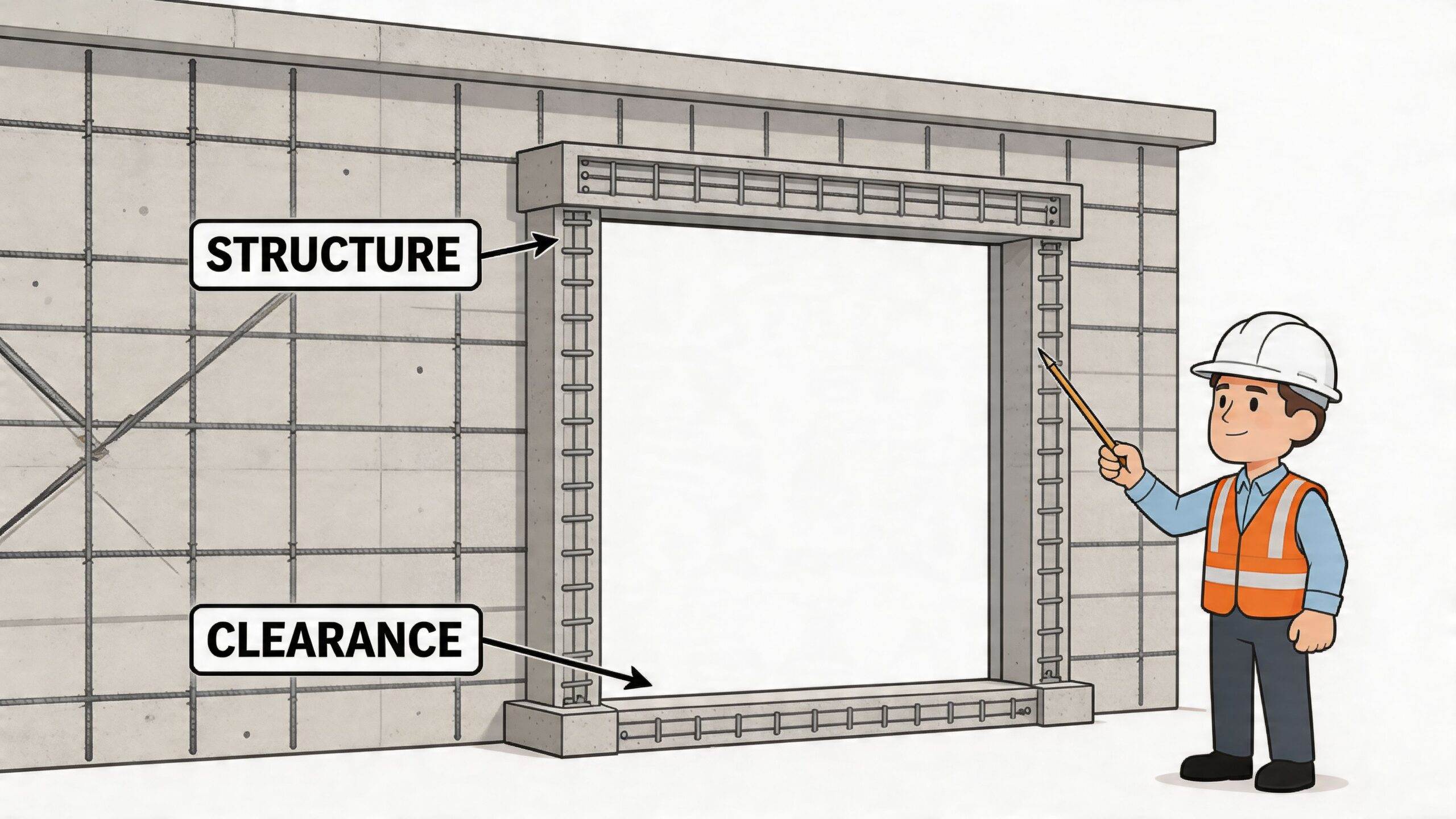
Teams sometimes treat the opening like a finish detail. It isn’t. The frame, header, jambs, slab condition, and clearances act like the support skeleton for the whole system. If that skeleton is weak or undersized, the door will never run properly for long.
The clearances that matter
Three measurements usually decide whether a proposed door system will fit and operate correctly:
- Headroom: The space above the opening.
- Sideroom: The space beside the opening for tracks or guides.
- Backroom: The building depth behind the opening so the door can travel and store.
Those terms sound simple, but they drive lift type, operator selection, and hardware layout. Miss them early and the project often pays for it later in redesign, field modifications, or compromised performance.
For double size industrial doors, 12-15 inches of headroom and backroom allowance are typically required for vertical lift operators. Inadequate headroom is a leading cause of operator failure, accounting for an estimated 20% of failures due to track binding, and that can double annual service calls (reference).
Why the structure has to be right
Wider doors carry more weight and create more force at the opening.
That load transfers into the header and jambs every time the door cycles. If the supporting steel, concrete, wood framing, or attachment points aren’t prepared for that demand, the system starts to show symptoms fast. You’ll see misalignment, rough travel, uneven wear, and recurring hardware issues that never seem fully resolved.
A proper pre-install review should verify:
- Header capacity: Can the wall structure carry the imposed load?
- Jamb condition: Are the side supports straight, sound, and capable of anchoring hardware?
- Slab condition: Is the floor level enough for bottom seal contact and safe operation?
- Obstructions: Will sprinklers, lights, ducts, racking, or conduit interfere with travel?
- Lift path: Does the selected track arrangement match the available space?
Retrofit jobs are where surprises hide
New construction gives teams more freedom. Retrofits are less forgiving.
An older facility may have settled slabs, patched openings, hidden steel, or years of modifications above the ceiling line. That’s where field measurement matters most. A rough opening can look acceptable until the crew checks plumb, level, and available clearance in detail.
A door can be perfectly manufactured and still fail in service if the opening wasn’t properly assessed.
That’s why experienced installers insist on site verification before fabrication. It protects the contractor, the owner, and the maintenance team that inherits the opening once the project closes.
The simplest way to avoid rework
Treat the door opening like a structural coordination point.
Bring the door supplier, installer, and project team into the review before steel is finalised or retrofit demolition begins. Confirm dimensions, support conditions, lift type, and operator location early. That small step prevents the familiar late-stage discovery that the opening is wide enough on paper but unusable in the field.
Performance Specifications Insulation Security and Safety
A commercial door’s value doesn’t come from the panel size alone. It comes from how the assembly performs once weather, traffic, and compliance requirements hit it every day.
For a double size garage door, three performance areas deserve close attention: insulation, security, and safety systems.
Insulation that affects operating cost
In Canadian facilities, insulation is often the difference between a door that merely opens and a door that supports the building’s energy plan.
Commercial double-size doors compliant with CAN/CSA standards can use polyurethane-insulated panels 40-50mm thick with R-values of R-12 to R-16, reducing heat loss by up to 40% compared with uninsulated doors. In energy-intensive sectors such as food and beverage or pharmaceutical manufacturing, that can cut facility operational costs by as much as 20% (reference).
Higher insulation matters most where the opening:
- Connects conditioned interior space to the outdoors
- Cycles frequently during winter
- Serves temperature-sensitive stock or process areas
- Sits near workstations affected by drafts
A strong insulated panel still needs proper perimeter sealing. Even a well-rated door loses value if air leaks around the jambs, header, or floor line.
Security that fits the opening’s risk
Wide openings create convenience, but they also create a larger access point to control.
Security starts with the door type and material. Heavier steel construction, reinforced guides, and appropriately selected locking or access-control hardware all help. The level of security should match the risk of the space behind the opening.
For example:
- A shipping bay may need access control integration and visible status indication.
- A secure equipment room may prioritise curtain strength and lock design.
- A plant perimeter opening may need stronger resistance to impact and forced entry than an internal process opening.
The mistake is buying every opening to the same security standard. That usually overspends in low-risk areas and underserves the places that need stronger protection.
A secure opening isn’t just hard to force. It also closes reliably, seals properly, and tells staff when it’s not in the condition they expect.
Safety systems are not optional
On a large door, the safety package matters as much as the motor.
People work around these openings on foot and by vehicle. That means operators need properly installed photo-eyes, reversing functions, control logic that fits the traffic pattern, and safe activation methods. Facilities also need periodic inspection and testing so those features still work when the opening is under pressure.
Fire separation adds another layer in some buildings. Where a code-required fire-rated door is part of the assembly, teams need to maintain it as a life-safety asset, not just an overhead door. That includes keeping the opening clear, protecting release components, and ensuring testing is carried out correctly.
What to ask when reviewing specs
A performance review should answer a few direct questions:
- Will this door help the building hold temperature, or will it become a constant leak point?
- Does the material and construction match the security risk behind the opening?
- Do the controls and safety devices fit actual traffic, not just code minimums?
- Will maintenance teams be able to inspect and service the system without difficulty?
Those questions usually reveal whether the quoted door is a durable operating asset or a basic assembly that looks acceptable until conditions get harder.
Operators Controls and Facility Integration
The operator determines whether a large door feels dependable or frustrating.
A heavy opening with the wrong operator may still function, but it won’t function smoothly. That shows up as slow travel, strain on components, inconsistent stopping, and more manual intervention from staff who already have other work to do.
Match the operator to the lift and duty
Large commercial doors often use operator types that differ from what people know from residential systems.
A jackshaft operator mounts at the side and drives the shaft directly. That layout often suits sectional doors with high lift or vertical lift because it works well with heavier commercial hardware and keeps the centre overhead area free.
Other applications may call for trolley, hoist, or specialty industrial operators. The correct choice depends on door weight, lift geometry, cycle demand, and the environment around the opening.
In high-risk regions, compliance with wind load and seismic codes is critical. Recent building code updates are boosting demand for hydraulic operators by up to 35% as facilities such as airports and government buildings retrofit large doors to withstand gusts over 150 mph and meet modern safety standards (reference).
Controls should support the workflow
An operator doesn’t work alone. The controls around it decide how traffic moves.
The best systems reduce unnecessary touches and prevent doors from staying open longer than needed. Depending on the opening, that can include push buttons, key switches, radio controls, motion activation, loop detectors, traffic lights, monitored safety devices, and links to building or security systems.
This overview of a commercial garage opener outlines the core differences between commercial operator setups and lighter-duty systems.
Control planning gets better when teams ask practical questions:
- Who uses the opening? Drivers, forklift operators, pedestrians, or all three?
- How should the door open? Automatically on approach, by authorised command, or only under supervised use?
- What happens after passage? Timed close, manual close, or sensor-confirmed close?
- Who needs visibility? Security, maintenance, shipping, or central building staff?
Integration reduces avoidable friction
A double size garage door affects more than the doorway itself.
When the controls are integrated properly, the opening can support dock sequencing, traffic management, security logging, and energy control. It can also reduce the familiar problems that come from doors left open, operated by the wrong users, or triggered at the wrong time.
One practical option in the market is to pair the door with a service strategy that includes installation, operator setup, and preventive support from a commercial provider such as Wilcox Door Service Inc., especially when the opening is part of a larger dock or access-control environment.
The operator should fit the building’s workflow. If staff have to work around the controls instead of with them, the system was never fully specified.
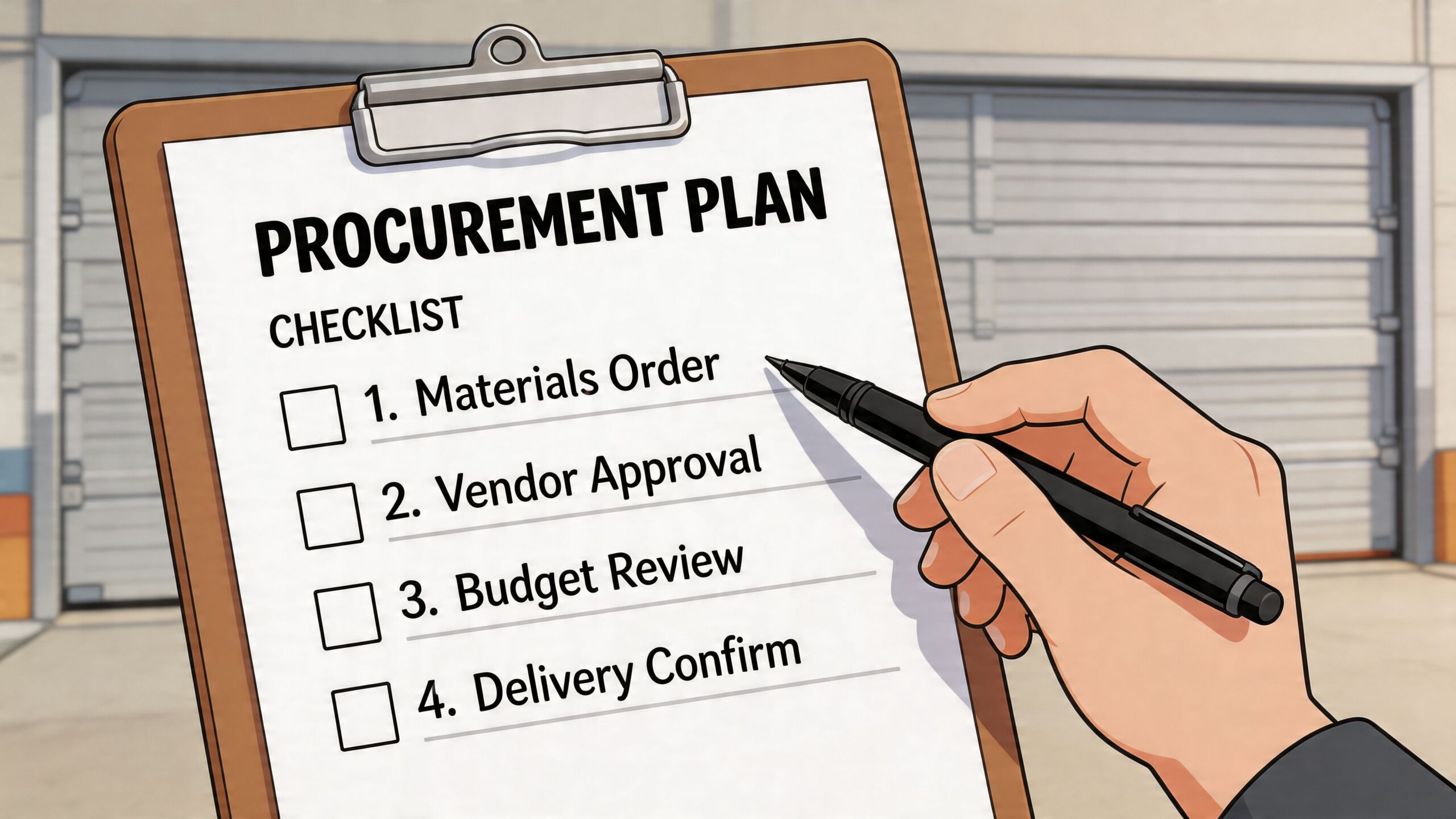
Procurement Checklist and Lifecycle Considerations
The purchase decision for a large commercial door shouldn’t stop at the quote.
A double size garage door may look similar across proposals, but the long-term cost often comes from what the quote leaves out. Hardware grade, operator duty rating, structural assumptions, sealing details, testing requirements, and service support all affect what the door costs over its life.
Questions worth asking before you buy
A supplier should be able to answer these clearly and in writing:
- Opening review: Has the existing or planned structure been field-verified for header, jamb, and clearance requirements?
- Door construction: What panel or curtain material is being supplied, and what insulation level is included?
- Operator duty: Is the operator selected for actual cycle demand, not just nominal door size?
- Control package: Which activation and safety devices are included, and how will they be mounted and tested?
- Environmental fit: Are seals, bottom bar details, and hardware finishes suitable for the site conditions?
- Compliance scope: Who is responsible for code-related coordination, commissioning, and any required testing?
- Service response: What does support look like after handover if the opening fails or drifts out of adjustment?
Weak answers to those questions usually predict future problems.
Think in total ownership, not purchase price
The lower quote can cost more if it buys recurring downtime.
Lifecycle thinking changes the conversation. Instead of asking only what the door costs to install, ask what it will cost to operate, maintain, and repair through years of service. A door that cycles reliably, seals well, and uses correctly matched components usually creates fewer disruptions for operations and fewer emergency calls for maintenance.
Good lifecycle planning includes:
- A preventive maintenance schedule
- Documented inspection intervals
- Access to replacement parts
- Clear ownership of testing and compliance tasks
- A service partner that understands the opening’s role in the facility
Installation quality decides the starting line
Even a well-specified door can start badly if the installation is rushed.
Alignment, anchoring, spring setup, operator limits, sensor placement, and control programming all affect how the door behaves from day one. Large openings don’t tolerate sloppy work. The system may still run, but wear begins early and service teams inherit the consequences.
Buy the installation standard, not just the product. Most recurring problems on large openings trace back to fit, setup, or control tuning.
What a strong procurement process looks like
The best projects usually share a few habits:
- The team measures the opening carefully and verifies the structure.
- They choose the door type based on use, not assumptions.
- They review insulation, safety, and security as separate requirements.
- They specify the operator and controls around actual traffic.
- They plan for maintenance before the door is installed.
That’s what turns a door purchase into a managed asset decision. It also reflects the kind of long-term thinking behind the Wilcox message, Respected Partners, Reliable Service.
If you’re planning a new opening, replacing an aging system, or trying to reduce repeat service calls on a high-use door, contact Wilcox Door Service Inc. for a site assessment, quote, or service review. A proper evaluation can help you align door size, controls, compliance, and maintenance with the way your facility runs.