


Standard residential garage doors in Canada are most commonly 7 feet high, with single-car widths of 8 to 9 feet and a double-car width of 16 feet. That familiar baseline works for homes, but once you’re sizing doors for a warehouse, loading dock, plant, or service bay, the right standard garage door height and width becomes an operating decision, not just a building detail.
If you’re reviewing a replacement, planning a retrofit, or trying to avoid a bad fit before a new door is ordered, the stakes are usually obvious. A new truck spec shows up. A forklift route changes. A dock opening that worked for years suddenly feels tight. The problem usually isn’t the door alone. It’s the mismatch between the opening, the equipment using it, and the building constraints around it.
The good news is that most sizing mistakes are avoidable. The right approach starts with the common standards, then checks the rough opening, headroom, side room, traffic pattern, and code requirements before anyone commits to a product or schedule.
Why Accurate Door Sizing is Critical for Your Facility
Facility managers usually find out a door is the wrong size at the worst moment. A delivery unit can’t clear the opening. A replacement door arrives and the framing isn’t what the drawings suggested. A maintenance team swaps equipment and realises the opening that worked for older traffic now slows every move through the bay.
That’s why standard garage door height and width isn’t a cosmetic choice. It affects safe clearance, daily throughput, energy control, and compliance. If the opening is too tight, operators start making awkward approaches. If the headroom is short, track and operator options narrow quickly. If the rough opening is wrong, the install turns into a framing job.
Practical rule: Size the door for the equipment that actually uses the opening, not the equipment the building was originally designed around.
In a commercial setting, a few inches matter. They matter at the lintel, at the jambs, and in the turning path in front of the door. A nominal door size is only part of the picture. You also need enough room for tracks, springs, seals, and the operator, plus enough clear space for traffic to move without clipping panels, guides, or bollards.
What usually goes wrong
- The opening is measured once, too late. A quoted door size gets treated as the opening size, and the site conditions don’t match.
- Vehicle height changed over time. The building didn’t. Delivery vans, light trucks, and material handling needs often outgrow an older opening.
- The door type was chosen before the layout was checked. Sectional, rolling steel, high-lift, and high-speed doors all use space differently.
- Retrofit assumptions replace site verification. Existing buildings often hide surprises in framing, utilities, and ceiling obstructions.
What a good sizing review should answer
A proper review should tell you:
- What size opening you have
- What size opening you really need
- Whether the building can support the door system you want
- What trade-offs you’ll make on clearance, insulation, speed, and maintenance access
Get those answers first, and the rest of the project becomes far more predictable.
Understanding Standard Residential Garage Door Sizes
Residential sizing is the easiest place to start because it gives everyone a common reference point. In Canada, the standard residential garage door height is predominantly 7 feet (84 inches), aligned with National Building Code of Canada guidance, and by 1980, 7-foot heights accounted for 85% of new single-family garage installations in provinces such as Ontario and British Columbia, according to Canadian residential garage size data.
That history matters because many mixed-use properties, small service buildings, and older ancillary structures still reflect residential-era assumptions. If a facility inherited an older detached storage garage or a light-duty outbuilding, a 7-foot-high opening is often the first clue that the space was never intended for modern commercial traffic.
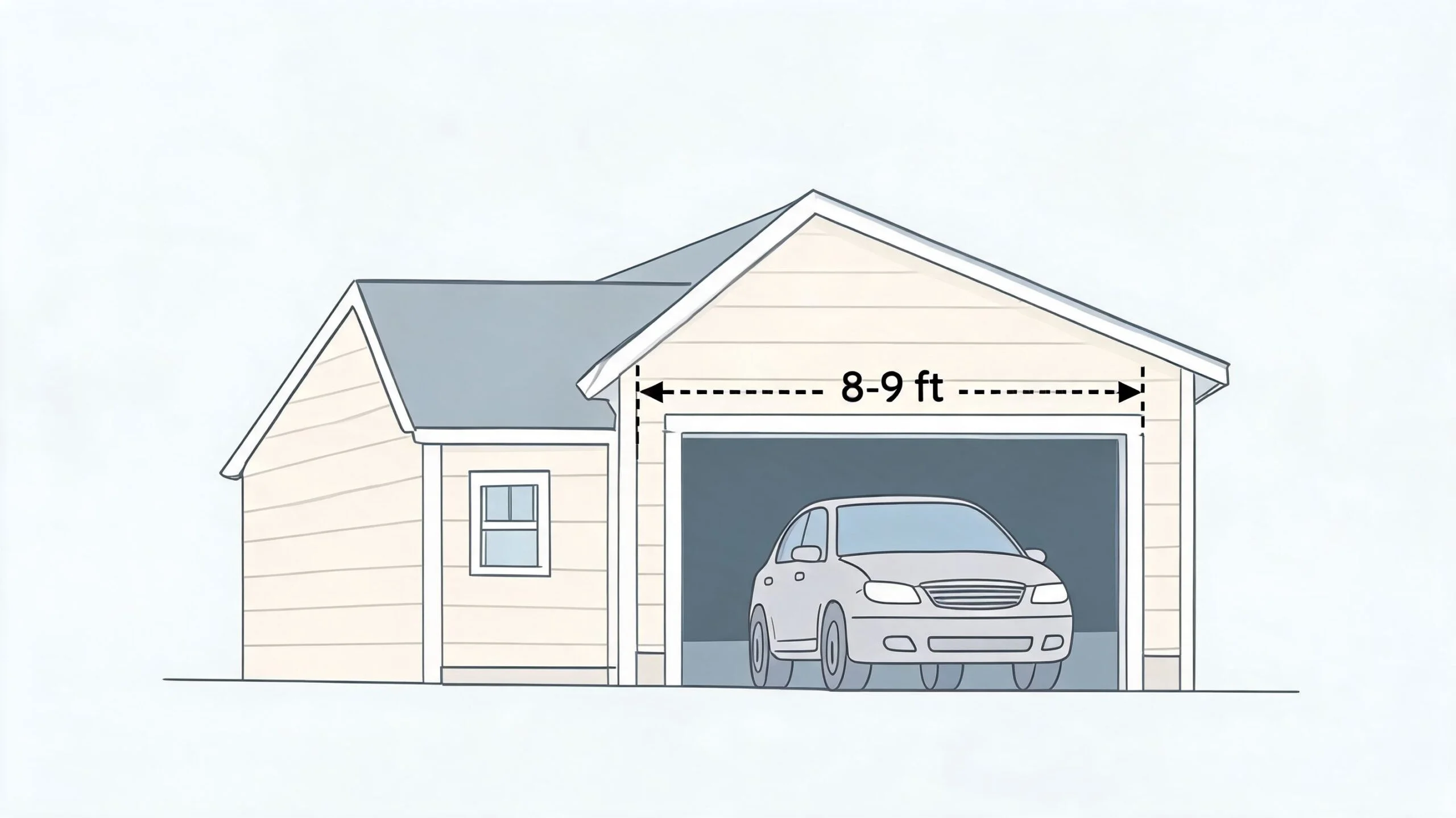
Common residential widths
For most homes, the standard width breaks down:
- Single-car doors are typically 8 to 9 feet wide
- Double-car doors are commonly 16 feet wide
Those widths became standard because they suit typical passenger vehicles without wasting opening space. In practical terms, that means enough room to enter and exit with reasonable margin, while still keeping framing, ceiling layout, and insulation manageable.
A good reference point for these baseline dimensions is Wilcox’s guide to standard garage sizes, especially if you’re comparing older residential openings against newer operational needs.
Why residential standards stop being useful
Residential sizes work well for cars, small SUVs, and light household storage use. They stop working when the opening starts serving:
- cube vans
- fleet pickups with roof accessories
- forklifts
- pallet jacks moving tall loads
- frequent in-and-out traffic in a commercial schedule
A door that feels generous in a house often feels restrictive in a facility within the first week of real use.
The other issue is tolerance. Residential users can accept a slower approach and tighter margins. Commercial users can’t. If operators need to square up carefully every time, throughput drops and impact damage becomes more likely.
A practical baseline
If you’re looking at an older small opening and wondering whether it’s “standard,” it probably is by residential terms if it falls near 7 feet high and 8 to 9 feet wide for a single bay, or 16 feet wide for a double bay. That doesn’t mean it’s suitable for a warehouse, plant, or modern service workflow. It just means it started from a different design intent.
Commercial and Industrial Overhead Door Dimensions
Commercial sizing is less uniform because the opening has to match the job. In Canada, warehouse-style commercial doors commonly fall into single-car widths of 8 to 10 feet and heights of 7 to 8 feet, while larger logistics openings can extend to 10 to 14 feet wide by 12 to 16 feet high to handle high-cube trailer activity, as outlined in this overview of commercial garage door dimensions in Canada.
That range tells you something important. There isn’t one “commercial standard.” There are several practical standards, each tied to traffic type.
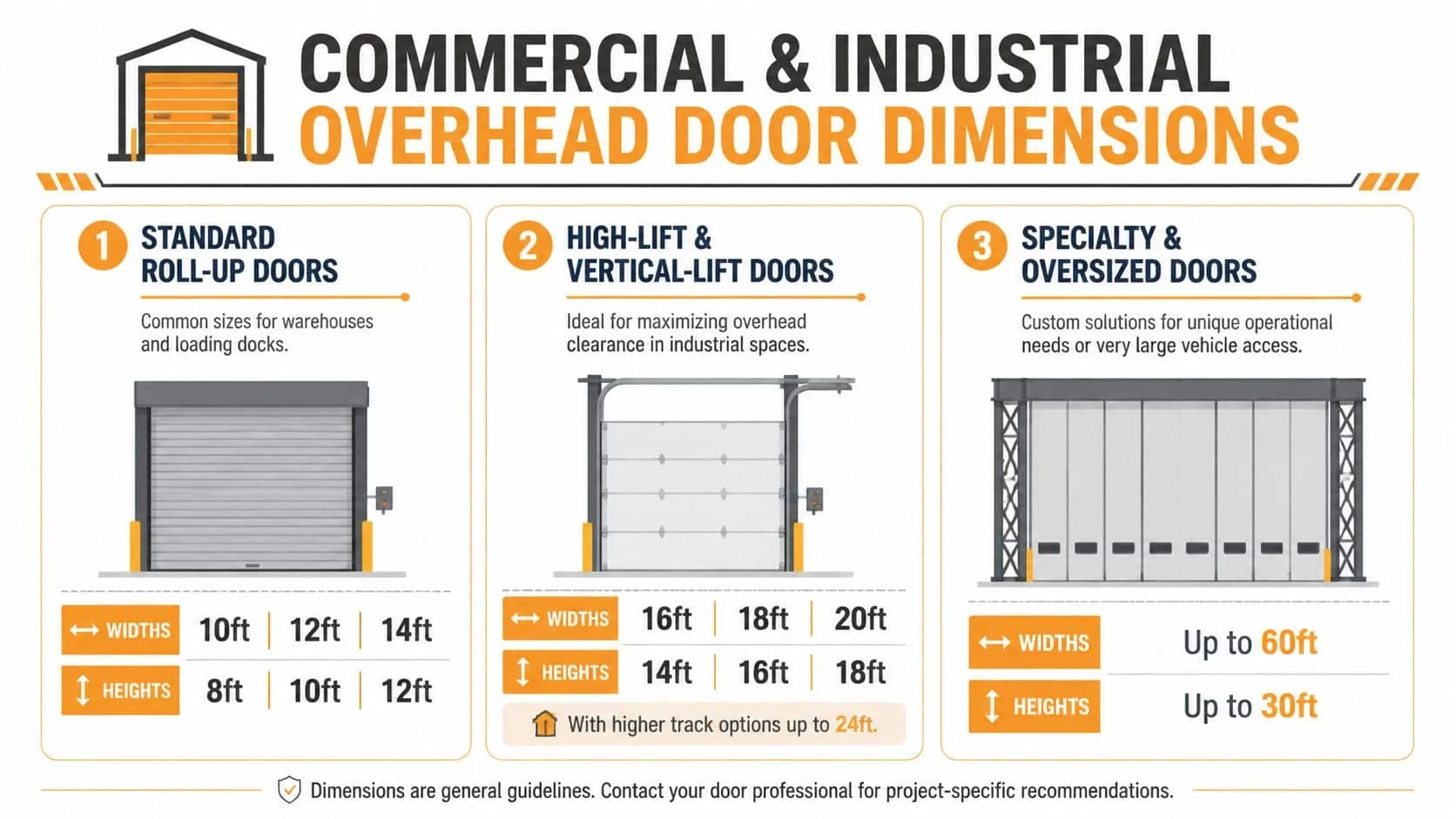
Sizes by application
Here’s the simplest way to think about it.
| Application | Common sizing approach | What drives it |
|---|---|---|
| Light commercial bay | Often within the 8 to 10 ft wide and 7 to 8 ft high range | Vans, pickups, small fleet vehicles |
| Warehouse access point | Depends on pallet height, forklift route, and dock layout | Repeated traffic and load clearance |
| Trailer-facing opening | May need 10 to 14 ft wide and 12 to 16 ft high | High-cube trailers and dock flow |
| Industrial service opening | Determined by equipment envelope and building clearance | Machinery, maintenance access, specialised use |
Loading docks and warehouse traffic
For loading docks, width is only half the issue. Height often becomes the primary constraint because trailer profiles, dock hardware, and overhead obstructions all compete for the same space. In logistics settings, the larger openings used for high-cube traffic are meant to avoid bottlenecks. The source above notes that undersized openings can contribute to 15 to 20% downtime in distribution operations when dock flow is interrupted.
That’s why a dock manager shouldn’t ask only, “Will the truck fit?” The better question is, “Will the truck fit repeatedly, under pressure, with enough tolerance for safe alignment and fast turnover?”
Forklifts, lift types, and interior use
Inside the building, the opening also has to work with the door system. A sectional overhead door needs track space. A rolling steel door stores differently above the opening. A high-lift configuration changes how the door travels, which can preserve overhead clearance in the work zone.
In practice:
- Sectional overhead doors are often chosen where insulation, sealing, and controlled movement matter. They’re commonly used in commercial sectional door applications such as warehouses, service centres, and conditioned spaces.
- High-speed fabric doors make sense where traffic is frequent and facilities want fast opening cycles with separation between environments. They’re widely used in high-speed door systems for plants, cold-chain zones, and high-traffic interiors.
What works and what doesn’t
What works:
- sizing the opening around the tallest routine load, not the average one
- matching the lift style to the ceiling and equipment path
- allowing room for seals, guides, and safe manoeuvring
- checking whether the dock face, leveller, or restraint changes the usable opening
What doesn’t:
- choosing a door based only on the old opening
- assuming a nominal size solves the full clearance problem
- forgetting how door hardware affects usable space
- treating a forklift route like a passenger vehicle route
If your operators have to slow down, duck a mast, or re-approach the opening every cycle, the door is already costing you time.
For commercial and industrial sites, standard garage door height and width should always be treated as a starting point. The final dimension has to fit the building, the traffic, and the duty cycle together.
How to Measure for a New or Replacement Overhead Door
Good door sizing starts with site measurements, not catalogue dimensions. The three checks that matter most are the rough opening, headroom, and side room. If any one of them is off, the door may still be orderable, but it won’t necessarily install cleanly or operate the way you expect.
A useful starting point is this Wilcox reference on standard garage height dimensions, especially if you’re comparing a nominal door size against an existing opening.
Measure the rough opening first
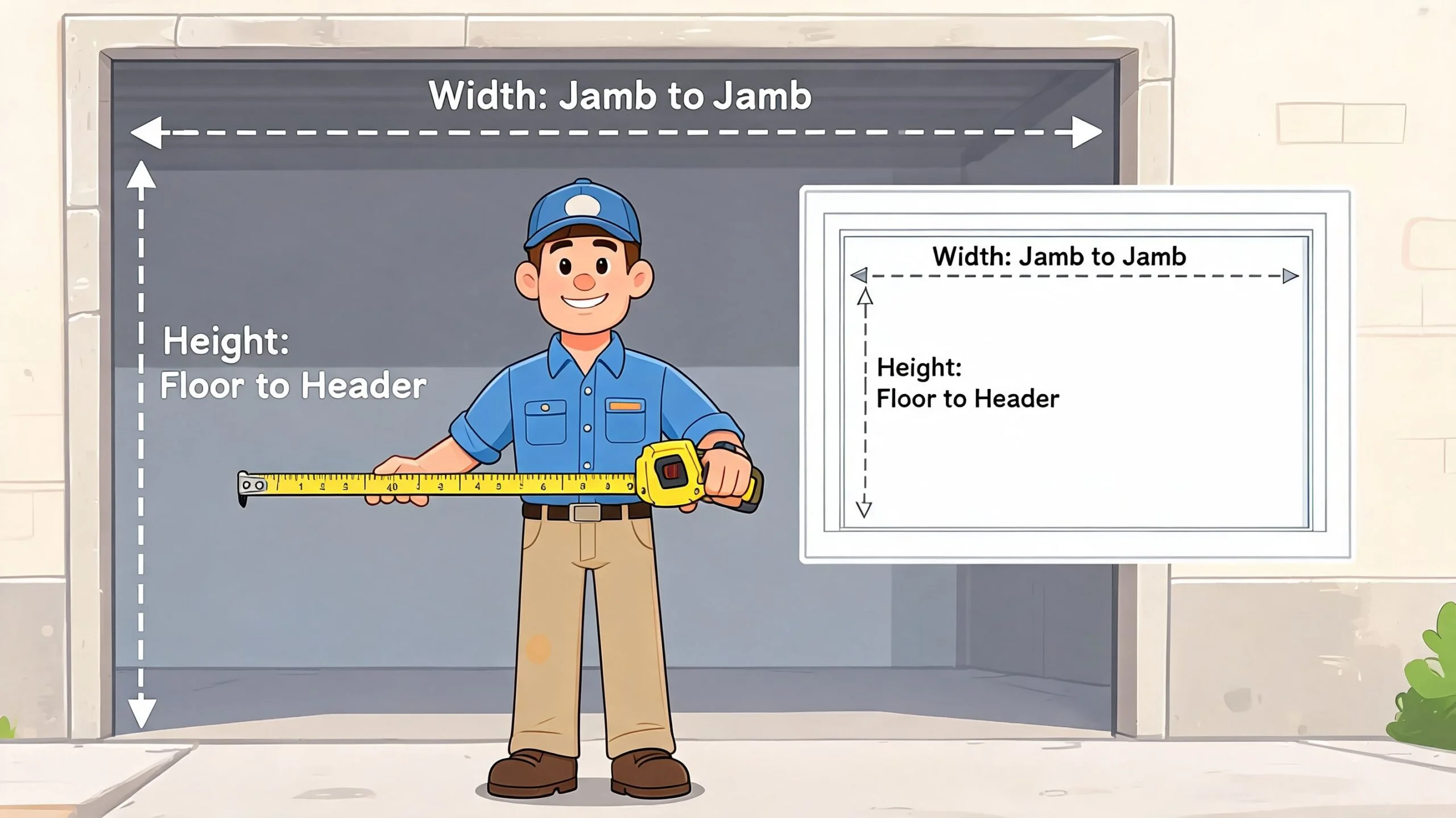
The rough opening is the framed opening where the door fits. Measure:
- Width, from jamb to jamb
- Height, from finished floor to the underside of the header
A jamb is the vertical side of the opening. A header is the structural member across the top.
Record both dimensions at more than one point if the building is older. Openings can drift out of square, and concrete floors can slope. If the opening varies, don’t average it casually. The smallest limiting point usually controls the design decision.
Check the side room and headroom
The next measurements tell you whether the hardware can fit.
- Side room is the space beside the opening where the vertical track mounts.
- Headroom is the clear space above the opening needed for track, spring assembly, and often the operator.
These dimensions matter because two doors of the same width and height can require different clearances depending on the track style and operator arrangement.
Measure the opening, then measure the space around the opening. Both determine whether the installation will work.
Here’s a simple visual walkthrough before you finalise a site review:
Don’t forget the operating space
Beyond the opening itself, look at what surrounds it:
- Ceiling obstructions such as ductwork, lighting, and sprinkler lines
- Wall obstructions near the jambs
- Backroom, meaning the interior space the open door travels into
- Traffic approach, including whether drivers or operators can line up safely
A measuring tape alone won’t catch every issue. Walk the path. Stand where the equipment approaches. Look up, not just across.
Common measuring mistakes
- Using nominal size as actual opening size
- Ignoring floor buildup or uneven slab conditions
- Missing steel, conduit, or pipe near the track path
- Assuming the old door configuration must be the right one
For a replacement project, never assume the existing system is proof that the layout is ideal. Many facilities have lived with compromised clearance for years because no one revisited the opening when operations changed.
Key Considerations Beyond Height and Width
A door can be the right size on paper and still be wrong for the facility. That happens when the opening dimension is treated as the whole job instead of one part of it. For commercial and industrial work, performance depends on framing, code, insulation, lift design, traffic pattern, and maintenance access as much as the width and height.
Ontario and BC codes often require rough openings 1 inch wider and 1 inch taller than the nominal door size, and the same source notes that moving from a 7-foot to an 8-foot door in manufacturing can increase effective forklift stacking height by 12 to 18 inches while reducing racking costs by 20%. It also reports that 16×7 ft double doors with insulated R-16 panels reduce energy loss by 15 to 25% compared with older doors in Canadian retrofits, according to this review of garage door sizing and retrofit considerations.
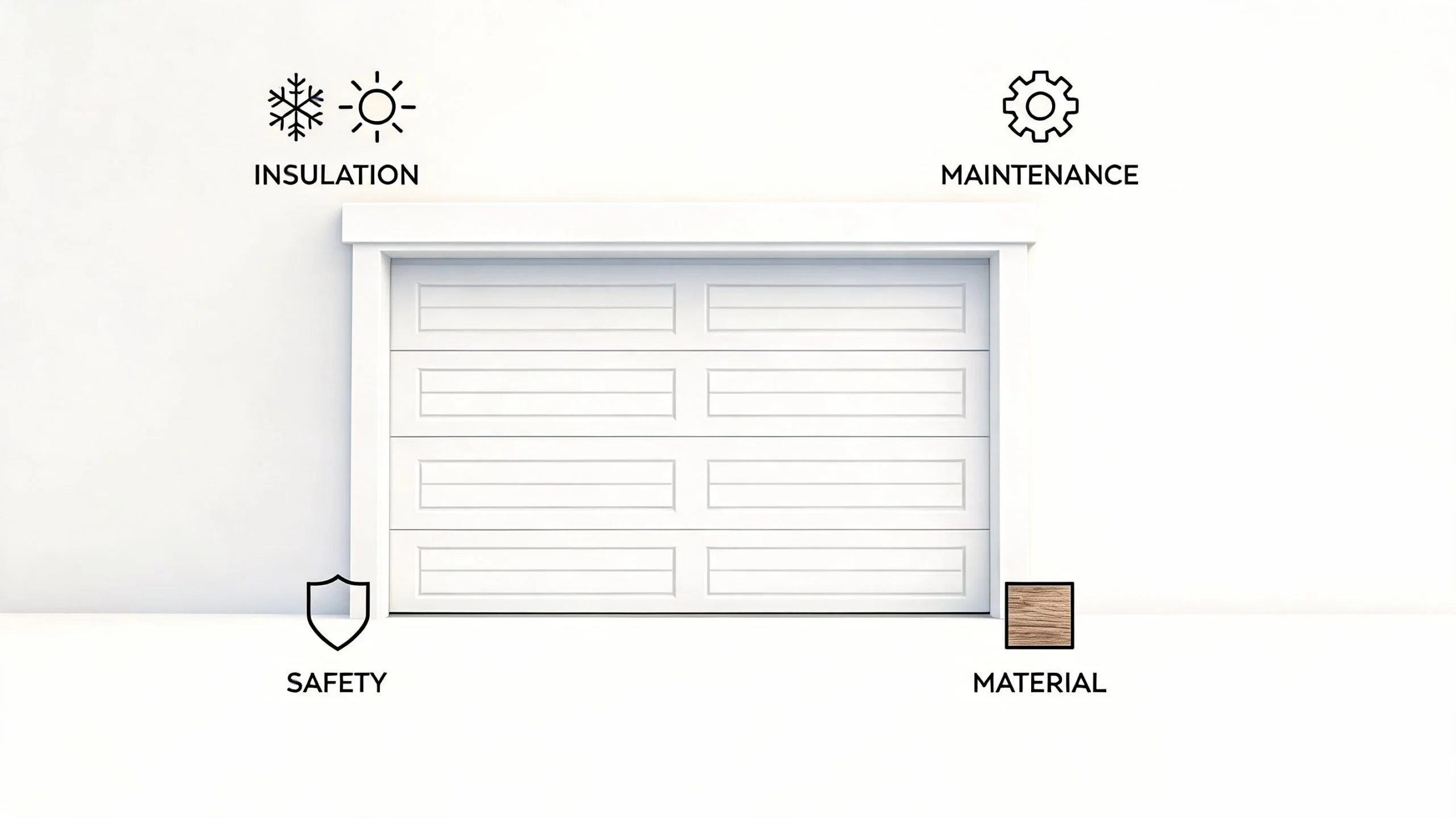
Code compliance changes the real opening
That rough-opening requirement matters because many ordering mistakes happen when someone measures the finished opening and forgets the framing relationship. In retrofit work, that can trigger rework before the new system can even be installed.
For facility teams, the practical takeaway is simple. Confirm whether your quoted size is:
- the nominal door size
- the rough opening size
- or the clear usable opening after hardware is installed
Those aren’t always the same thing.
Productivity and equipment clearance
A door affects workflow far beyond the threshold. If a forklift mast clears the opening comfortably, operators can move loads without hesitation. If it doesn’t, every pass becomes slower and more careful.
That’s why the difference between a 7-foot and 8-foot opening can be operational, not cosmetic. In a plant or warehouse, more usable vertical clearance can support denser storage and smoother handling. It can also reduce the temptation to run loads too close to the opening, which is where panel and track damage often starts.
The most expensive door problem is often the one that never shows up on the invoice. It shows up as slower movement, repeat impacts, and workarounds that staff stop reporting.
Door type affects the space you keep
Not every overhead door uses space the same way.
- Sectional doors travel on tracks and are often a strong fit where insulation and perimeter sealing matter.
- Rolling steel doors store compactly above the opening and can help when ceiling conditions are tight.
- High-speed doors suit frequent cycles and controlled interior environments.
- Fire-rated assemblies add another layer of compliance and testing requirements in some buildings.
If your site includes rated openings, inspection and testing matter just as much as sizing. Services such as fire door drop testing and inspection are part of keeping those assemblies compliant and functional over time.
Energy, retrofits, and lifecycle thinking
Insulation is often treated as a product upgrade. In many facilities, it’s really an operating-cost decision. A better-sealed and properly sized opening helps control drafts, supports conditioned zones, and reduces strain on adjacent equipment and spaces.
This is one reason retrofit projects need a broader lens. Even in residential contexts, readers comparing repair versus replacement often start by understanding home door replacement expenses before deciding how far to go. The same mindset applies in commercial work. If the opening no longer suits the operation, replacing like-for-like may preserve the problem instead of solving it.
For teams reviewing access layouts across a site, this Wilcox guide to the width of doorways is a helpful companion when you’re checking whether the opening supports the traffic using it.
A better way to make the decision
Use this checklist before approving a new door or retrofit:
- Verify the use case. List the tallest, widest, and most frequent traffic through the opening.
- Confirm the building constraints. Check framing, obstructions, slab condition, and available lift options.
- Review compliance needs. Fire rating, wind considerations, and opening requirements should be settled before product selection.
- Think beyond day one. Consider maintenance access, seal wear, operator placement, and future equipment changes.
That’s the difference between ordering a door and solving an access problem.
Partner with Experts for a Perfect Fit
The basic dimensions are straightforward. Residential openings usually start at 7 feet high, with familiar single and double widths. Commercial and industrial openings are different because they have to support equipment, traffic, dock activity, and the building around them.
That’s where many projects either go smoothly or get expensive. A door that matches the opening but ignores the headroom, operator layout, traffic envelope, or compliance requirement can still be the wrong choice. Facility teams usually don’t need more theory. They need a door system that fits the work, installs cleanly, and keeps the opening reliable.
A solid decision usually comes down to three things:
- Measure the actual site conditions
- Match the door type to the operation
- Plan for compliance, maintenance, and future use
If you’re managing multiple buildings, the same principle applies across the portfolio. Standard sizes help with budgeting and early planning, but every opening still needs verification. That’s especially true in retrofits, older buildings, and facilities where vehicle types or material flow have changed.
Wilcox Door Service Inc. is one option facility teams use for site assessments, commercial overhead door replacement, dock integration, and ongoing service support when the opening has to work reliably in real operating conditions.
The right fit protects more than the frame. It protects uptime, energy performance, operator confidence, and maintenance budgets. That’s what “Respected Partners, Reliable Service” should mean in practice.
If you’re planning a replacement, retrofit, or new opening, contact Wilcox Door Service Inc. for a site assessment. A measured review of your opening, clearance, and operational needs can prevent avoidable rework and help you choose a door that fits the facility properly.
Meta description: Standard garage door height and width explained for Canadian facilities, with practical sizing tips for safer, code-compliant overhead door decisions.
Frequently Asked Questions
What is the standard garage door height in Canada?
Standard residential garage doors in Canada are most commonly 7 feet high, though commercial and industrial doors are sized based on the equipment and vehicles using the opening.
What is the standard garage door width?
Single-car garage doors are typically 8 to 9 feet wide, while double-car doors are commonly 16 feet wide — commercial bays are sized larger based on truck and forklift traffic.
Why does accurate garage door sizing matter for facilities?
Incorrect sizing causes clearance problems, delivery vehicles that can’t clear openings, and mismatches between the door and the equipment or traffic patterns using it, leading to costly delays and safety issues.
What should I check before ordering a replacement garage door?
Before ordering, verify the rough opening, headroom, side room clearance, current traffic patterns, and applicable code requirements to avoid a bad fit.