


Meta description: Overhead shed door buying guide focused on total cost of ownership, insulation, safety, sizing, and maintenance for commercial facilities.
A lot of facility managers get handed the same job with very little runway. An auxiliary building needs a new door. Maybe it’s a storage shed, a maintenance outbuilding, a small fleet bay, or a service room that now sees more traffic than anyone expected. The first quote lands on your desk, and the temptation is to compare purchase price alone.
That’s usually where expensive mistakes start.
An overhead shed door for a commercial or industrial property isn’t just a closure for an opening. It affects security, building envelope performance, access speed, operator safety, service frequency, and how often your team gets interrupted by preventable issues. A cheap door that binds in winter, leaks air, or needs constant adjustments can cost more over its life than a better-specified door ever would.
The practical approach is to treat the door as a facility asset. That means looking at the full picture: door type, material, insulation, track layout, operator duty, safety devices, installation quality, and maintenance support. It also means matching the opening to the actual use case. A lawn-equipment shed, a salt-exposed service building, and a heated parts room shouldn’t all get the same door package.
If you’re sorting through options now, focus on what will keep the opening dependable under your site conditions. The right choice protects uptime, reduces nuisance calls, and gives your team fewer surprises during bad weather and busy periods.
Introduction: More Than Just a Door for Your Shed
A small building can create outsized problems when its door is underspecified. I’ve seen secondary spaces become critical overnight because inventory moved there, a maintenance crew expanded, or a property team started storing higher-value equipment inside. Once that happens, the door has to perform like part of the operation, not like an afterthought.
That’s the main difference between a commercial overhead shed door and a typical residential garage door. Commercial applications demand tougher hardware, more predictable cycle performance, better resistance to impact and weather, and safer integration with operators and controls. The expectation isn’t occasional weekend use. It’s repeated, reliable operation with minimal disruption.
What makes a commercial door different
Three things usually separate a commercial package from a lighter residential one:
- Hardware built for repeated use: Tracks, rollers, hinges, springs, and brackets need to stand up to regular opening cycles and heavier panels.
- Site-specific configuration: The door has to work around obstructions like lights, sprinklers, conduit, shelving, or low ceilings.
- Operational accountability: If the door fails, someone loses access, work stops, or a security exposure opens up.
Practical rule: If the building stores business-critical tools, vehicles, parts, records, or regulated materials, specify the door like a commercial asset from the beginning.
What to evaluate before you buy
A good buying decision usually comes down to a short list of practical questions:
- How often will the opening cycle in a normal day?
- Does the building need temperature control, even part of the year?
- Is security more important than appearance?
- Do you have enough headroom and backroom for the track layout you want?
- Who will service the door, and how quickly can they respond when it’s down?
Those answers shape everything that follows. Get them right, and the door supports the facility reliably for years. Get them wrong, and you end up paying for adjustments, retrofits, and emergency calls that could have been avoided.
Choosing Your Door Type and Material
The first decision is usually the most important. You’re not just picking a look. You’re picking how the door moves, how much space it needs, how easy it is to repair, and what kind of wear it will tolerate.
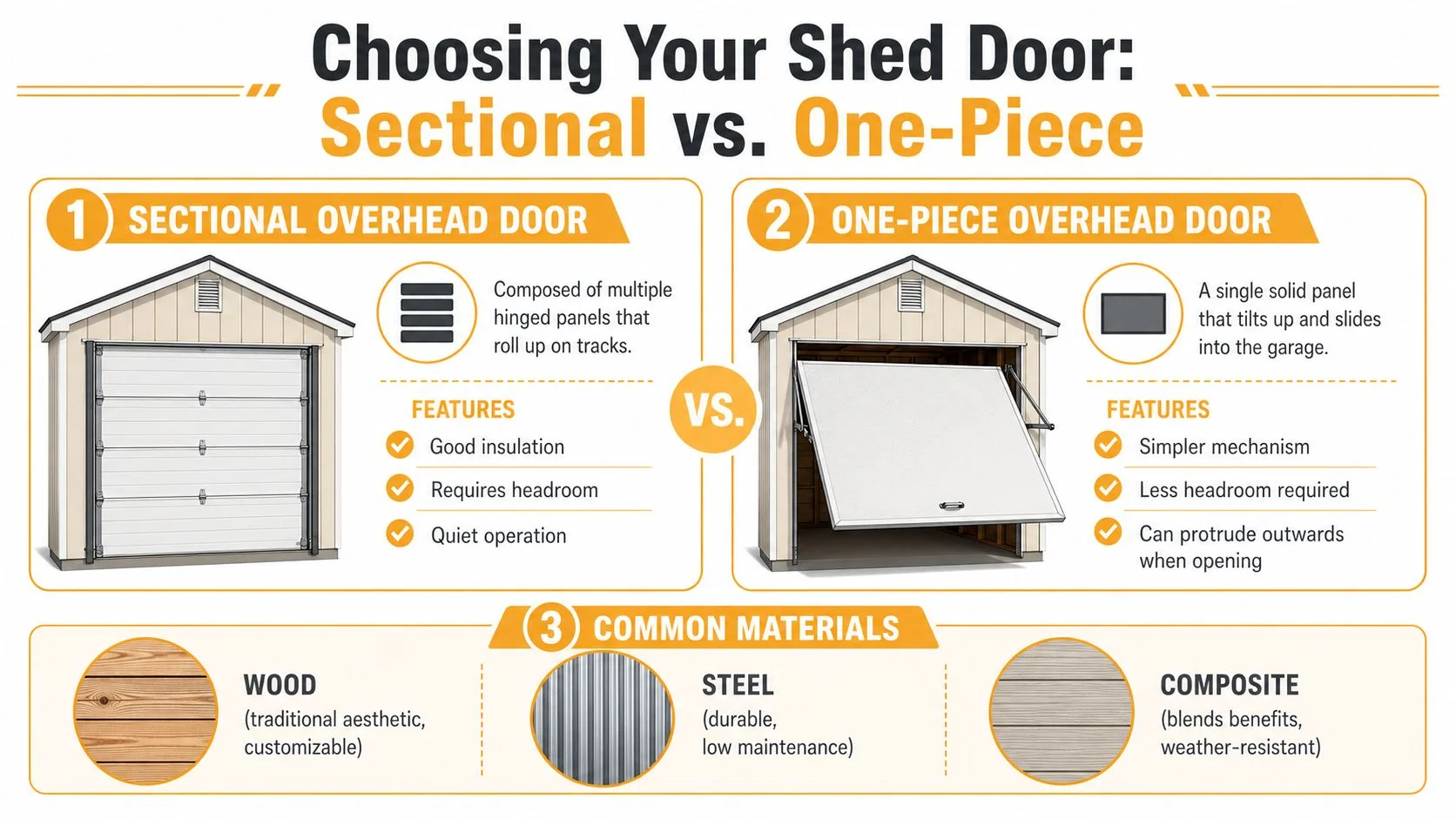
Sectional versus rolling or one-piece designs
A sectional overhead shed door uses hinged horizontal panels that travel on tracks. This is the format most facility teams recognise because it’s versatile, serviceable, and available with many insulation and window options.
A rolling steel door coils above the opening. It often makes sense where security matters, side clearance is tight, or the opening needs to stay compact and protected from incidental damage.
A one-piece tilt-up door has a simpler mechanism, but in commercial settings it’s usually a niche choice. It swings outward as it opens, which can create clearance issues in front of the building. It also gives you fewer practical options for insulation, sealing, and heavy-duty hardware.
For a detailed side-by-side review, Wilcox has a useful guide on sectional vs. rolling steel doors.
| Door type | Works well for | Trade-offs to watch |
|---|---|---|
| Sectional | Heated sheds, service bays, general commercial storage, mixed-use buildings | Needs enough headroom and backroom for track travel |
| Rolling steel | Security-focused spaces, tighter openings, utility buildings, harsher conditions | Can be noisier and less forgiving if damaged slats are neglected |
| One-piece | Light-duty applications with simple requirements | Swing-out motion and fewer commercial-grade options |
Material choice affects ownership cost
Material has a direct effect on maintenance calls, finish life, and how the door handles the environment around it.
- Steel: Most commercial sites end up here for good reason. Steel offers solid impact resistance, broad design options, and manageable upkeep. It’s the practical default for tool storage, light vehicle access, and service sheds. The weak point is corrosion if the coating gets compromised and the site sees moisture, salt, or chemicals.
- Aluminium: Lighter and naturally more resistant to corrosion. It can be a smart choice in damp or coastal settings, or where the operator setup benefits from lower panel weight. The trade-off is that aluminium generally dents more easily than steel.
- Composite or wood-look products: These can suit sites where appearance matters, such as public-facing properties or architecturally sensitive campuses. They can also hold up well in weather, depending on the product. The caution is to verify exactly what the skin and core are made of, because “composite” covers a wide range of products.
If forklifts, ride-on mowers, or utility carts use the opening, favour durability and repairability over decorative finishes.
What works in the field
In most small commercial outbuildings, a sectional steel door with commercial hardware is the most balanced specification. It’s easier to insulate, easier to service, and easier to adapt to operators and safety devices.
What doesn’t work well is choosing purely by appearance or assuming a lightly used shed doesn’t need commercial-grade components. Secondary buildings often get rougher treatment than primary entrances. People bump them with equipment, leave them open during bad weather, and delay repairs because the space feels “non-essential” until the day it suddenly isn’t.
Understanding Insulation and Thermal Performance
A shed door doesn’t need insulation in every case. But many facilities benefit from it far more than they expect. If the building is heated, cooled, stores temperature-sensitive materials, or houses staff for part of the day, insulation shifts from nice-to-have to operationally useful.
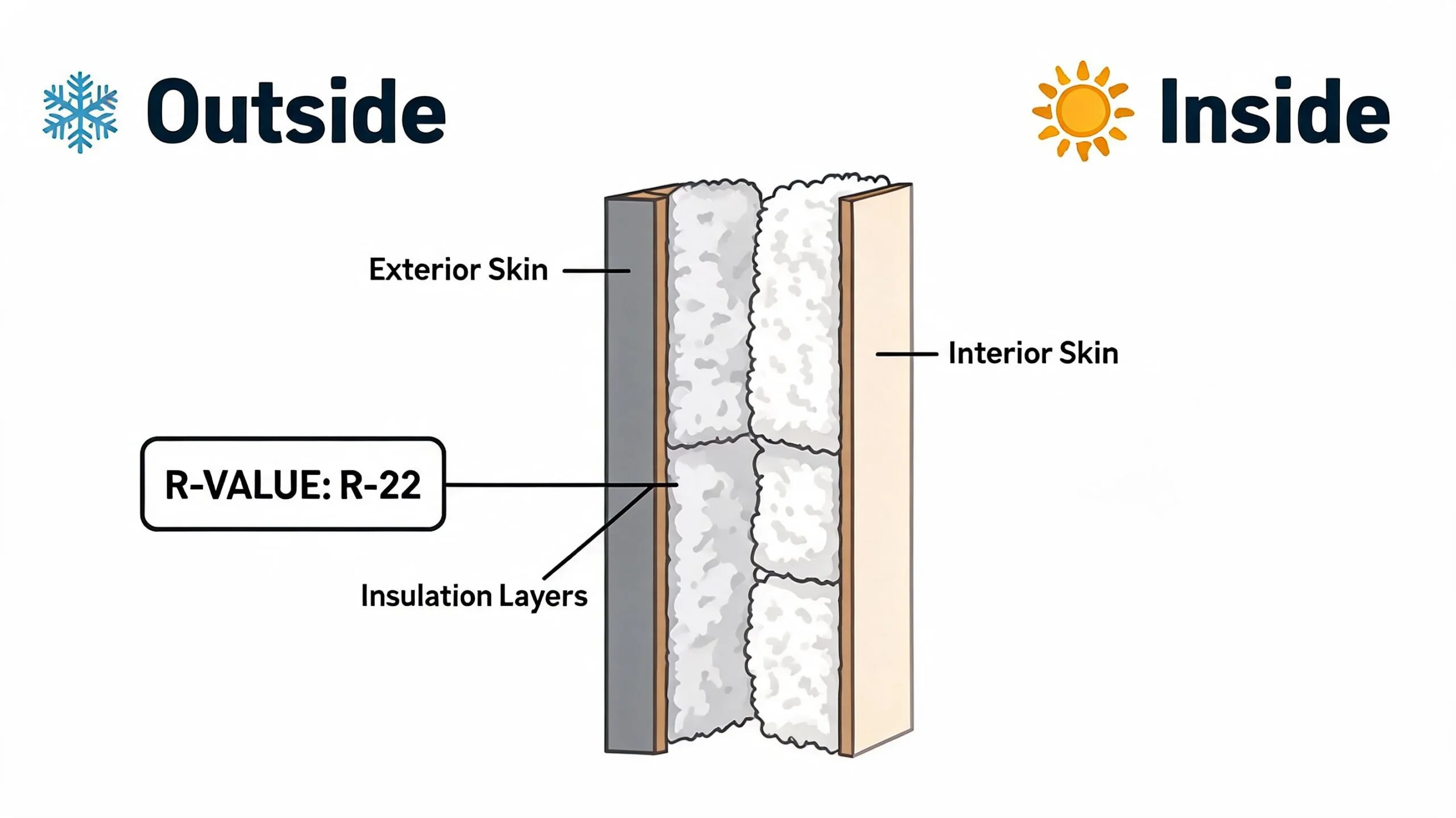
R-value and U-factor in plain language
R-value tells you how well a door resists heat flow. Higher is better. It's similar to a heavier winter coat for the opening.
U-factor measures how readily heat moves through the assembly. Lower is better. For most facility managers comparing door packages, R-value is often the easier starting point, but the actual result depends on the whole assembly, not just the panel core.
The weak point in many openings isn’t only the panel. It’s the perimeter. If the jamb seals, header seal, and bottom weather seal are poor, even a well-insulated panel won’t perform the way you expect.
According to the Department of Energy, installing an insulated commercial door with an R-value of 12 or higher can reduce energy loss through the opening by over 75%, which can lower annual heating and cooling costs in the right application, as noted in the Department of Energy garage weatherisation guidance.
Insulation type matters less than assembly quality
Most buyers compare polyurethane and polystyrene because those terms show up in product sheets. That’s useful, but it’s only part of the decision.
What you really want to verify is this:
- Panel construction: Is the insulation bonded into a rigid panel or loosely fitted?
- Interior and exterior skins: Will the panel resist denting, moisture exposure, and repeated use?
- Perimeter sealing: Are the side and top seals durable enough for your climate?
- Bottom seal design: Will it stay in contact with the floor if the slab isn’t perfectly level?
Wilcox also has a practical resource on insulated overhead doors in commercial spaces that’s worth reviewing if energy performance is part of your decision.
A well-insulated door with poor sealing often disappoints. A properly sealed door with a sensible insulation level usually performs better than buyers expect.
When insulation pays for itself operationally
Insulation isn’t only about utility bills. In day-to-day operations, it also helps with:
- Temperature stability: Better for stored materials, batteries, electronics, and staff comfort.
- Condensation control: Important in shoulder seasons and mixed-temperature spaces.
- Noise reduction: Helpful when the building sits near offices, residences, or tenant areas.
- Equipment reliability: Operators and hardware generally behave better when the opening isn’t constantly exposed to wide swings in temperature and moisture.
For an overhead shed door on a heated site, skipping insulation often saves money only on paper.
Specifying Door Size and Mounting Options
Sizing errors create some of the most frustrating door problems because they usually show up after the order is placed. By then, the building hasn’t changed, but your options have narrowed.
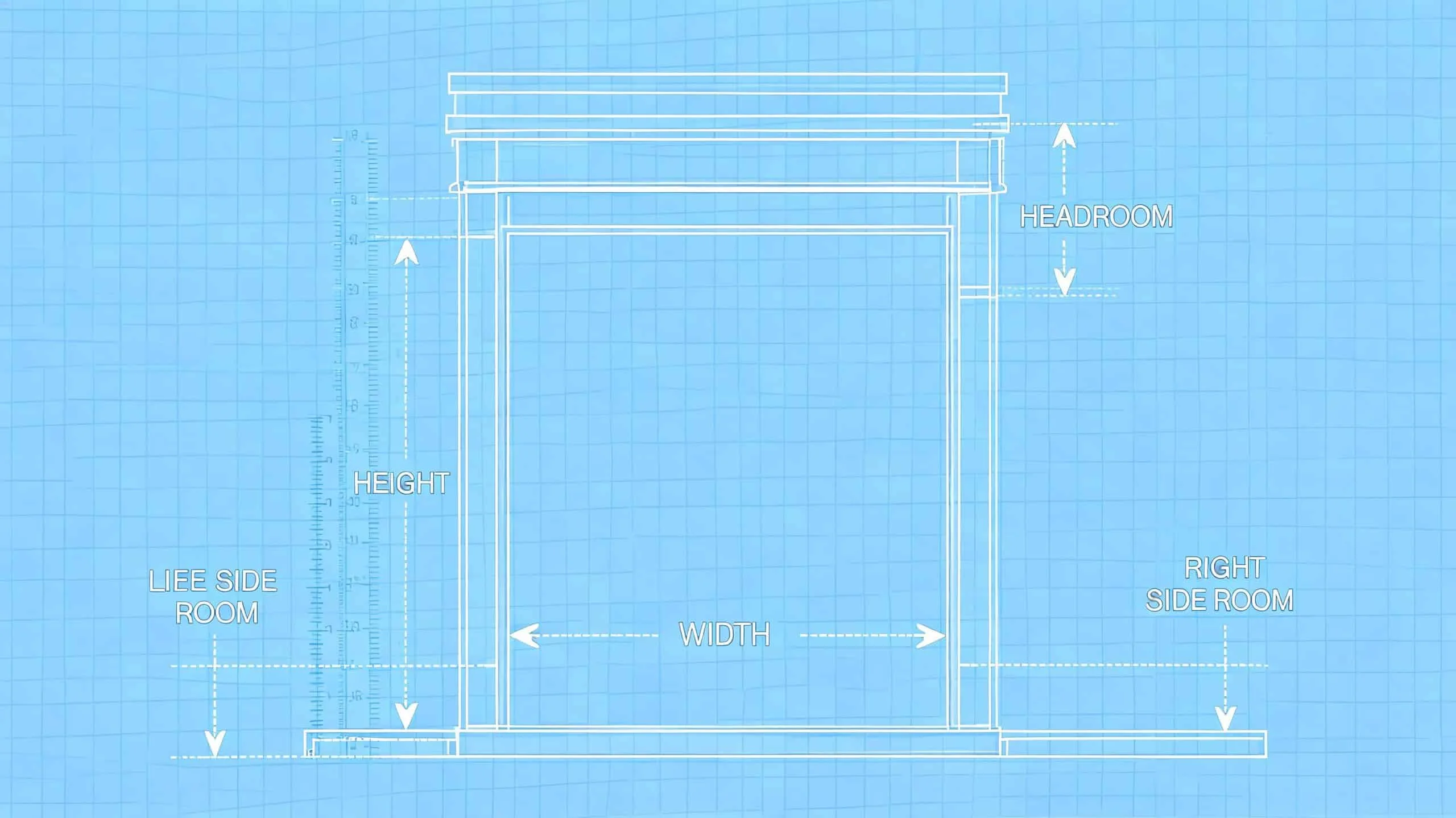
The measurements that matter
Before anyone quotes accurately, confirm four dimensions on site.
- Rough opening: The actual width and height of the framed or finished opening.
- Headroom: The clear space above the opening to the nearest obstruction.
- Sideroom: The clear space on each side for track, brackets, and spring assembly.
- Backroom: The available depth inside the building for horizontal track travel or operator components.
If the slab is uneven, or if the jambs aren’t plumb, note that early. Those conditions affect sealing, track alignment, and sometimes the mounting method itself.
Track layouts are driven by the building, not preference
Many buyers ask for a standard setup because it sounds simplest. Sometimes that’s right. Sometimes it guarantees interference with lights, piping, or storage racks.
Here’s the practical distinction:
| Mounting option | Best fit | What to check |
|---|---|---|
| Standard lift | Typical sheds and small bays with straightforward ceiling conditions | Confirm enough headroom for track curve and spring line |
| High-lift | Buildings where you want the door to rise higher before turning horizontal | Useful when ceiling space needs to stay clearer near the opening |
| Vertical lift | Taller interiors where the door can travel straight up | Common when overhead space must remain open for equipment movement |
For rough planning, an external sizing reference like the Van Dyke Outdoors garage door guide can help a manager understand common opening discussions before meeting with an installer. It’s not a substitute for a site survey, but it helps you ask better questions.
Avoiding conflicts above the opening
The most common field issue isn’t the opening itself. It’s everything around it. Sprinkler lines, unit heaters, conduit, lighting, shelving, and structural bracing can all interfere with track travel or operator placement.
A quick video can help visualise how track and operator layouts consume space:
Measure the opening, then measure the room around the opening. The second set of measurements is often what decides the project.
A cleaner way to prepare for quoting
When you send out for pricing, include:
- Opening width and height.
- Headroom, sideroom, and backroom.
- Photos of the interior and exterior.
- Notes on floor slope, obstructions, and intended use.
- Whether the door will be manually operated or motorised.
That simple package usually shortens revisions and helps vendors specify a door that fits the space the first time.
Selecting Operators Controls and Safety Systems
The operator gets attention only when it fails, but it shapes daily performance more than most buyers realise. The wrong operator can struggle with door weight, duty cycle, or mounting constraints. The right one disappears into the background and does its job without drama.
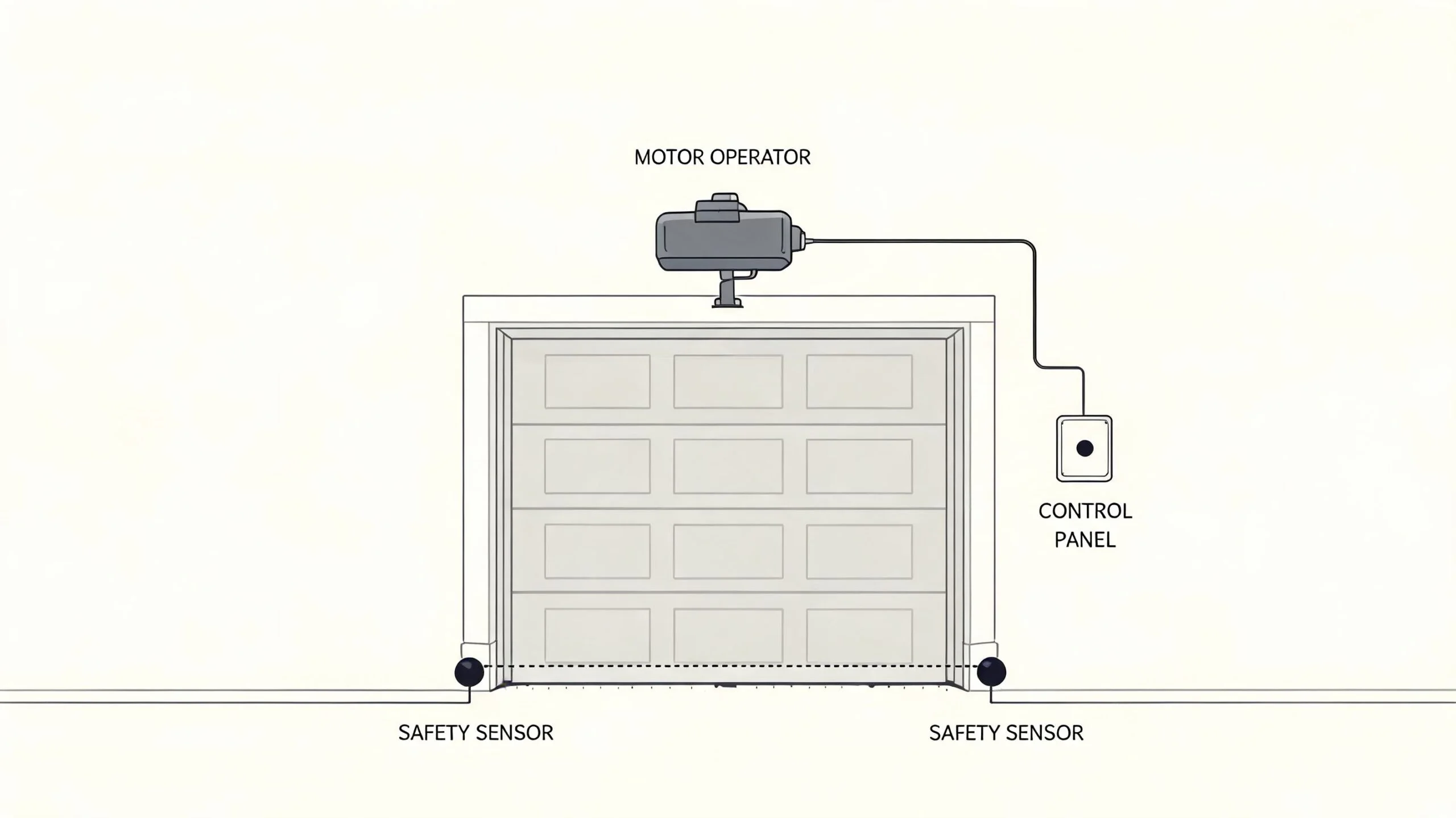
Match operator duty to actual use
A lightly used storage shed may only need a straightforward commercial operator with simple controls. A parts room or fleet support building that opens repeatedly through the day needs a more durable setup.
The main decision points are usually:
- Duty cycle: How often the door opens and closes in normal operation.
- Mounting constraints: Whether the ceiling allows a trolley-style setup or calls for a side-mounted jackshaft operator.
- Control method: Basic push-button, keyed access, radio control, or integrated access control.
- Power reliability: Whether the opening needs manual override procedures that staff can safely employ.
If you’re comparing options, this overview of overhead door garage opener systems gives a useful frame for matching operator style to building conditions.
Safety devices are part of the system, not accessories
For a commercial overhead shed door, safety equipment shouldn’t be treated as an optional add-on. Photo-eyes, reversing devices, and properly configured control stations protect staff, vehicles, and stored equipment. They also help the facility maintain a more defensible safety posture.
What often causes trouble is partial modernisation. A team replaces the operator but leaves mismatched controls, ageing safety sensors, or damaged wiring in place. The opening may technically run, but it won’t behave consistently.
A sound specification usually includes:
- Photo-eye sensors positioned and aligned to detect obstructions
- Reversing protection suited to the door and operator package
- Clearly located controls so users aren’t reaching around vehicles or pinch points
- Manual operation procedures that maintenance staff understand before an emergency happens
The safest commercial door is usually the one with the simplest control logic for the people who actually use it.
Integration matters more than gadget count
More controls don’t always mean better control. A remote, keypad, wall station, timer, and access system can create convenience, but only if the opening’s use pattern justifies that complexity.
For many secondary buildings, a simpler commercial operator package with well-placed controls and properly tested safety devices works better than a feature-heavy setup that few people understand. If you need outside support, Wilcox Door Service Inc. is one of the providers that installs and services operators, controls, and related safety systems for commercial door applications across Canada.
Planning for Installation and Long-Term Maintenance
A door that looks right on paper can still perform poorly if the installation is rushed. Retrofit work is where this shows up most often. Existing openings may have settled slabs, worn jambs, hidden obstructions, or structural details that weren’t obvious during budgeting.
New opening versus retrofit conditions
In new construction, the installer usually has cleaner geometry and better coordination with other trades. In retrofits, the crew often has to correct for real-world conditions before the new overhead shed door can run properly.
Typical retrofit complications include:
- Uneven floor contact: Bottom seals don’t seat evenly, so water, debris, and air get through.
- Out-of-square openings: Tracks and panels need adjustment to avoid premature wear.
- Interference from legacy equipment: Old conduit, framing, or operator mounts can force layout changes on site.
That’s why professional installation matters. Spring tensioning, track alignment, fastener selection, operator setup, and safety testing all affect service life and user safety.
Planned maintenance protects uptime
Most door failures don’t start as sudden failures. Rollers wear, hinges loosen, cables fray, seals harden, and operators fall out of adjustment. A planned maintenance programme catches those issues before they become lockouts or safety concerns.
Industry data shows that facilities with a planned maintenance programme for commercial doors see up to 40% less unexpected downtime and can extend door life by an average of 5 to 7 years, according to the DASMA technical data sheet on commercial garage doors.
A basic in-house check should include visual inspection of:
- Cables and springs: Look for wear, corrosion, or distortion.
- Tracks and rollers: Check for debris, damage, or obvious misalignment.
- Weather seals: Replace hardened, torn, or missing sections before leakage spreads.
- Safety devices: Confirm sensors are clean, unobstructed, and behaving as expected.
For a structured service approach, many teams use planned maintenance programmes from their door provider or service contractor so inspections, adjustments, and records don’t depend on memory.
A maintenance plan costs less than emergency work because it fixes wear while the door is still serviceable.
Calculating Costs and Asking the Right Questions
Budgeting for an overhead shed door gets easier when you stop treating the quote as the whole cost. The invoice covers the purchase and installation. Ownership continues long after that.
A lower-priced door can still become the expensive option if it leaks energy, needs frequent service, lacks suitable safety devices, or has to be modified to fit the building. On the other hand, a better-specified door may reduce disruptions and stay in service longer with fewer surprises. That’s the total cost of ownership lens, and it’s the right one for facility decisions.
What to include in your real budget
Don’t just compare line totals. Compare the package:
- Door construction: Material, panel design, and corrosion resistance for your environment.
- Thermal package: Insulation level and seal quality if the building needs climate control.
- Track and operator fit: Whether the quoted system suits your available space.
- Serviceability: How easily parts can be adjusted, replaced, and maintained.
- Support after handover: Response capability for breakdowns, annual inspections, and compliance-related service.
If you’re trying to sharpen cost control across a broader facility or capital project, this article on DFM and supplier strategies offers useful thinking on reducing long-term manufacturing and sourcing friction. The same logic applies to door procurement. Early specification decisions usually shape downstream cost more than late-stage price negotiation.
Questions worth asking every vendor
Use this shortlist when reviewing proposals:
- What door type and material are you recommending for this specific use case, and why?
- What site measurements are required before final approval?
- How are safety devices included and tested?
- What maintenance does the door need in the first year and after?
- What warranty applies to the door, operator, and installed components?
- What happens if the opening goes down after hours?
- Can you support retrofits, future operator changes, and replacement parts without redesigning the full opening?
Clear answers usually tell you whether you’re dealing with a supplier that’s just moving product or a service partner that understands lifecycle responsibility.
If you’re evaluating an overhead shed door for a storage building, service bay, or secondary facility opening, Wilcox Door Service Inc. can help you review sizing, insulation, operator fit, and maintenance requirements so you can buy for long-term performance, not just first cost. Respected Partners, Reliable Service.