


TL;DR: Canadian commercial garage door opener installation cost typically runs from CAD $1,500 to $4,500 per unit, and some projects go higher once retrofits, controls, and compliance work are included. That’s a completely different budgeting reality from residential numbers, which is why facility managers need a commercial-specific cost view before approving a replacement or retrofit.
If you're dealing with an overhead door that opens late, stalls halfway, or has started tripping safety devices during shipping hours, you already know the problem isn't the opener alone. The issue is lost throughput, backed-up trailers, avoidable risk, and a maintenance budget that gets blown up by emergency calls instead of planned work.
Search online for garage door opener installation cost and most of what you’ll find is built for homeowners. That advice falls apart in a warehouse, plant, airport, food facility, or multi-tenant commercial property. A Canadian commercial operator has to handle heavier doors, higher cycle counts, code requirements, and often older infrastructure that needs upgrading before the motor ever gets mounted.
This guide focuses on the numbers and trade-offs that matter in Canadian commercial and industrial facilities. The goal isn’t just to estimate a purchase price. It’s to help you understand what belongs in the quote, what tends to get missed, and what decisions protect uptime over the full life of the system.
Understanding Commercial Garage Door Opener Installation Cost
A failed opener at home is annoying. A failed opener at a loading dock can stop receiving, delay outbound orders, hold trucks at the door, and create an immediate safety concern for operators and pedestrians.
That’s why commercial budgeting has to start with the right baseline. In the Canadian commercial and industrial sector, garage door opener installation costs typically range from CAD $1,500 to $4,500 per unit, driven by heavy-duty operators rated at 1 to 2 horsepower for doors weighing 500 to 1,500 lbs and the need to meet CSA standards, according to this Canadian commercial opener installation cost reference.
Why residential pricing leads buyers astray
Most online cost pages are built around light residential doors, standard framing, and simple power access. A commercial quote has different realities:
- Heavier door loads: The opener has to move more weight, more often, without drifting out of adjustment.
- Safety obligations: Sensors, reversing systems, and testing aren't add-ons. They're part of a compliant installation.
- Operational integration: The opener may need to work with dock equipment, access control, or facility procedures.
- Site conditions: Existing steel, wiring, and mounting points may not be suitable for a new operator without modifications.
A facility manager who budgets from homeowner numbers usually ends up short on both cost and scope. The problem isn't just a bad estimate. It can lead to approving an under-specified operator that wears out early or creates recurring service calls.
Practical rule: If the quote looks similar to a residential install, it probably excludes commercial realities that will show up later as change orders, delays, or failures.
What the cost really buys
Commercial opener installation isn’t just buying a motor. You’re paying for a system that can open a critical access point reliably, safely, and in a way that matches the door, track, duty cycle, and electrical conditions already in the building.
A proper installation should leave you with a door that runs consistently, reverses correctly, and doesn’t fight the counterbalance system every cycle. That’s the difference between a capital expense that supports operations and a quick replacement that becomes a maintenance problem.
Decoding the Quote A Line-Item Cost Breakdown
A commercial opener quote should read like a scope document, not a single lump sum. If the proposal doesn't separate equipment, labour, site modifications, and testing, you can't tell whether you're comparing complete work or a stripped-down install that leaves key items outside the price.
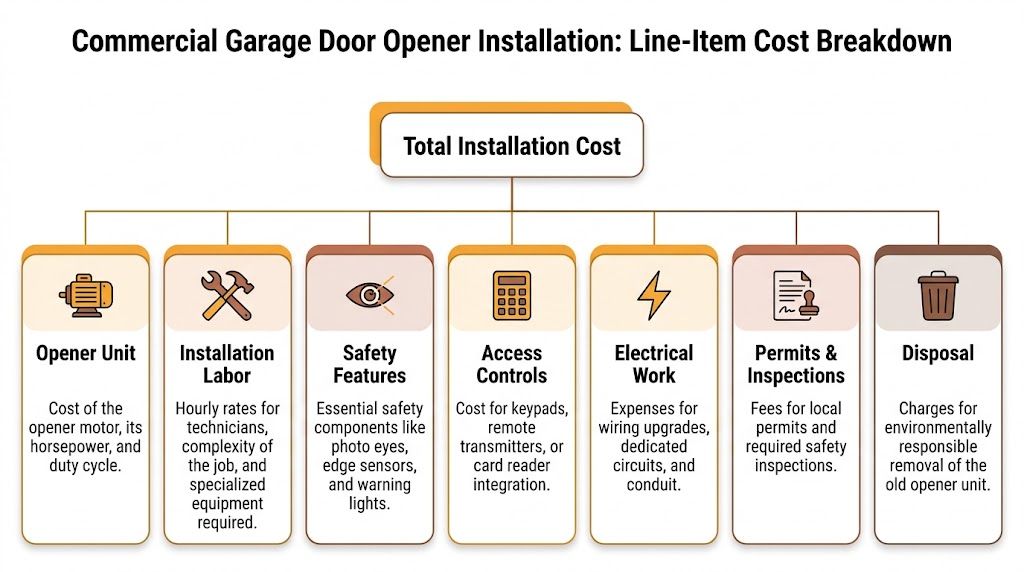
The main buckets inside a commercial quote
The top-line number usually includes some mix of the following.
| Quote item | What it covers | Why it matters |
|---|---|---|
| Operator equipment | Motor, control components, drive arrangement, mounting hardware | The wrong operator type causes premature wear and unreliable opening cycles |
| Installation labour | Mounting, alignment, adjustment, wiring terminations, testing | Commercial labour includes setup and verification, not just hanging the unit |
| Safety components | Photo eyes, reversing devices, warning accessories, setup | These items support safe operation and code compliance |
| Electrical work | Circuit suitability, wiring changes, disconnects, control connections | A good operator still fails if power supply and control wiring are wrong |
| Structural modifications | Reinforcement, support steel, bracket changes, retrofit hardware | Older openings often need strengthening before a new operator is installed |
| Removal and disposal | Safe removal of the old unit and related parts | Leaving worn components in place creates future service issues |
Labour is usually where scope gets misunderstood
In commercial projects, labour isn't just the crew time to physically install the opener. It includes setting limits, calibrating safety devices, confirming reversing behaviour, checking door balance, and making sure the opener works with the actual door in front of it.
That’s why labour can’t be treated as a minor line item. It often determines whether the installation runs smoothly for years or starts generating nuisance failures in the first season of use.
The bigger risk is hidden retrofit work. A 2025 FacilitiesNet Canada report noted a 40% cost overrun risk on commercial door projects stemming from unforeseen retrofits, which is exactly why detailed quoting matters in older or mixed-use buildings, as noted in this commercial project overrun reference.
A short quote often means a long invoice later.
What often gets missed in low-detail proposals
Low-price commercial quotes usually leave out one or more of these items:
- Door condition review: If the spring system, rollers, or track alignment are already off, the new opener inherits those problems.
- Electrical suitability: Existing power may be present but not appropriate for the new operator or controls.
- Integration work: Card access, keypads, dock interlocks, and building controls can add both labour and materials.
- Retrofit steel: Many older openings need reinforcement or revised mounting arrangements.
- Testing and documentation: Facilities that need traceability should expect verification and closeout details, not just an invoice.
For property teams managing several sites, portfolio thinking is essential. A broader review of property management costs and services can help frame why building systems often cost more than their visible equipment alone. The same principle applies here. The opener is only one part of the operating expense.
How to read a quote like a facility manager
Ask these questions before approving any proposal:
- Does the quote identify the operator type clearly? Generic wording makes substitutions easy later.
- Are safety devices named, not implied? If they aren't listed, don't assume they're included.
- Is electrical work included or excluded? This is one of the biggest causes of budget drift.
- Does the contractor mention existing door condition? A serious installer checks the full system, not just the opener.
- Is removal of the old unit covered? If not, disposal becomes your problem or a later extra.
A good quote doesn't just protect the contractor. It protects your schedule, your budget, and your ability to explain the purchase internally.
Key Factors That Drive Your Commercial Opener Cost
Two openings can look similar from the floor and still require very different operator setups. The final garage door opener installation cost comes from what the door demands, what the site allows, and how much retrofit work sits behind the opening.
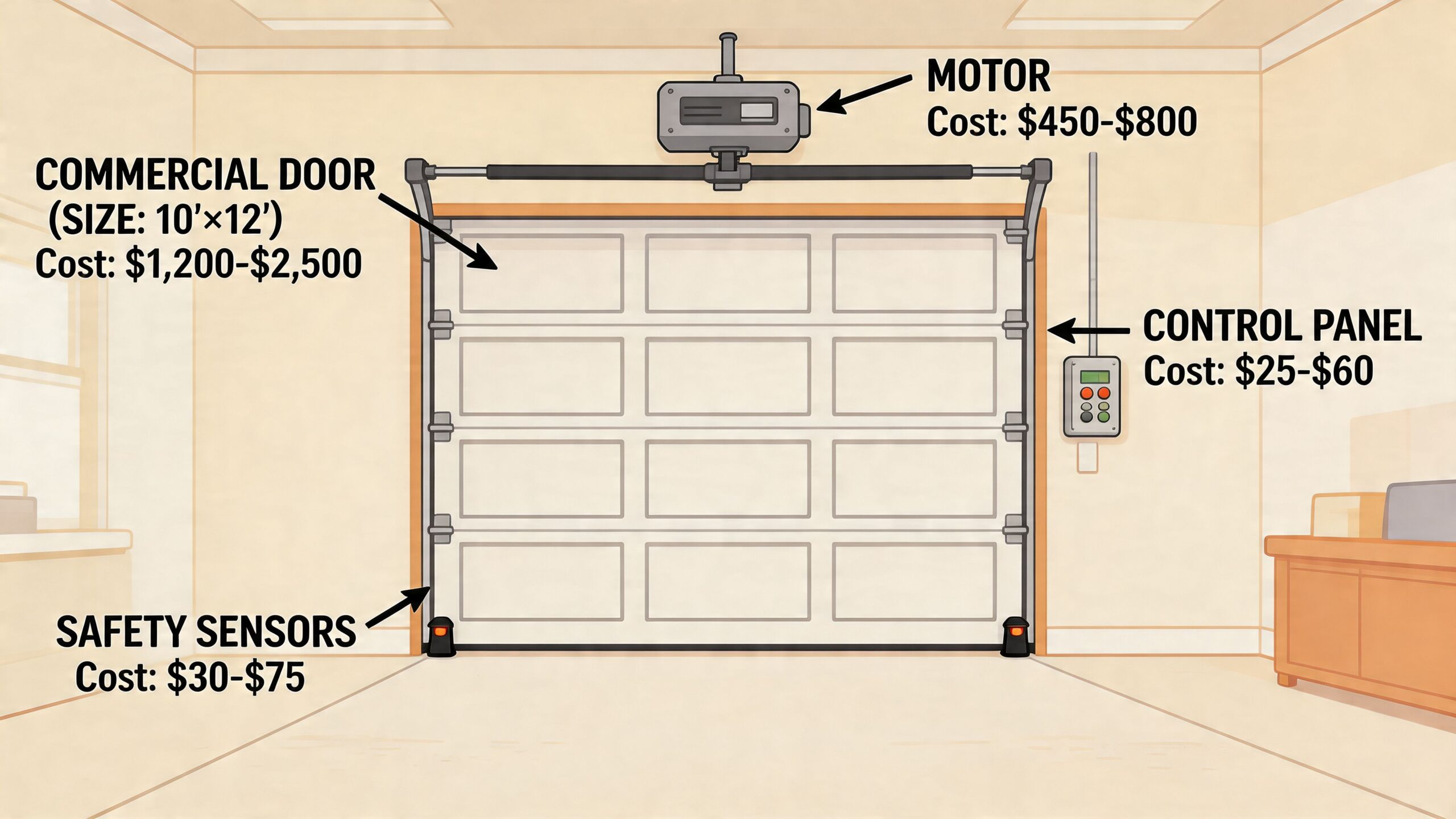
Door size and weight change everything
The first question isn’t which opener brand you want. It’s what the door is.
A sectional overhead door on a standard opening asks something very different of an operator than a high-lift door, a rolling steel door, or a large insulated opening on a cold-storage wall. As door weight rises, the opener needs more torque and sturdier mounting. If the door cycles constantly through the day, duty rating matters just as much as lifting force.
Cause and effect is simple here. More door mass and more cycles mean more stress on the operator, mounting points, and controls. If the operator is selected too lightly, you won’t save money. You’ll just move the cost into breakdowns.
Operator style depends on the opening, not preference
Many buyers start with the assumption that one opener style is basically interchangeable with another. In commercial work, that’s rarely true.
Common choices include:
- Trolley-style operators: Often suitable where there’s straightforward overhead room and a compatible door setup.
- Jackshaft operators: Mounted at the side of the shaft and often chosen where overhead space is limited or track geometry makes that layout practical.
- Hydraulic operators: Used where durability, smooth force application, or harsh conditions justify the heavier solution.
Jackshaft units are popular for space-saving layouts, but they’re not automatically the right answer for every building. If you’re comparing layouts, this guide to jackshaft garage door openers in commercial applications is useful for understanding when side-mounted designs make sense and when they create trade-offs.
The opener should fit the door system you have. The door system shouldn’t be forced to fit the opener that happens to be cheapest.
Existing power supply can add real cost
Electrical scope is one of the most common reasons a simple replacement turns into a more involved project. A facility may have power nearby but still need panel capacity review, dedicated circuits, revised disconnects, or cleaner control wiring before the installation is complete.
That’s especially true in older buildings where previous operator replacements were done piecemeal. The opener may have worked, but the electrical path behind it can be inconsistent, improvised, or no longer suitable for the new equipment.
If your team is trying to understand the wider budgeting context before a retrofit, this overview of the average cost to upgrade an electrical panel can help explain why electrical readiness matters before you finalise a door operator scope.
The building itself affects install complexity
The opener isn't installed in isolation. It has to be anchored into a real building with real constraints.
A few examples show how that plays out:
- Older steel and concrete conditions: Mounting may require custom support or reinforcement.
- Tight mechanical spaces: The crew may need alternate layouts or access equipment to install safely.
- High-lift or vertical-lift track: Standard operator arrangements may not apply.
- Shared commercial occupancy: Scheduling, shutdown windows, and access restrictions can add planning effort.
These aren’t edge cases. They’re common in active facilities where the opening has been modified several times over its life.
Here’s a short visual overview of the components and decisions that often shape commercial opener selection:
Cold climate and operating environment matter
Canadian facilities have to think about temperature, moisture, dust, washdown, and traffic intensity. A quiet operator that works acceptably in a light commercial interior may not hold up at an exterior shipping door exposed to winter cycling, contaminants, and frequent impacts.
That’s why experienced installers look beyond brochure features. The right commercial recommendation comes from matching the operator to the opening’s duty, environment, and failure consequences. In practice, the cheapest acceptable unit and the right unit are often not the same thing.
Beyond the Basics Controls Integration and Safety Compliance
A commercial opener becomes much more valuable when it works as part of the full opening system. That means controls, safety devices, logic, and in some facilities, networked monitoring. These are the costs that residential guides almost always ignore, even though they often decide whether the finished system supports operations or creates headaches.
Safety devices are not optional extras
At a minimum, commercial openings need safety systems that fit the door and the application. That can include monitored photo eyes, reversing devices, warning accessories, and control logic that suits how people and equipment move through the opening.
A warehouse pedestrian crossing in front of a door needs different protection than a secured service bay with controlled access. The installer should be asking how forklifts move, where staff stand, whether trailers back close to the opening, and whether the door operates unattended at any point.
For a practical look at how these components protect people and equipment, this article on garage door safety sensors for commercial doors is a useful reference.
Controls integration changes both cost and value
Basic wall stations are one thing. Real commercial use often goes further.
Examples include:
- Keypads and credential access: Useful where staff turnover or tenant control matters.
- Loop detectors or traffic logic: Helpful where vehicles approach quickly or need automated response.
- Interlocks with dock equipment: Important when sequence control affects safety and workflow.
- Building management connections: Relevant where facilities want central visibility or remote status.
Each added layer increases scope, but it can also reduce workarounds. If staff are bypassing procedures because the door system is awkward to use, the problem isn't just behavioural. It may be poor system design.
Smart operators can help, but only if the environment supports them
Networked operators, app-based monitoring, and remote diagnostics can be useful in multi-site portfolios and high-demand facilities. They can help maintenance teams see door status, identify recurring faults, and respond before a failure becomes a shipment delay.
But smart features only pay off when the basics are right. If the door is out of balance, the opening has inconsistent power, or the control layout confuses users, adding connectivity won’t solve the root issue. It just gives you better visibility into a system that still has underlying mechanical problems.
Smart controls are valuable when they sit on top of a stable mechanical system. They’re expensive distractions when they’re used to compensate for bad hardware choices.
Cold-weather performance deserves closer scrutiny
Operator choice becomes even more important in harsh environments. A 2026 CMHC facilities report noted that certain operator types, including jackshaft openers, can have a 22% higher failure rate in extreme Canadian cold at -30°C, while hydraulic alternatives may cost 15 to 20% more upfront and offer a 30% longer asset life, according to this cold-climate operator comparison.
That doesn’t mean every jackshaft install is wrong. It means climate, duty cycle, and opening conditions should influence the recommendation. For an interior opening, side-mounted equipment may be perfectly suitable. For an exposed industrial opening in severe cold, a more heavy-duty operator can be the lower-risk lifecycle choice.
Compliance includes how the system is tested
Many facility teams focus on what gets installed and forget to ask how the finished system will be verified. That’s a mistake.
The installer should confirm that controls, reversing behaviour, and safety devices operate correctly under the actual conditions of the site. If the opening ties into other systems or has special operating rules, those should be reviewed with the facility before handover. A complete commercial installation is judged by safe behaviour in service, not by whether the motor runs on day one.
Budgeting for the Full Lifecycle ROI and Maintenance Costs
The purchase price matters. It just doesn’t tell the whole story.
A facility manager who budgets only for installation usually pays again through emergency labour, unplanned downtime, repeat adjustments, and early replacement. The better approach is to budget for total cost of ownership, meaning the install, the service life, the maintenance burden, and the operational consequences of failure.
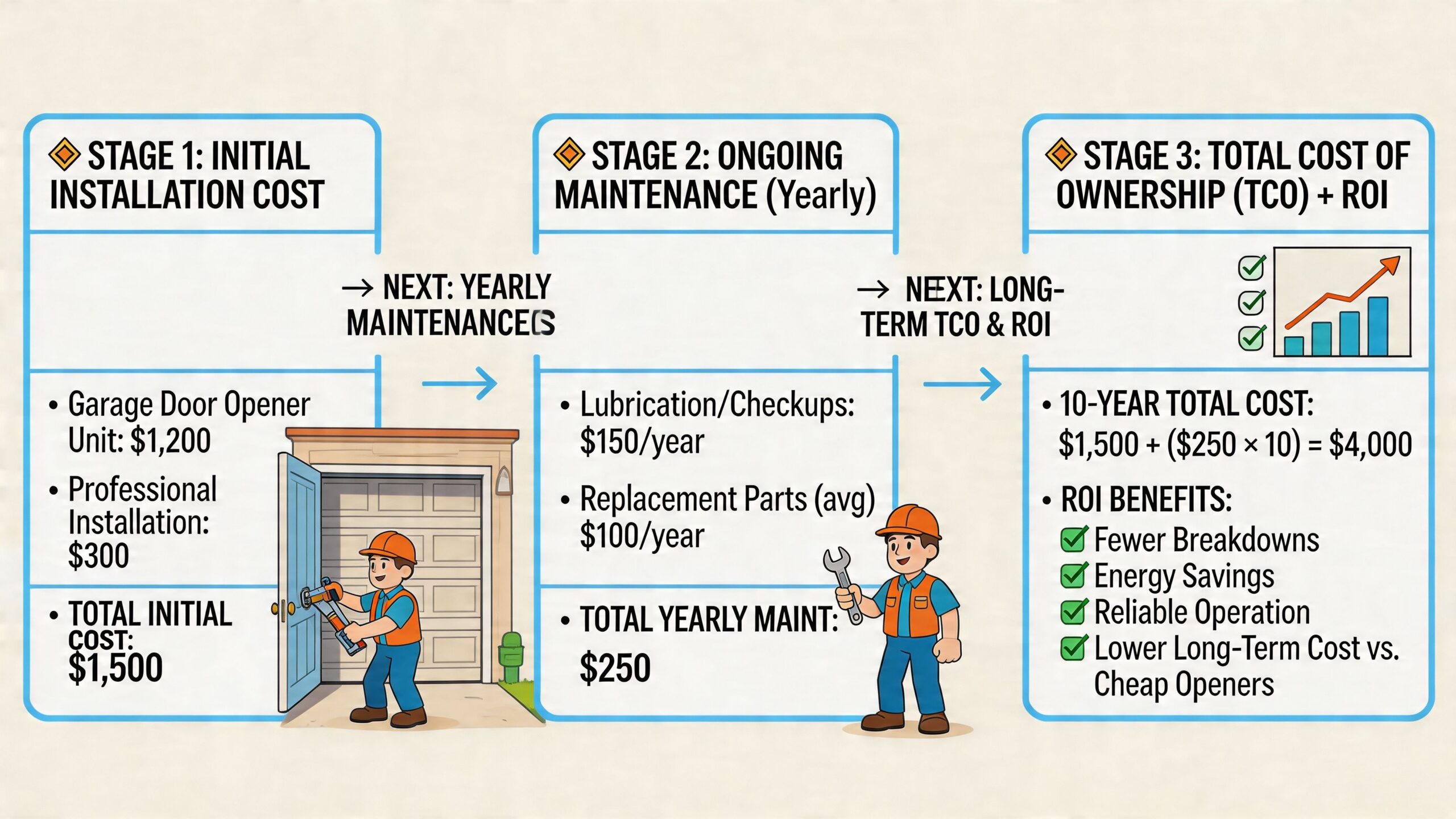
The cheapest install is often the most expensive asset
A low upfront number usually comes from one of four shortcuts:
- An under-sized operator
- Limited safety scope
- Minimal electrical or structural allowance
- Little attention to the condition of the existing door system
Each shortcut shifts cost forward. The opener strains. The door drifts out of adjustment. Controls become inconsistent. Your staff starts reporting nuisance issues that don't look serious individually but add up to a door nobody trusts.
That’s why homeowner pricing causes real damage in commercial budgeting. In Los Angeles, a residential opener install averages $428 USD, but that figure is misleading for Canadian facility managers because it doesn't reflect heavy-duty equipment, union labour, or CSA and CEC compliance requirements that push commercial work into a different cost bracket, as shown in this Los Angeles opener installation cost guide.
Where the return actually comes from
The return on a commercial opener investment usually shows up in operational stability, not in a flashy accounting line.
A well-matched installation helps by:
- Reducing avoidable downtime: Doors open when shipping needs them.
- Lowering emergency call frequency: Fewer failures mean less disruption to staff and carriers.
- Protecting the door system: A properly matched operator doesn’t fight springs, tracks, and hardware.
- Supporting safer workflows: Reliable reversing and control logic reduce risky workarounds.
- Extending useful service life: Better installation quality typically means fewer recurring adjustments.
One practical example is a busy distribution centre door that cycles all day. A basic operator may technically work, but if it runs hot, drifts in settings, or reacts badly to frequent use, the maintenance team ends up babysitting the opening. A heavier-duty setup costs more at the start but often costs less to own because the opening becomes predictable.
Budget for the cost of failure, not just the cost of purchase. At a critical opening, those are rarely the same number.
Maintenance is part of the investment
Commercial operators need planned maintenance. That includes inspection, adjustment, testing of safety features, and attention to wear items before they fail during a shift.
For many sites, a planned programme makes the difference between controlled maintenance and reactive maintenance. It also gives facility teams a better record of what was checked, what is wearing, and which openings should be scheduled for future capital replacement rather than patched again.
Wilcox Door Service Inc. offers commercial operator installation, planned maintenance, emergency repair, and related door and dock service for facilities that need one provider across multiple locations or opening types.
How to budget more accurately
When you build the budget, include more than the install quote itself:
- Base installation cost
- Likely retrofit allowance for older openings
- Safety and control requirements
- Electrical readiness
- Planned maintenance after commissioning
- Operational cost if a critical door fails unexpectedly
That approach gives you a number leadership can trust. It also reduces the chances of approving a project that looks affordable on paper but becomes expensive once the opening is opened up and the actual conditions are exposed.
Procurement and Partnering for a Successful Installation
The right equipment can still fail early if the installer doesn’t assess the opening properly, align the operator to the door system, or account for site conditions. In commercial work, partner selection isn't a soft factor. It's part of the technical outcome.
What to verify before awarding the job
Use a scorecard, not a gut feeling. At minimum, review these points:
- Commercial experience: Ask whether the contractor works regularly on warehouses, manufacturing sites, airports, or multi-site portfolios.
- Technician qualifications: Confirm that the people doing the work are trained for commercial and industrial door systems, not only residential installs.
- Safety programme: Review whether the contractor can work within your site safety requirements and documented procedures.
- Insurance and labour compliance: Verify coverage and the labour compliance expected in your province and sector.
- Emergency capability: If the opening is critical, you need to know what happens after hours, not just during the install.
Questions that expose weak bidders quickly
A serious provider should be able to answer these without hesitation:
| Question | What a solid answer usually includes |
|---|---|
| How will you assess the existing door before selecting the operator? | Discussion of door weight, balance, track configuration, cycle demand, and current hardware condition |
| What exclusions should we expect? | Clear notes on electrical upgrades, structural steel, access controls, and any third-party trades |
| How do you handle older openings with retrofit issues? | A process for site review, documentation, and revised scope before installation proceeds |
| What support is available after commissioning? | Service response process, maintenance options, and parts support |
Look for transparency, not just a lower bid
The strongest proposals usually have clear scope language, a realistic description of site dependencies, and enough detail that your maintenance team can understand what is being installed. That matters more than polished sales language.
For buyers comparing installation approaches, this overview of commercial garage door opener installation considerations can help frame what a complete scope should include before tender closes.
A good partner also communicates operationally. They’ll ask when trailers are scheduled, whether shutdown windows exist, how tenant access is controlled, and what the door failure would disrupt if the project slips. Those questions show they understand the opening as an asset, not just a work order.
Your Next Step Towards a Reliable and Compliant Facility
Commercial garage door opener installation cost isn't a homeowner number with a few extras added on. It reflects heavier doors, more demanding cycles, code-driven safety requirements, integration needs, and the realities of older Canadian buildings that often need retrofit work before a new operator can perform properly.
The best buying decision usually isn't the lowest quote. It's the quote that accurately reflects the opening, the environment, and the cost of failure if that opening goes down during active operations. For facility managers, that means reviewing scope carefully, challenging anything vague, and budgeting for service life instead of purchase day alone.
If you're replacing a failing operator, planning a retrofit, or trying to standardise multiple sites, get the opening assessed as a system. Door condition, controls, electrical readiness, and operator type all need to be aligned. That’s how you protect safety, reduce downtime, and avoid paying twice for the same opening.
If you need a detailed, code-conscious quote for your facility, contact Wilcox Door Service Inc. to review your opening, confirm the right operator strategy, and plan the installation around uptime, safety, and compliance.